Robber fly - Nature photographer Thomas Shahan specializes in amazing portraits of tiny insects. It isn't easy. Shahan says that this Robber Fly (Holcocephala fusca), for instance, is "skittish" and doesn't like its picture taken.

Nature by Numbers (Video)

"The Greater Akashic System" – July 15, 2012 (Kryon Channelling by Lee Caroll) (Subjects: Lightworkers, Intent, To meet God, Past lives, Universe/Galaxy, Earth, Pleiadians, Souls Reincarnate, Invention: Measure Quantum state in 3D, Recalibrates, Multi-Dimensional/Divine, Akashic System to change to new system, Before religion changed the system, DNA, Old system react to Karma, New system react to intent now for next life, Animals (around humans) reincarnate again, This Animal want to come back to the same human, Akashic Inheritance, Reincarnate as Family, Other Planets, Global Unity … etc.)

Question: Dear Kryon: I live in Spain. I am sorry if I will ask you a question you might have already answered, but the translations of your books are very slow and I might not have gathered all information you have already given. I am quite concerned about abandoned animals. It seems that many people buy animals for their children and as soon as they grow, they set them out somewhere. Recently I had the occasion to see a small kitten in the middle of the street. I did not immediately react, since I could have stopped and taken it, without getting out of the car. So, I went on and at the first occasion I could turn, I went back to see if I could take the kitten, but it was to late, somebody had already killed it. This happened some month ago, but I still feel very sorry for that kitten. I just would like to know, what kind of entity are these animals and how does this fit in our world. Are these entities which choose this kind of life, like we do choose our kind of Human life? I see so many abandoned animals and every time I see one, my heart aches... I would like to know more about them.

Answer: Dear one, indeed the answer has been given, but let us give it again so you all understand. Animals are here on earth for three (3) reasons.

(1) The balance of biological life. . . the circle of energy that is needed for you to exist in what you call "nature."

(2) To be harvested. Yes, it's true. Many exist for your sustenance, and this is appropriate. It is a harmony between Human and animal, and always has. Remember the buffalo that willingly came into the indigenous tribes to be sacrificed when called? These are stories that you should examine again. The inappropriateness of today's culture is how these precious creatures are treated. Did you know that if there was an honoring ceremony at their death, they would nourish you better? Did you know that there is ceremony that could benefit all of humanity in this way. Perhaps it's time you saw it.

(3) To be loved and to love. For many cultures, animals serve as surrogate children, loved and taken care of. It gives Humans a chance to show compassion when they need it, and to have unconditional love when they need it. This is extremely important to many, and provides balance and centering for many.

Do animals know all this? At a basic level, they do. Not in the way you "know," but in a cellular awareness they understand that they are here in service to planet earth. If you honor them in all three instances, then balance will be the result. Your feelings about their treatment is important. Temper your reactions with the spiritual logic of their appropriateness and their service to humanity. Honor them in all three cases.

Dian Fossey's birthday celebrated with a Google doodle

Dian Fossey's birthday celebrated with a Google doodle
American zoologist played by Sigourney Weaver in the film Gorillas in the Mist would have been 82 on Thursday (16 January 2014)

Sunday, April 18, 2010

Latest Mudflow Bubble on Sidoarjo Roadway Raises Fears of Explosion

Jakarta Globe, Amir Tejo, April 18, 2010

Workers cordoning off a fresh mudflow bubble. Officials say the eruption of mud contains unsafe levels of methane, which could be sparked by a cigarette. (Antara Photo/Eric Ireng)

Sidoarjo, East Java. Another bubble has emerged on the Porong highway near Sidoarjo in East Java after the appearance of gas bubbles and mud in the middle of the highway last week.

The new bubble, near Porong fruit market, is just 80 meters from the earlier one, said Acmad Zulkarnaen, spokesman of the Sidoarjo Mud Flow Mitigation Agency (BPLS).

It is the 169th to appear since the devastating mud flow eruption on May 29, 2006.

The latest fissure contains flammable gas, and its proximity to railway tracks has caused safety concerns among officials.

Herry Winarno, the acting spokesman of state railway company Kereta Api Indonesia (KAI) in East Java, is calling on train passengers not to throw cigarette butts out the window between the Tanggulangin area of Sidoarjo and Porong.

“This prohibition was issued to anticipate unwanted situations because those bubbles are easily flammable,” Herry said.

The earlier bubble, in the middle of the highway, which is the main road linking Surabaya to towns in the east such as Pasuruan and Probolinggo, consists of mud and gas. An analysis by the BPLS showed that the gas contained methane.

“Flammable gas of the methane type was clearly detected,” Achmad said.

He added that the methane content was fluctuating, sometimes exceeding safe levels.

Achmad said possible danger came from the carelessness of road users, who often threw lit cigarette butts out of vehicle windows or lit up anywhere.

“We are coordinating with the police to minimize the danger,” he said.

The BPLS and the Sidoarjo district police have already issued a ban on tossing cigarette butts along the Porong highway.

The areas around the bubbles have been cordoned off from traffic.

The appearance of the bubbles on and around the highway makes it more urgent than ever to press ahead with plans for another highway to connect Siring to Porong.

Achmad said the BBPLS had also told local residents whose land would be needed for the new highway to agree with the price offered by the local district administration so that construction could begin as soon as possible.

“We hope that those people who are still reluctant to release their land soon agree to the price offered by the district administration,” Achmad said.

The Siring-Porong alternative highway was scheduled to be completed this year, but so far only 65 percent of the needed land has been acquired.

The price of the purchase of another 24 hectares has been agreed but the deals have not yet gone ahead.

The seven-kilometer road will need about 124 hectares for completion. Many landowners want more for their land than that being offered by the local administration.

The road that links the Tanggulangin subdistrict in Sidoarjo to Gempol in Pasuruan district through Porong and Jabon will also be upgraded with a 10-meter-wide, 600- meter-long flyover in Porong.

Joint Project Aims to Rescue Java’s Critical Forests

Jakarta Globe, April 18, 2010

Banyumas, Central Java. The president director of state forest management company PT Perhutani has said that up to 900,000 hectares of land on Java Island are in critical condition, including areas located within forests overseen by the company.

Speaking during a working visit to Perhutani’s Baturaden tourist forest in Banyumas district, Central Java, over the weekend, Upik Rosalina Wasrin said that in 2005 the company began rehabilitating 350,000 hectares of critical areas under its management through its Green Perhutani program.

She said the program, which is hoped to be completed by the end of this year, also called for 70,000 hectares of land to be planted with trees and areas outside its scope to be rejuvenated.

“Perhutani is currently working on land outside its forest areas that belong to the public. This is part of the rehabilitation program and the development of local enterprises,” Upik added.

Rehabilitation plans for critical lands in the Dieng Plateau region of Central Java, Upik said are still awaiting agreement from local residents because the land there is privately owned.

“If we can reach a deal to work together with the local people, we will first start with an effort to identify the [problems],” she said.

Reforesting and rehabilitating private land is a complex issue, Upik said, and Perhutani needs to consult with local land owners in Dieng before any work can begin.

“Whether they want their land rehabilitated or not, we first need to find out if they want their land to be managed as public forested areas, how the land will be shared and what type of trees should be planted,” she said, citing a few of the problems that need to be resolved.

Forest rehabilitation efforts in cases such as Dieng require cooperation in the form of public forested areas, also known as joint forestry management, Upik said, adding that just handing out assistance funds does not work. The best way, she added, is to get local residents to form a business that offers the land as part of the public forested area in return for a share of its products.

Similar cooperation efforts have already been entered into by Perhutani with Banten’s provincial government and the province’s Pandeglang district administration, covering some 7,500 hectares of forest.

Several other cooperation programs have also been entered into with other regions in Central Java, including with Banyumas and the district administration in Kendal.

In Dieng, forested lands, especially on the region’s mountainous terrain, have been converted for agriculture by local residents. The resulting land degradation has been blamed for landslides in the area during the rainy season.

Upik said Perhutani’s rehabilitation model involved providing loans to residents to be repaid under a production-sharing system. “The people are encouraged to make use of their land in a productive and economic way,” she said.

The land rehabilitation projects also involve working with local forestry offices — in the case of Dieng, both Banyumas and Wonosobo districts — to ascertain whether any rejuvenation programs have already been conducted in the areas concerned.

“If there has already been some program, we will not get involved in the area because each of us, the Ministry of Forestry and Perhutani, have our respective programs,” Upik said. “And so that there is no overlap, we have to make sure of this first so the handling of critical areas in Java can be done together.”

As for Perhutani’s long-term reforestation program, Upik said the company aimed to replant an additional 2,000 hectares of forest lands across Java by 2014.

Antara

Friday, April 16, 2010

Regents blamed for food crisis in NTT

The Jakarta Post, Fri, 04/16/2010 12:20 PM

KUPANG: Legislative councilors of East Nusa Tenggara (NTT) responded to the reported food crisis in several regencies saying the respective regents should be held responsible for the situation.

Antonius Landi from the Indonesian Democratic Party of Struggle (PDI-P) said that the food crisis occurred because regents had failed to heed the precautionary warning by the Meteorology and Geophysics Agency (BMKG) over the prospect of a drastic decline in rainfall and the premature arrival of drought.

"Food crisis due to a drop in agricultural yields should not occur because the BMKG had warned us about that," he said Thursday.

He said the BMKG warning carried consequences regarding what planting method the farmers should adopt and what plant species could survive with low rainfall.

Nico Nuhan, head of the NTT self-management food team deployed to survey the food crisis, found 369 villages faced risk of a food crisis with 56 categorized as inside the "red zone". - JP

Fearful Aceh Islanders Tell of Massive Sea Change in the Wake of Earthquake

Jakarta Globe, Nurdin Hasan, April 15, 2010


Banda Aceh. Local residents claim the seabed near Banyak Island in Aceh Singkil district, Aceh, has risen dramatically since the 7.2-magnitude earthquake on April 7.

They also say they have seen an undersea fissure spewing out mud and rocks. But experts are not so sure about the supposed geological phenomenon.

Banyak islander Mufliadi told the Jakarta Globe the phenomenon was first noted on Tuesday by fisherman Ruslan, who had been trawling for sea cucumbers in the Gosong Turak waters around Pailana Island, just off Banyak.

“He was shocked and came back to tell us what he’d seen because the site is a prime fishing spot for the local fisherman,” Mufliadi said on Thursday.

Ruslan had been shocked to find layer upon layer of rocks and no fish in the area. The fisherman also reported a 10-meter-long fissure shaped like a frying pan.

Before the quake, the water in Gosong Turak had been 20 to 30 meters deep but now was just five meters, he said.

On Wednesday, hundreds of villagers dove into the water to see the change for themselves and take rock samples.

“The black rocks were the size of a person’s head, and crumbled easily,” Mufliadi said. “When we burned the rocks, a very strong odor was emitted.”

He said the villagers were concerned the fissure could be an undersea volcano because it kept spewing mud.

Mufliadi urged local authorities to survey the area to confirm what was happening and ease villagers’ concerns.

“If the fissure really is a volcano, we want to anticipate and be ready for the worst-case scenario,” he said.

Mufliadi said more people visited the area on Thursday, bringing back yellow stones “that looked like gold.”

Banyak Island subdistrict head Safnil confirmed the seabed was silting, after visiting the area. “There is a geological anomaly underwater, shaped a bit like a volcano, that keeps spewing out mud,” he said. “But the mud isn’t hot like lava from a regular volcano.”

Safnil said many Banyak residents were worried. He urged them to remain calm and alert pending the arrival of geologists to study whether the fissure posed a threat.

But Danny Hilman Natawidjaya, a geologist from the Indonesian Institute for Sciences (LIPI), told the Jakarta Globe it was impossible for the seabed to have risen so much. “The maximum the seabed can rise is one meter,” he said. “If it did really happen, there should have been a major landslide near the area.”

Danny also said the anomaly that looked like a volcano was called liquefaction. “It’s normal, as the layer of sand on the seabed is pushed by the quake until it liquefies and forms a volcano and can spew out mud,” he said.

Danny said earthquakes altered the land and sea structure and sometimes fish left to find a more comfortable habitat.

Additional reporting by Nurfika Osman


Related Articles:

Thursday, April 15, 2010

CPO firms brainstorm greener PR

The Jakarta Post, Jakarta | Thu, 04/15/2010 10:42 AM

Mounting market pressure on Indonesia’s palm oil industry has forced producers to unite and consolidate efforts to combat what they deem an incomplete assessment by environmentalists.

Government representatives, members of the Association of Indonesian Palm Oil Producers (Gapki) and company CEOs gathered in Jakarta on Wednesday to draft guidelines on how to convince global consumers of the sustainability of palm oil development in Indonesia.

Swiss food and beverage company Nestle SA announced last month of it would drop an Indonesian palm oil supplier, PT Sinar Mas Agro Resources and Technology (SMART), over concerns about the company’s environmental record.

Previously Unilever and Kraft had stopped buying palm oil from Sinar Mas for the same reason.

In a report widely publicized in 2008, Greenpeace states that CPO producers had converted peat lands, natural forests and habitats of Indonesia’s indigenous orangutan into oil palm plantations. The report was later supported by field investigations and satellite data.

After the Wednesday meeting Gapki secretary-general Joko Supriyono said a joint endeavor had been established between the association, the Agriculture Ministry and the Malaysian Palm Oil Board (MPOB) to provide “a more accurate analysis” of the palm oil industry, particularly in terms of carbon emissions generated compared to other commodities used for biofuel such as cassava and corn.

Musdhalifah Machmud, assistant to the deputy coordinating economic minister for plantation and horticulture, admitted there were plantation companies that abused their permits and carried out illegal logging.

However, she said, plantation firms currently operated on 7.2 million hectares of land or 5.5 percent of the 188 million hectares of forests available in Indonesia.

Most of the forest destruction was carried out by other parties, she said.

Musdhalifah said the government had made a significant improvement in fighting illegal logging, imprisoning many company officials, several regents and governors involved with the crime.

She also said palm oil was among the strategic commodities chosen by the government for its export value and ability to provide jobs.

“The negative campaign waged by the NGO is no longer attacking us producers but the state and its people,” Joko said.

Indonesia is the biggest producer of palm oil, contributing 44.5 percent to the world’s total output of 42.9 million tons in 2008.

Also present at the meeting was Alan Oxley, the chairman and founder of World Growth, an NGO focusing on sustainable development in developing countries.

Several foreign NGOs including Greenpeace and WWF had strong connections with the European Commission, he said, claiming that up to 60 percent of WWF’s revenue came from the commission.

“It suited these NGOs to maintain the European perspective on developing countries ... Europe can prioritize environmental issues over economic growth because they are already wealthy,” Oxley said.

Related Article:

Letter: WWF clarifies


Govt regulation to allow businesses in peatlands

Adianto P. Simamora , The Jakarta Post, Jakarta | Thu, 04/15/2010 9:36 AM

The government is drafting a regulation on peatland protection that would allow businesses to utilize the areas despite mounting calls for a moratorium to conserve the areas to prevent the release of emissions.

Article 16 of the draft regulation stipulates peatland areas could be used for at least 10 purposes including, pastures, plantations, fisheries, residential, mining and transmigration areas.

It says any people operating businesses in peatland areas should manage a minimum water level to prevent fires that would lead to the huge release of emissions into the atmosphere.

“The regulation aims to minimize damage to peatland ecosystems,” Masnellyarti Hilman, deputy minister for environmental damage control at the Environment Ministry told reporters on Wednesday.

“It would be wrong if we were prohibited to utilize peatland.”

The draft, which has been submitted to the ministry’s legal and human rights affairs, says peat domes with thickness of more than 3 meters would be categorized as protected areas and would be restricted.

It also stipulates that businesspeople should set aside 30 percent of its peatland area to be restored.

Currently, the government has no specific regulation on peatlands, which are believed to contain huge stocks of greenhouse gas.

The ministry predicted Indonesia has 30 million hectares of peatland mostly in Sumatra, Papua and Kalimantan.

A number of plantations currently operate on peatland.

A study by the the National Development Planning Agency (Bappenas) last year recommended a moratorium on peatland conversion to meet pledged emissions cuts to tackle climate change.

Bappenas predicted damaged peatlands contributed to about 1 billion tons of the carbon dioxide (CO2) emissions per year, half of the country’s total emissions.

Indonesia has pledged to cut emissions by 26 percent by 2020 to help slow the effects of climate change.

Activists said opening peatlands risked the release of huge amounts of CO2 into the atmosphere.

Wetlands International asked the government to review the draft on fears it would only encourage people to open business on peatland.

“It is not in line with the government’s commitment to cut emissions,” I Nyoman Suriyadiputra from Wetlands International said.

A study from Wetlands said that Kalimantan, with 5.8 million hectares of peatland could store some 40 gigatons of CO2.

It said that Central Kalimantan alone, with 3 million hectares of peatland in Kapuas, Ketingan and Kahayan Hilir regencies, has the capacity to store 22 gigatons of emissions.

“One effective way to reduce emissions in Central Kalimantan is by blocking canals to prevent fires,” he said.

The Greenpeace earlier protested the destruction of peatlands in Riau, which they say stored around 2 gigatons of carbon, with peat layers of more than 15 meters.

Rp 5 Billion to Take Care of Bandung Cavities

Tempo Interactive, Wednesday, 14 April, 2010 | 23:53 WIB

TEMPO Interactive, Bandung: The West Java Provincial Government has allocated a fund of Rp5 billion to take care of water sources in cavities in North Bandung.

In the initial stage, this will be conducted in the foothills of of Manglayang Mountain, Padasuka area.

“This year we will focus on water conservation in the North Bandung area,” said the Head of the West Java Forestry Office, Anang Sudama, yesterday.

The same government had planned the expansion of the Juanda Forest Park, from 526 hectares to 2,750 hectare, spread from fractured area in Lembang, West Bandung, to West Manglayang, Sumedang Regency.

ALWAN RIDHA RAMDANI

SBY’s New Strategy on Illegal Logging is an Improvement, Say Indonesian Green Activists

Jakarta Globe, Fidelis E. Satriastanti, April 14, 2010

There have been few convictions among hundreds of cases since the president’s first call to stamp out illegal logging in 2005.  (Antara Photo)

After deriding President Susilo Bambang Yudhoyono’s call to go after the “mafia” involved in illegal logging last week, some environmentalists are now applauding his decision to assign the Judicial Mafia Eradication Task Force to help tackle the issue by targeting legal system flaws that block convictions.

“Illegal logging is a serious crime, meaning that it’s an organized crime,” said Rhino Subagyo, executive director of the Indonesian Center for Environmental Law. “It has very complex elements, including corruption, money laundering and environmental disasters. It cannot be handled just by one institution, like the KPK [Corruption Eradication Commission], because they are only equipped to deal with corruption issues.”

In 2005, Yudhoyono issued a presidential instruction involving 12 ministries, the Attorney General’s Office, National Police, Army, State Intelligence Agency (BIN), governors and district heads. The instruction was meant to herald the start of a concerted campaign against illegal logging, but resulted in few convictions among hundreds of cases.

Critics took his April 7 announcement as a sign that his previous efforts to halt illegal logging had been a complete failure

“There’s nothing wrong with the instruction as it had a good purpose: To ensure his subordinates coordinated with each other to make sure the massive policy movement supported the action. But its implementation turned out to have little effect because too many conflicts of interest between sectors and ministries caused them to only halfheartedly [execute the instruction],” Rhino said.

One of the most visible examples of lack of coordination and conflict of interest, Rhino said, was when the police closed active investigations into 13 major pulp and paper companies in Riau that were allegedly committing serious violations.

“That is a blatant example of a dispute between the forestry ministry and police,” Rhino said.

Indonesia currently has about 10 percent of the world’s remaining rainforests, but officials estimate the country has lost over 10 million hectares to illegal logging. Indonesia Corruption Watch estimates state losses from the practice could be as high as Rp 30 trillion ($3.33 billion).

Hariadi Kartodiharjo, a forestry expert at the Bogor Institute of Agriculture, said the missing link in addressing illegal logging lies in the justice system, where the Ministry of Forestry rarely wins cases.

“We already have the institutions who are in charge, but they don’t effectively work because there’s something wrong in the legal process, including at regional levels,” Hariadi said, adding that the country’s legal system has not revised its burden of proof requirements for environmental and forestry cases, making it difficult to obtain convictions against large-scale illegal logging enterprises.

“Illegal logging cases are treated like regular criminal acts, where they require eyewitnesses to really see that someone chopped down the trees. It’s obvious that there is a gap [in the law] between everyday rationality and legal rationality. You can’t eradicate illegal logging within the conventional system,” he said.

However, Hariadi said, the task force should not busy itself with policy matters, which are supposed to be the domain of the government, including permit issues, but should rather focus on aggressively targeting illegal logging’s major players.

“Just use intelligence data and information and aim at one big target, whether in Sumatra, Papua or Kalimantan, because many players in illegal logging are actually the [legitimate companies], considering that it’s actually an expensive business that only those with lots of money are able to join in,” he said.

Mas Achmad Santosa, a member of the anti-mafia task force, said the team was assigned to fight organized criminals operating in the forestry sector, meaning that they will be working in the context of legal enforcement.

“We will be there to help ministries to deal with the ‘bottleneck’ concerning plenty of failed illegal logging cases as a result of the legal process. Our job is to seize on any indications that those failures are being caused by case brokers,” Mas said.

Wednesday, April 14, 2010

Govt drops designating plantations as forests

Adianto P. Simamora, The Jakarta Post, Jakarta | Wed, 04/14/2010 8:43 AM

The forestry ministry dropped its controversial initiative to classify oil palm plantations as forests after strong protests from environmental activists on fears that it would speed up deforestation.

The statement was made by the ministry’s head of research and development Tachrir Fathoni on the sidelines of a seminar on Indonesian forestry following the Copenhagen climate talks.

“We have dropped it. No more talk about it,” he told reporters on Tuesday.

He said the ministry acknowledged that any changes on forest definitions should be made by amending the 1999 forest law.

The law defines forest as an integrated ecosystem in the form of land comprising biological resources, dominated by trees in natural forms and surrounding environment, and which cannot be separated from each other.

The same statement was also made by Nur Masripatin, the ministry’s director of the center for social economics and policy research.

“Indonesia will not include palm plantations as part of forest although some countries have done it,” she said on the sideline of seminar.

Malaysia, the second largest producer of palm oil after Indonesia, uses the UN Food and Agriculture Organization (FAO) standard to identify forest — which is land with tree crown cover of more than 10 percent and an area of more than 0.5 hectares with trees reaching a minimum height of five meters.

The forestry ministry planned to draft a ministerial decree to include oil palm plantations as forest after the Copenhagen meeting.

But a group of activists from Greenpeace Indonesia and the Indonesian Environmental Forum (Walhi) criticized the government over its plans accusing the authorities of not being serious on promises to cut greenhouse gas emissions.

Greenpeace Indonesia then put a giant banner at the ministry of forestry building reading “plantations are not forests”.

Greenpeace said inclusion of ‘plantations’ in the definition of forests, would lead to massive concealment of emissions from the destruction of peat land and forests.

On Tuesday, Walhi welcomed the decision from the government to drop the plan.

“The ministry’s decision to not include plantations in forest is correct, the most important thing now is the ministry should exclude the industrial forest concessions (HTI) as part of the forest,” Walhi’s forest campaign director, Teguh Surya.

HTI usually carries monoculture plants like acacia for paper mills.

He said that the ministry should also audit the existing oil palm plantations which converted forest areas without permits.

“Forestry Minister [Zulkilfli Hasan] should gather the courage to withdraw the licenses of oil palm plantations operating in forest areas,” he said.The Agriculture Ministry earlier said it planned to use 1.8 million hectares of land designated as industrial forests (HTI) for oil palm plantations.

Agriculture Minister Suswono said that of 9.7 million hectares of land available for oil palm plantation, some 7.9 million hectares was already developed, leaving 1.8 million hectares designated as HTI.

Sunday, April 11, 2010

Bengkulu closed to new plantations

Antara News, Sunday, April 11, 2010 20:02 WIB

Bengkulu (ANTARA News) - The Indonesian Environmental Forum (Walhi) said Bengkulu province was now closed to new big-scale plantations because there was no longer land space available.

"Bengkulu province, with 1.9 million hectares of land, 900 thousand hectares of forest and a population number of 1.7 million, is now running short of land spaces," Walhi`s campaign affairs coordinator for Bengkulu, Firmansyah said here over the weekend.

Firmansyah said that with a population of 1.7 million, Bengkulu could not share one hectare for each of its people. This condition makes Bengkulu unable to open more land for new big plantations if it does not want to remove its own locals.

However, the local government of Kaur district is planning to provide 14,400 hectares to a new oil palm plantation company, PT Desaria Plantation Mining.

"This is threatening the existence of the locals in eight subdistricts of Kaur district," Firmansyah said.

Climate change scientists turn to Inuits for research

Inuit communities in tune with nature note that the weather is changing, scientists concur.

Mother Nature Network, by Katherine Butler, Sat, Apr 10 2010 at 12:15 PM EST

Inuits has long studied nature. Photo from 1854. (Photo by paukrus /Flickr)

Native people have long lived in harmony with nature, following the patterns of the weather for centuries. Now, science is listening. Scientific American reports that climatologists at the University of Colorado used information from two Canadian Inuit communities and scientific data in a recent study on shifting weather patterns.


Scientists tracking weather for over a decade recognized that native insight might eclipse the latest weather satellites and computer models. Elizabeth Weatherhead is an atmospheric scientist at the University of Coloradoand lead author for this study. As she told Scientific American, "This is not the first scientific paper on Inuit knowledge. But it is the first paper linking that Inuit knowledge to more scientific approaches."

And just what have they found? The scientists looked at how much weather changes from one day to the next, and how long a weather pattern lasts. The Inuits, located in and near the Arctic, explained to Weatherhead and co-author Shari Gearheard that there are unexplained changes in weather patterns. The natural time scale to a weather event is becoming more erratic. In other words, it could be cold one day, and warm the next – as opposed to usual three weeks of warm weather. Canadian Inuit tribes have noticed that their traditional forecasting measures are becoming less accurate. Inuits believe this is because the weather has become erratic.

Mead Treadwell is the chairman of the U.S. Arctic Research Commission, and he feels like this report justifies new interest in indigenous observations about our world. As he told Scientific American, "If you lose the language that people have been speaking for 10,000 years as it has evolved, you lose a huge amount of information that is built up in the language…If something is named 'a place where the caribou mate,' that tells you the caribou were once there if they are not there now." After all, a popular though disputed saying notes that Inuits have several worlds for snow. Why should science not pay attention?

This is not the first time scientists have turned to native people for information. According to Treadwell, the U.S. National Oceanic and Atmospheric Administration twice changed its report of the Arctic's bowhead whale population based on indigenous people’s report that revealed more whales than counted by the government.


TALKING ABOUT THE WEATHER: Researchers credit a combination of scientific data and traditional environmental knowledge from Inuit communities for shedding new light on an overlooked aspect of climate change. (NATIONAL OCEAN & ATMOSPHERIC ADMINISTRATION)

Related Articles:

Inuit observations offer new tool for climate change scientists

"The tilting of the earth changes everything" - Inuit Elders Speak on Climate Change


Saturday, April 10, 2010

Farmers go organic in the use of eco-friendly planting method

Slamet Susanto, The Jakarta Post, Klaten | Fri, 04/09/2010 12:13 PM

Hundreds of farmers in Klaten regency, Central Java, no longer fully depend on chemical fertilizers and pesticides, applying eco-friendly organic fertilizer instead.

Leader of the Tani Mulyo farming group, Juwandi, said that at present, 75 percent of the farmers' crops in Karanglo and Polanharjo villages were provided with organic fertilizer. The rest still used chemical ones.

"We will use 100 percent organic fertilizer during the upcoming planting season," he said.

He said previously, farmers depended on chemical fertilizer, which was expensive as well as harmful.

"Seventy percent of farmers here cultivate farms on a profit-sharing basis. Expensive fertilizer and pesticides impacted on their finances," he said.

Concerned with the condition, Juwandi and a number of community figures worked to develop an eco-friendly but profitable farming practice over the past year by joining the Tani Mulyo farming group.

Assisted by bottled water producer Aqua and the Bina Swadaya NGO, they set up a lab last year to conduct tests as well as produce organic fertilizer from cattle and buffalo manure.

After conducting tests for almost a year, they implemented the green farming method on seven of 85 hectares of rice fields at the end of last year with a mixed planting system, using 50 percent chemical and 50 percent organic fertilizers.

Based on the harvest, production experienced between a 10 and 15 percent drop. A 1,700-square-meter plot using chemical fertilizer produced 0.85 tons of rice with a Rp 6,000-kilogram sale price, while the use of organic fertilizer produced 0.8 tons of rice at the higher Rp 7,000-kilogram sale price.

"The difference in yields was not high and the concern that the system would reduce production up to 30 percent was not proven," Juwandi said.

As part of efforts to support the eco-friendly farming system, the lab also produces organic fertilizer to meet the farmers' demand at a selling price of Rp 300 per kilogram, as well as natural pesticides.

Juwandi said that as many as 75 percent of 450 farmers, who are grouped in Tani Mulyo, are expected to apply the eco-friendly planting pattern on about 85 hectares of their farmland by 2012.

When visiting the group's lab recently, Agriculture Minister Suswono said as part of the government-sponsored 2010 Go Organic program, the ministry would provide 10,000 organic fertilizer processors to meet the demands of farmers so they would no longer depend on chemical fertilizer.

A budget for processors, each costing Rp 350 million, is currently being proposed to the House of Representatives for approval, he added.

Suswono said the program would not be undertaken fast, but would ensure good production as organic farming was expected to improve the farmers' economy apart from being eco-friendly.

"Organic products are sought after at the international market and their prices are also higher," he said. "Prices of *organic* farm products can multiply up to fivefold if we obtain organic agricultural certification."


Related Article:

Farmers in Banten told to switch to organic fertilizer


NGOs hail president`s call for cooperation in fighting illegal logging

Antara News, Fardah, Saturday, April 10, 2010 14:28 WIB

Jakarta (ANTARA News) - Before leaving for an ASEAN Summit in Vietnam, President Susilo Bambang Yudhoyono made a significant call for partnership with Non-Governmental Organizations (NGOs) in environmental preservation.

"The government and non-governmental organizations share the same spirit with regard to environmental conservation efforts," the head of state said before leaving for Hanoi, Vietnam, to attend an Asean summit on Wednesday (April 7).

The President on the occasion thanked Greenpeace Indonesia and also Walhi (Indonesian Environmental Forum) that have so far been critical about and cared for environmental conservation in the country.

Yudhoyono encouraged the central and regional governments to cooperate with the non-governmental organizations to save the forests and the environment.

Earlier, when calling for continued efforts in the fight against illegal logging and deforestation, at a cabinet meeting held in Jakarta, last Monday (April 5), the President, also stressed the importance of cooperation with NGOs in the battle.

"Ask environmental non-governmental organizations to cooperate. NGOs that really care about the environment, have good will to save the country, are our partners. We must not be controlled by the world. Let us conduct the control by ourselves. It is us who should be more concerned about the safety of our country and grandchildren," he said.

Yudhoyono`s statement drew immediate reactions from some NGOs, such as Greenpeace.

"Greenpeace welcomes President SBY`s call for Greenpeace to work together with the government to save the Indonesian environment. The Ministry for the Environment has the mandate and the power to take action against those who destroy forests and peat lands," said Yuyun Indradi, Greenpeace Southeast Asia Forest Political Campaigner, in a press statement on Thursday (April 8).

According to Indradi, the ministry must turn Indonesian President Susilo Bambang Yudhoyono`s words into action by investigating environmental destruction and taking urgent and necessary action.

"We are here to help the ministry take this action by providing evidence of the oil palm and pulp and paper industries destroying forests and peat lands to aid the ministry`s investigations," he said.

A number of environmental NGOs met Thursday (April 8) to compile data on illegal logging activities at the request of President Yudhoyono, who has ordered sterner action against illegal logging crimes.

The NGOs included Greenpeace Indonesia, WWF Indonesia, Forest Watch Indonesia, Sawit (Oil Palm) Watch Indonesia, and Conservation International.

"We asked them to supply data on illegal logging. This will be a good chance for the activists to help the government battle illegal logging," Agus Purnomo, special assistant on climate change to the President, told the Jakarta Post.

Yudhoyono in the cabinet meeting reminded that the fight against illegal logging must not ease. The police, military, law enforcers, governors, district heads and mayors must all immediately go back into the field and seriously continue the fight against illegal logging, he said.

He also emphasized that they should act without compromise or discrimination against the crime.

"I will ask for a report on the progress of the efforts from each province and forest area, on what they have done with regard to reforestation, what compensations are given to people (participating in the effort) and what forest concession holders have done in terms of sustainable forest management. We must not lag behind," he said.

The head of state also warned government officials against protecting illegal loggers.

"There must never be backing, protection on anyone involved. Do not be influenced by information about backing or protection. There is no such thing. No sponsor. No one protects activities that destroy our country," he said.

President Susilo Bambang Yudhoyono suspected that a mafia was involved in the handling of illegal logging cases in several regions so far.

"I believe a mafia is behind the illegal logging activities. I call on the judicial mafia eradication task force to also tackle this problem, reduce or stop these activities," he said.

He said eradicating mafia in the forestry sector was very important for the sake of law enforcement as well as forest and environment conservation in the country.

A number of Greenpeace activists dressing up in costumes resembling endangered species rallied at the Environment Ministry in Jakarta, Thursday (April 8), to demand the enforcement of the laws to protect the environment.

The activists on the occasion delivered dossiers of companies committing environmental destruction in Sumatra, Kalimantan and Papua where action to save the country`s forests was most urgently needed.

Greenpeace considered their visit to the Ministry`s office not just as an expression of concern regarding continuing forest destruction in Indonesia by giant companies, but also as a way of supporting the agency to execute the mandate in the new environmental law. "We take President Susilo Bambang Yudhoyono (SBY)`s call for partnership very seriously and call on his Ministries to do the same.

In order to truly develop a model of forest protection and welfare for the Indonesian people, President SBY and the Ministry for the Environment must stop the destruction now," Indradi of the Greenpeace Southeast Asia, said.

A recently-passed environmental law on Environmental Protection and Management gives the Ministry of Environment a greater mandate to implement environmental audit, law enforcement, investigation, and administrative prosecution.

According to Bogor-based CIFOR (the Center for International Forestry Research), deforestation in Indonesia, which has around 120 million hectares of forest areas, has hovered around 2-3 million hectares annually for the last seven years.

"The President`s call for cooperation with NGOs is progress. Apparently, the head of state has realized that the government cannot rely on its bureaucracy alone in fighting environmental destruction," AJ Muaya, a senior editor, said.

Illegal logging ‘must end’ before REDD takes effect

Adianto P. Simamora , The Jakarta Post, Jakarta | Sat, 04/10/2010 9:33 AM

The government should work out how to stamp out long-standing illegal logging within two years if the country wants to secure funding from carbon trading in the forestry sector, say environment activists.

They warned that failure to tackle illegal logging would also jeopardize the government’s pledge to implement the UN system of measurable, reportable and verifiable (MRV) scheme on emissions cuts.

“It will be difficult for Indonesia to claim the emission cuts if illegal logging persists after REDD takes effect after 2012,” Jatna Supriatna, director of International Conservation told reporters on the sidelines of an international conference on Muslim action against climate change on Friday.

The reducing emissions from deforestation and forest degradations (REDD) schemes are expected to be an alternative to emission cuts from forestry, which contributes about 20 percent of global emissions.

Under the program, countries that protect their forests can receive financial incentives through carbon trading with rich nations.

Indonesia, the world’s third largest forested nation with 120 million hectares of forest, is a supporter of the REDD schemes, which are expected take effect after the Kyoto Protocol expires in 2013.

President Susilo Bambang Yudhoyono made a promise to implement the MRV system during last year’s Copenhagen climate talks to ensure international communities that all emission cuts in Indonesia would be verifiable.

The government is currently debating how to implement MRV amid poor forestry data.

On Wednesday, the President ordered his taskforce to probe illegal logging and forestry corruption before a visit to Vietnam for an ASEAN summit to discuss climate change.

Jatna, who is also a lecturer at the University of Indonesia, welcomed Yudhoyono’s gesture but also warned the President against treating the issue as lip service for a political agenda. “The most important thing now is how to stop illegal logging within two years,” he said.

Executive director of the Indonesian Environmental Forum (Walhi) Berry Furqon agreed that tackling illegal logging should aim to protect the forest and not be used for political gain.

“We still doubt the effectiveness of action against illegal logging as long as the current gap between timber demands and production levels remains unresolved,” he said.

Indonesia has so far received funding from Australia and Norway to prepare for REDD in the field.

Indonesia secured an US$80 million grant from the Multilateral Development Bank (MDB) last month to be used to mitigate emissions from the forestry sector.

“The money will be used to ready the implementation of REDD schemes,” Ismet Hadad, chairman of the working group on financing at the National Council on Climate Change (DNPI) said.

A list of five countries eligible to receive the grants, which included Indonesia, was announced at an MDB meeting in the Philippines.

Some 48 countries, including Brazil and Papua New Guinea, applied for the funds. Indonesia was the largest forest nation to win the funds.

Malaysian Loggers Try to Improve Their Image

The New York Times, by LIZ GOOCH, April 9, 2010

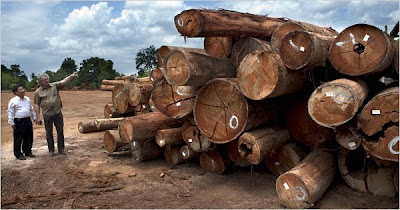
Kok Foo Sim, left, manager of the Maran sawmill in Pahang, Malaysia, explains the local timber harvesting system to Thomas Trooster, a timber buyer from the Netherlands. (Photo: Palani Mohan for the International Herald Tribune)

TEMERLOH, MALAYSIA — Huge meranti tree trunks, many of them destined for faraway shores, are piled up high along the road in this town about a two-hour drive northeast of Kuala Lumpur, awaiting their date with the saw.

Steps away, inside the Maran Road Sawmill workers nimbly slice lengths of timber into thinner strips, adding to the blanket of ochre dust beneath them.

All the logs have numbers scrawled on their ends, indicating the area they came from, plus the sawmill’s license number — assuring buyers that the wood was harvested legally and could be traced to its source.

As band saws droned on a recent Friday, the mill director, Ng Kay Yip, ushered a potential customer from the Netherlands around the facility, explaining how the trees had been harvested and showing him the nearby factory, where the timber is planed into semifinished pieces for windows and doors.

Europe is already an important export market for the company, but Mr. Ng and others in the timber industry here are hoping that even more traders from Europe will soon knock on their doors. Malaysia is working to become the first country in Asia to sign a voluntary agreement with the European Union guaranteeing that all timber exports to the bloc have been harvested legally.

The Union says the agreement is likely to give Malaysia, and other countries that sign similar pacts, a competitive advantage as the bloc pushes for tighter regulation of timber imports because of environmental concerns. Last year, countries in the 27-member Union imported wood, wood charcoal and cork worth an estimated €8.5 billion, or $11.4 billion, 4.6 percent of it from Malaysia.

Uncontrolled logging can destroy animal habitats, cause erosion and increase the risk of natural disasters like floods and landslides, contribute to deforestation and climate change, and deprive governments of tax revenue. A report by the World Wide Fund For Nature estimated that illegally harvested timber accounted for as much as 19 percent of the Union’s wood imports in 2006, with Russia and Indonesia the main culprits.

The Union has no region-wide law preventing the importation of illegally logged wood products, although in response to consumer demand, some companies voluntarily buy timber from sources certified by various groups as sustainable. The Union is considering legislation that would require all importers in the bloc — from furniture companies to those buying raw materials like boards — to conduct due diligence to show that the timber they bought had been legally harvested.

A draft of the measure being negotiated in Brussels says importers would have to know the origin of timber and take steps to minimize the risk that it was illegally harvested.

Companies importing from countries that have signed a voluntary partnership agreement, like the one being negotiated with Malaysia, would be given a “green lane” for entry into E.U. markets and would be exempt from further checks. “There’s no doubt that this will create an advantage for the timber traders on the E.U. market,” said Vincent Piket, head of the Union’s delegation to Malaysia.

Under its Forest Law Enforcement, Governance and Trade action plan, the bloc has already signed agreements with Ghana, the Republic of Congo and Cameroon. In addition to Malaysia, negotiations are under way with Indonesia, the Central African Republic, the Democratic Republic of Congo, Gabon and Liberia. The Union has not begun negotiations on an agreement with China — the biggest exporter of timber to the Union — but the two sides signed a cooperation pact last year that was intended to reduce unlawful logging and trade in illegal timber.

Under the voluntary partnership agreements, source countries are responsible for determining that the timber has been harvested according to their national laws and the criteria in the E.U. agreements. While the agreements may vary among countries, requirements typically include that trees not be cut from protected forests, that endangered species not be logged and that companies comply with trade and customs regulations.

A third-party monitor, like an independent auditing company, would conduct spot checks to ensure compliance.

Whether such agreements will significantly decrease illegal logging, however, remains to be seen.

“It’s a very positive step, the idea of introducing these structural changes by requiring companies to use control systems, but we believe that it’s not enough,” Sebastien Risso, forest policy director at Greenpeace’s European Unit, said by telephone from Brussels.

Companies should be compelled to show a product’s complete chain of custody, he said, documenting its journey from the forest to its final destination.

Rupert Oliver, director of Forest Industries Intelligence, a British consulting company, said the proposed Union legislation could result in the sale of illegal timber to other countries that lack strict rules on timber imports, like China and India.

“It doesn’t really get to the root cause of the problem,” he said. “It shifts the problem elsewhere.”

Mr. Oliver added that the proposed Union legislation was not as tough as the U.S. law known as the Lacey Act, under which companies can be criminally prosecuted for importing illegal timber. The draft E.U. law does not stipulate the level of penalties to be imposed on those involved in importing illegal timber, leaving it to the member states to determine the penalties.

Ivy Wong Abdullah, forest conservation senior manager at WWF Malaysia, said that no statistics were available on the extent of illegal logging in Malaysia but that “sporadic instances” were still being detected. For example, just last month, the authorities discovered hundreds of fallen trees in a suspected case of illegal logging on the border of Perak and Pahang States, the Malaysian national news agency, Bernama, reported.

Ms. Wong Abdullah said that while Malaysia had strong laws against illegal logging, “there’s a need for more enforcement personnel on the ground.”

Malaysia’s timber industry already has several voluntary programs for certifying that timber is legally and sustainably harvested, with sawmills and other businesses participating to make their products more appealing to buyers concerned about environmental issues. Once the pact with the E.U. is signed, all timber companies will be compelled to comply with the criteria.

Saskia Ozinga, the campaign coordinator at FERN, a Brussels-based nongovernment organization that monitors E.U. forest policies, said there had been some resistance to the agreement from Sarawak State in Malaysia over a requirement that the land rights of indigenous people be respected.

While the Malaysian authorities say that the industry still has some concerns that need to be resolved, both the Union and Malaysia expect to sign the agreement this year.

Malaysian environmental groups have welcomed the proposed agreement but say sustainability issues as well as legal ones must be addressed.

Ms. Wong Abdullah said that while some of the current voluntary certification systems require operators to address sustainability issues, including assessment of an area’s conservation value, the draft E.U. agreement focused on the “bare legal minimum” requirements for logging in Malaysia.

Europe is Malaysia’s second-largest timber export market after Japan, with 2.67 billion ringgit, or $834 million, in sales of timber and timber products in 2009. Furniture, sawn timber, moldings, plywood, doors and flooring materials are among the main exports. Meranti, the timber at the Temerloh mill, is an important hardwood that grows in the tropical forests of Asia and is used in light construction and veneers

Jalaluddin Harun, director general of the Malaysian Timber Industry Board, said Malaysia was committed to fighting illegal logging and had decided to pursue the agreement with Europe to ensure that timber traders continue to have unhindered access to E.U. buyers.

“We want to ensure that our timber continues to be exported without having to be re-evaluated,” he said. “In Malaysia we would like to have the image of selling or trading in legal timber.”