Robber fly - Nature photographer Thomas Shahan specializes in amazing portraits of tiny insects. It isn't easy. Shahan says that this Robber Fly (Holcocephala fusca), for instance, is "skittish" and doesn't like its picture taken.

Nature by Numbers (Video)

"The Greater Akashic System" – July 15, 2012 (Kryon Channelling by Lee Caroll) (Subjects: Lightworkers, Intent, To meet God, Past lives, Universe/Galaxy, Earth, Pleiadians, Souls Reincarnate, Invention: Measure Quantum state in 3D, Recalibrates, Multi-Dimensional/Divine, Akashic System to change to new system, Before religion changed the system, DNA, Old system react to Karma, New system react to intent now for next life, Animals (around humans) reincarnate again, This Animal want to come back to the same human, Akashic Inheritance, Reincarnate as Family, Other Planets, Global Unity … etc.)

Question: Dear Kryon: I live in Spain. I am sorry if I will ask you a question you might have already answered, but the translations of your books are very slow and I might not have gathered all information you have already given. I am quite concerned about abandoned animals. It seems that many people buy animals for their children and as soon as they grow, they set them out somewhere. Recently I had the occasion to see a small kitten in the middle of the street. I did not immediately react, since I could have stopped and taken it, without getting out of the car. So, I went on and at the first occasion I could turn, I went back to see if I could take the kitten, but it was to late, somebody had already killed it. This happened some month ago, but I still feel very sorry for that kitten. I just would like to know, what kind of entity are these animals and how does this fit in our world. Are these entities which choose this kind of life, like we do choose our kind of Human life? I see so many abandoned animals and every time I see one, my heart aches... I would like to know more about them.

Answer: Dear one, indeed the answer has been given, but let us give it again so you all understand. Animals are here on earth for three (3) reasons.

(1) The balance of biological life. . . the circle of energy that is needed for you to exist in what you call "nature."

(2) To be harvested. Yes, it's true. Many exist for your sustenance, and this is appropriate. It is a harmony between Human and animal, and always has. Remember the buffalo that willingly came into the indigenous tribes to be sacrificed when called? These are stories that you should examine again. The inappropriateness of today's culture is how these precious creatures are treated. Did you know that if there was an honoring ceremony at their death, they would nourish you better? Did you know that there is ceremony that could benefit all of humanity in this way. Perhaps it's time you saw it.

(3) To be loved and to love. For many cultures, animals serve as surrogate children, loved and taken care of. It gives Humans a chance to show compassion when they need it, and to have unconditional love when they need it. This is extremely important to many, and provides balance and centering for many.

Do animals know all this? At a basic level, they do. Not in the way you "know," but in a cellular awareness they understand that they are here in service to planet earth. If you honor them in all three instances, then balance will be the result. Your feelings about their treatment is important. Temper your reactions with the spiritual logic of their appropriateness and their service to humanity. Honor them in all three cases.

Dian Fossey's birthday celebrated with a Google doodle

Dian Fossey's birthday celebrated with a Google doodle
American zoologist played by Sigourney Weaver in the film Gorillas in the Mist would have been 82 on Thursday (16 January 2014)
Showing posts with label Energy. Show all posts

Wednesday, October 5, 2016

Cow manure power plan steams ahead

DutchNews, October 4, 2016

Grass: a new potential power source.
Photo: DutchNews.nl
Two hundred farmers will soon be generating electricity from cow manure and there are plans to recruit 1,000 in four years, reports NOS on Tuesday.

FrieslandCampina, the largest dairy collective in the Netherlands, set up a business in September called Jumpstart to channel subsidies to farmers who want to install mono-digesters that break down waste into biogas.

Henk Kamp, minister for economic affairs, has committed €150m to the project and turned on the first mono-digester in Friesland on Tuesday morning.

FrieslandCampina plans to pay farmers a surcharge of €10 per thousand litres of milk they sell if they buy a mono-digester, and currently works with 13,500 of the Netherland’s 17,000 farmers. The organisation has committed to carbon-neutral growth, and currently most of the 13% of carbon emissions from the agriculture sector come from methane released by cow manure. 

There has been some debate about whether it is sustainable to generate electricity from cow dung, since mono-digesters only become profitable for a farm of at least 150 cattle. 

On Monday, FrieslandCampina announced that it wants to change its profit-sharing scheme with members, abolishing a quantum allowance and effectively stopping seasonal payments to farmers. It intends to increase its premium for outdoor grazing to €1.50 per 100kg of milk (from €1), and final proposals will be agreed in December.

Related Articles:


(39) Question: Dear Kryon: I've noticed how many children are developing severe allergies to foods (my daughter included). When I've researched this, it seems that most of the allergies are essentially to seeds, grains, legumes, eggs, and dairy. I've noticed that these foods all hold the potential for life, or in the case of dairy, are essentially used to sustain the first stages of life in an animal's baby. My feeling is that because we're not releasing the life force within these foods (that is, sprouting, etc.), they're becoming harmful to us. I would like your impressions of this.

Answer: For thousands of years, these foods have worked for humanity. In these cases you speak about, the main culprit continues to be the way in which these foods are collected and processed. You won't find these allergies in third-world countries, and you won't find them within the children who work on farms, where they eat the foods directly. There will eventually have to come a day when you relax some of your efficiency attributes and go back to the way food was meant to be collected and eaten. And yes... there are effects from how the dairy animals are treated, too. Going back to some basics will help, and so will eliminating some of the procedures that supposedly create a "safer food." These procedures have instead made them begin to look like foreign food to the Human body.

Monday, April 18, 2016

'Reverse photosynthesis' could change fuel production

Researchers in Denmark have discovered that a certain enzyme causes sunlight to break down the chemical bonds in plants. The finding could improve industrial processes such as the production of biofuels.

Deutsche Welle, 17 April 2016


Photosynthesis is a process in which plants convert sunlight into chemical energy that can be later released as fuel. But now, a group of scientists from the University of Copenhagen have found that adding an enzyme called monooxygenase to the process causes sunlight to break down plant material instead of helping create it. They refer to this phenomenon as "reverse photosynthesis."

The discovery could be applied to processes that require the breakdown of chemical bonds, such as the production of bioethanol, which is made from biomass via a fermentation process.

In a press release, Professor Claus Felby from the Plant Science Centre at the University of Copenhagen, the head of the study, called the discovery a "game changer" that could transform the production of fuels and chemicals, increasing efficiency and decreasing pollution.

Great usage potential

The first step to producing bioethanol is breaking down cellulose, an organic material that forms the walls in plant cells. This is exactly what happens when monooxygenase is added to the photosynthesis process.

Ethanol is widely used as engine fuel
"Basically, we have found a new way of using solar energy - going directly from sunlight to chemistry," Felby told DW. "This opens up a lot of possibilities."

The scientists' lab tests indicated that applying this process resulted in much faster production of ethanol and at lower temperatures. The duration of some of the chemical reactions was reduced from hours to minutes when sunlight was involved.

Ethanol has a multitude of uses in the modern world, mostly as engine fuel, but also as an ingredient in medical and personal care products.

The team also found that the same process can be applied to oxidizing methane. This produces methanol, a key ingredient in the manufacture of different chemicals.

"Methanol currently requires very large and expensive steel units to produce," explained Felby. "If our method was applied to this process, you would only need small, simple production units, something similar to a greenhouse."

Need to test large-scale application

While the process has proven effective in a lab environment, the scientists need to do further research to determine how it would work in real life.

"We are now working on exploring this," David Cannella, a co-author of the study, told DW. "You need to make sure that sunlight penetrates the organic material that you are converting, and we still need to work out how to do this."

Cannella feels optimistic about the commercial applicability of the process, as does Felby.

"We have to determine the exact amount of light needed for the process and how and when to apply it," said Felby. "But that's just a question of engineering."

He added that going directly from sunlight to chemical energy results in very little energy loss: "It's a near-perfect process."

Saturday, October 11, 2014

Sumba powers up with renewables

Indonesian island hopes to spark green power revolution.

The Star – AFP, Angela Dewan, May 26, 2014

Catch the wind: Villagers erect a windmill on a field of small wind turbines
in Kamanggih, Sumba island, East Nusa Tenggara. — AFP

AN Indonesian family of farmers eat cobs of corn outside their hut under the glow of a light bulb, as the women weave and young men play with mobile phones.

Until two years ago, most people in Kamanggih village on the island of Sumba had no power at all. Now 300 homes have access to 24-hour electricity produced by a small hydroelectric generator in the river nearby.

“We have been using the river for water our whole lives, but we never knew it could give us electricity,” Adriana Lawa Djati said, as 1980s American pop songs drifted from a cassette player inside.

While Indonesia struggles to fuel its fast-growing economy, Sumba is harnessing power from the sun, wind, rivers and even pig dung in a bid to go 100% renewable by 2025.

The ambitious project, called the “Iconic Island“, was started by Dutch development organisation Hivos and is now part of the national government’s strategy to almost double renewables in its energy mix over the next 10 years.

Sumba, in central Indonesia, is an impoverished island of mostly subsistence farmers and fishermen. Access to power has made a huge difference to people like Djati.

“Since we started using electricity, so much has changed. The kids can study at night, I can weave baskets and mats for longer, and sell more at the market” she said.

While only around 30% of Sumba’s 650,000 people have been hooked up to the power grid, more than 50% of electricity used now on the island comes from renewable sources, government data show.

Hivos field co-ordinator Adrianus Lagur hoped the project would be replicated by other islands in the same province of East Nusa Tenggara, one of the country’s poorest.

Indonesia is one of the region’s most poorly electrified nation, partly because it sprawls over 17,000 islands of which more than 6,000 are inhabited.

Despite enjoying economic growth of around 6% annually in recent years, Indonesia is so short of energy that it rolls out scheduled power cuts that cripple entire cities and sometimes parts of the capital.

To keep up with growth, Indonesia is planning to boost its electricity capacity by 60 gigawatts over a 10-year period to 2022. Twenty percent of that is to come from renewable sources.

“Indonesia has been a net importer of oil for years, and our oil reserves are limited, so renewables are an important part of our energy security,” said Mochamad Sofyan, renewable energy chief of state electricity company PLN.

Hefty electricity and fuel subsidies have been a serious burden on the state budget.

But small-scale infrastructure, like mini hydroelectric generators and small wind turbines that power Sumba are not enough to close the national energy gap, even if they were built on all Indonesia’s islands.

Massive hydropower and geothermal projects, which use renewable energy extracted from underground pockets of heat, are needed to really tackle the nationwide problem, said Sofyan.

Indonesia, one of the world’s most seismically active countries, also has the biggest reserves of geothermal, often near its many volcanoes and tectonic plate boundaries. It is considered one of the cleanest forms of energy available.

But geothermal is largely untapped as legislation to open up exploration moves slowly and the industry is bound in red tape.

Sofyan said there is also concern that Sumba’s target to be powered 100% by renewable energy is unrealistic.

“In the long term, we see Sumba still relying somewhat on diesel generators. It will be powered predominantly by renewables, but I don’t think it will be able to switch off the grid,” Sofyan said.

Hivos admits its goal is ambitious, saying it is “inspirational and political” rather than technical but the NGO believes the target may be achievable even in the long term.

Nonetheless the Sumbanese are reaping the benefits of the green energy sources already available, which have lifted a considerable financial burden for many due to reduced costs for wood and oil.

Elisabeth Hadi Rendi, 60, in the town of Waingapu, has been farming pigs since 1975, but it was only two years ago when Hivos visited her home that she came to understand the power of porcine poo. Pigs are commonly kept in Sumba, a predominantly Christian island in Muslim-majority Indonesia.

Each day Rendi shovels dung from the pig pens and churns it in a well, after which it is funnelled to a tank and converted into methane gas. It has saved her household around six million rupiah (RM1,680) in two years, a significant sum for a typical Sumbanese family.

“We also make fertiliser from the waste to use in our garden, where we grow vegetables,” said Rendi. “We eat the vegetables and feed some to the pigs too, which will become biogas again, so the energy literally goes round and round.” — AFP


Tuesday, June 24, 2014

Jane Goodall, an Eco Legend, Preaches Love for All in Bali

Jakarta Globe, Nadia Bintoro,  June 24, 2014

Renowned conservationist Jane Goodall was the star of a recent conference
in Bali on sustainability. (Photo Courtesy of Green School)

It was the day that many conservationists and environmentalists in Bali had been awaiting for quite some time, the inaugural “Sustainability and Conservation Conference,” set in Bali’s  famous Green School, amid the lush forests of Banjar Saren near Ubud.

The conference was special in many ways, yet the most intriguing aspect for many was that it featured Dr. Jane Goodall, the world-renowned ethologist, environmental leader and UN messenger of peace.

The one-day conference aimed to ignite discussions and initiatives to ensure the sustainability of Bali’s nature and culture. The conference was packed with talks and discussion panels featuring some of the key players in Indonesia’s conservation efforts.

In attendance from early morning to late afternoon, the conference attendees were happily roaming around, moving between the distinct traditional bamboo architecture at the Green School, attending the various talks, panel discussions and activities that appealed most to their interests.

The event was divided into three venues: the main field, the Mepantigan building, and the Turtle room.

Among the speakers in the main field were Steve Lansing, a specialist on subak, the Balinese traditional irrigation system, who presented a talk on the topic “Survival of Subak”; Ian Singleton from the Sumatra Orangutan Conservation Program; as well as David Metcalf, who shed some light on the Dayak tribes of Kalimantan and the challenges they face from the loss of their forests to mining and plantation concessions.

There were also presentations and discussions from nongovernmental organizations and conservation groups, including the World Wide Fund for Nature, the Coral Triangle Center, Conservation International, Eco Bali, Kopernik, Threads of Life and more, each sharing their expertise and concerns on conservation issues and challenges.

The Turtle room was reserved for “lighter” presentations in the form of movie screenings. Inside the eye-catching bamboo structure, characteristic of the Green School, and amid a cool breeze flowing in beneath the thatched roof, dozens of conservation enthusiasts crowded around to watch movies including “Let Elephants be Elephants” and “Rise of the Eco-Warriors.”

Following the latter, there was a panel discussion featuring two of the “eco-warriors” from the movie, Kodi Twiner and Paul Daley. The talked about their experiences, concerns and insights from filming the movie.

But the highlight of the day was without a doubt the talk by Goodall. A world-leading primatologist, Goodall — who has been passionate about animals since her childhood — began her extensive research on the behavior of chimpanzees in the 1960s in Tanzania. Her unorthodox research methods were initially controversial; for instance, the mere fact that she gave the chimpanzees names instead of numbers, as was common practice among researchers to avoid emotional attachment, raised many eyebrows.

However, Goodall’s research eventually became the foundation for future primate research in the world, and thanks to her findings the scientific community at the time was challenged in some their long-standing beliefs where the animals were concerned, especially with regard to their social behavior and diet.

Goodall has received numerous awards and honors throughout her career and has been twice appointed a UN messenger of peace, in 2002 and 2007. Her Jane Goodall Institute currently operates 19 offices around the world.

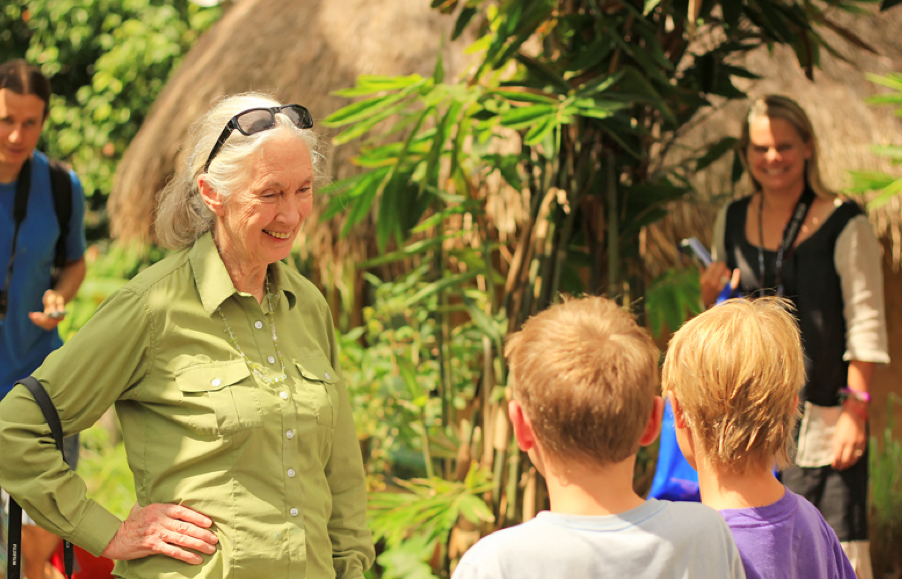
Jane Goodall conversing with children participating in the conference.
(Photo courtesy of Green School)

Rights of animals

As the sun slowly set over Bali, dozens of attendees sat cross-legged in the main tent, listening attentively to Goodall’s soft voice, enchanted by her heartfelt talk “Where the Hope Lies.”

Here, Goodall shared her personal stories of how she became a world-renowned primatologist, on the tremendous supports from her mother — who accompanied her daughter to Tanzania’s Gombe Stream National Park in 1960 out of concern for her safety — and on her belief and conviction on non-human rights. She stands firm that animals possess emotions and personalities just like humans do, and that they therefore deserve ethical treatment as well.

“In what terms should we think of these beings, non-human yet possessing so very many human-like characteristics, how should we treat them?” she asked. “Surely we should treat them with the same consideration and kindness as we show to other humans; and as we recognize human rights, so too should we recognize the rights of the great apes and other animals.”

Goodall also emphasized the importance of planting environmental awareness in young minds through specific programs such as Roots & Shoots, which she first founded back in Tanzania.

Roots & Shoots aims to bring together youths of all ages, from preschool to university, to work on environmental, conservation and humanitarian issues. The program now has chapters in more than 132 countries, involving 100,000 youth.

A day prior to the conference, the first Plastik Tidak Fantastik Festival (Plastic Isn’t  Fantastic Festival) was held by the student-led initiative Bye Bye Plastic Bag.

Hosting Goodall herself during the festival were Isabel and Melati Wijsen, the founders of the BBPB campaign. The sisters, aged just 11 and 12, who are also students at the Green School, accompanied Goodall throughout the day that was filled with various entertaining and socially responsible workshops; a fund-raising fun-run; a trash fashion show; and live musical performances, all prepared and presented by the students.

“Change happens by listening and then starting a dialogue with the people who are doing something you don’t believe is right,” Goodall told the attentive Bali kids from BBPB.

She appealed for the students to be the messengers for a brighter and more environmentally conscious future by being aware and taking the initiative to create more harmonious relationships between the environment and mankind.

The event was closed with a book signing by Goodall.

“Each one of us matters, has a role to play, and makes a difference. Each one of us must take responsibility for our own lives, and above all, show respect and love for the living things around us, especially each other,” she said.

Such inspiring words echoed in the tranquil grounds of the Green School as the sun slowly cast its last shadow.

As they found a way into the hearts of the audience, many participants, both young and adult, seemed to feel motivated to create a greener and more sustainable future for Bali and beyond.

Related Article:


Friday, June 20, 2014

Angry Japan farmers bring Fukushima cow to Tokyo

Yahoo – AFP, 20 June 2014

Japanese farmers bring a cow to the front of the agriculture ministry in
Tokyo, on June 20, 2014

Angry farmers from Fukushima brought a large cow to the centre of Tokyo Friday to demand Japan's government investigate a disease they say cattle have developed since the nuclear disaster three years ago.

"Kibo no Bokujo" leader Masami
 Yoshizawa (right) argues with a Japanese
 policeman as he tries to bring a cow to
 the agriculture ministry in Tokyo, on
June 20, 2014
Operators of non-profit "Kibo no Bokujo", or "Farm of Hope", delivered a full-size black cow to the front of the agriculture ministry to demand an investigation into why it and many other animals have developed white dots on their skin since reactors went into meltdown after the earthquake and tsunami of March 2011.

The farm is located only 14 kilometres (nine miles) from the nuclear plant and is keeping some 350 cows that were abandoned in the area when their owners had to evacuate because of radiation contamination.

"Our cows cannot be shipped as meat. They are evidence of lives affected by radiation," said Masami Yoshizawa, leader of the farm, in front of the ministry, as his supporters and media looked on.

Fellow Fukushima farmer Naoto Matsumura said: "What if this started happening to people? We have to examine the cause of this and let people know what happened to these animals."

The vast farmland in Fukushima has been contaminated by radioactive materials from the Fukushima plant, forcing tens of thousands of local residents to give up their homes to live in temporary shelters.

The government says it could take decades to clean the region, but scientists say many residents may never be able to return because of the contamination.

Related Articles:

"Fast-Tracking" - Feb 8, 2014 (Kryon Channelling by Lee Carroll) - (Reference to Fukushima / H-bomb nuclear pollution and a warning about nuclear  (> 20 Min)


"A Summary" – Apr 2, 2011 (Kryon channeled by Lee Carroll) (Subjects: Religion, Shift of Human Consciousness, 2012, Intelligent/Benevolent Design, EU, South America, 5 Currencies, Water Cycle (Heat up, Mini Ice Ace, Oceans, Fish, Earthquakes ..), Middle East, Internet, Israel, Dictators, Palestine, US, Japan (Quake/Tsunami Disasters , People, Society ...), Nuclear Power Revealed, Hydro Power, Geothermal Power, Moon, Financial Institutes (Recession, Realign integrity values ..) , China, North Korea, Global Unity,..... etc.) - (Text version)
“... Japan

Let us talk for a moment about Japan, and then I'll close the day of messages. There are thousands of souls on my side of the veil and they're just fine, more than fine. We have spoken so often of what happens at the Wind of Birth. I told you, before they even came in, they saw the potential. I looked in their eyes. "You may not last long. You know that, don't you? You're coming into this planet and you may not be here very long. And the passing that you will have with your family will not be pleasant, if any ever are. Why would you come in anyway?" I want to tell you what they said. When a soul has the mind of God, it understands fully what generates peace and what generates energy shift. You can clearly see what generates what the planet needs the most when you are about to arrive. So they said, "We're going to be part of one of the biggest compassion events the planet has ever seen." One earthquake, one tsunami. All of those who left that day will change the earth forever. And it already has. It was the same for the last tsunami as well.

Every single one of them on my side of the veil is getting ready to come back. Many old souls were involved, and just for a moment, if they could give you any information, if they could talk to you right now, if they could speak your language and look into your eyes, they would thank you for your compassion for them and those who are left. And they would say, "Be with those family members who are still alive. Enter their hearts every day and give them peace and keep them from crying, because we're OK."

Nuclear Power Revealed

So let me tell you what else they did. They just showed you what's wrong with nuclear power. "Safe to the maximum," they said. "Our devices are strong and cannot fail." But they did. They are no match for Gaia.

It seems that for more than 20 years, every single time we sit in the chair and speak of electric power, we tell you that hundreds of thousands of tons of push/pull energy on a regular schedule is available to you. It is moon-driven, forever. It can make all of the electricity for all of the cities on your planet, no matter how much you use. There's no environmental impact at all. Use the power of the tides, the oceans, the waves in clever ways. Use them in a bigger way than any designer has ever put together yet, to power your cities. The largest cities on your planet are on the coasts, and that's where the power source is. Hydro is the answer. It's not dangerous. You've ignored it because it seems harder to engineer and it's not in a controlled environment. Yet, you've chosen to build one of the most complex and dangerous steam engines on Earth - nuclear power.

We also have indicated that all you have to do is dig down deep enough and the planet will give you heat. It's right below the surface, not too far away all the time. You'll have a Gaia steam engine that way, too. There's no danger at all and you don't have to dig that far. All you have to do is heat fluid, and there are some fluids that boil far faster than water. So we say it again and again. Maybe this will show you what's wrong with what you've been doing, and this will turn the attitudes of your science to create something so beautiful and so powerful for your grandchildren. Why do you think you were given the moon? Now you know.

This benevolent Universe gave you an astral body that allows the waters in your ocean to push and pull and push on the most regular schedule of anything you know of. Yet there you sit enjoying just looking at it instead of using it. It could be enormous, free energy forever, ready to be converted when you design the methods of capturing it. It's time.

So in closing, do you understand what you're seeing? You're seeing intelligent design, quantum energy and high consciousness. You are seeing changes in Human nature. You're seeing countries putting things together instead of separating. You are seeing those who don't want war and instead want peace, good schools for their children, safety in their streets and a say in their government. We told you it was going to happen this way. I want my partner to teach these things that I have said in his 3D lectures for awhile. Many won't be able to know these things otherwise.  …”

Saturday, June 7, 2014

WRI: A Chance for Forests, if Government Can See Past the Trees

Jakarta Globe, Vita A.D. Busyra, Jun 07, 2014

Indonesia's resource-driven economic book has taken a heavy toll on the
 nation's forests, and environmental experts warn that the situation has become
untenable. (AFP Photo/Romeo Gacad)

Jakarta. Indonesia’s economic ascendancy from the crippling financial crisis of the late 1990s has seen the country become one of the biggest economies in the world.

But the boom has been built in part on a high rate of natural resources extraction — including coal mining and the wholesale clearing of forests to make way for oil palm plantations — that is not sustainable, experts warn.

“With the booming economy and rise of the middle class, we’re putting a lot of stresses on our natural environment, including power, wood, minerals, oil, gas and food,” says Andrew Steer, the president and chief executive of the World Resources Institute, an organization that focuses on the overlap between the environment and socioeconomic development.

Steer, speaking at the opening of the WRI’s Indonesian office on Wednesday, Steer said those stresses were responsible for Indonesia being a major emitter of greenhouse cases, mostly from deforestation.

“Over the last decade, Indonesia’s economy has become the third-fastest-growing economy in the world. With a massive 35 million people emerging into the middle class, or consuming class, we are trying to drive people to consider their consumption with the environmental sector,” he said.

“Indonesia has contributed to climate change and should be part of the solution to make it more resilient,” he added.

Steer said it was not all gloom and doom, though, noting that his institute was encouraged to open an office here because of the government’s commitment to extending a moratorium on issuing new land-clearing permits in primary and peat forests.

The moratorium was issued in May 2011 and was initially set to run for two years. However, the administration of President Susilo Bambang Yudhoyono decided last year to extend it to May 2015.

Dino Patti Djalal, a board member of the WRI in Indonesia, said there was an increasing number of environmentalists, activists and civil society groups raising awareness about environmental and economic issues.

He said the country was also witnessing the rise of a new generation of local government leaders coming up with innovative ideas to address their local economic and environmental challenges.

He cited the example of an Islamic boarding school, or pesantren , in Lombok, West Nusa Tenggara, that had begun using e-books after finding a way to generate electricity from waste.

“They also grow tree seedlings and give them to members of the local community to take care of the trees,” said Dino, the former Indonesian ambassador to the United States. “So from the local [government] level to pesantren, university and civil society level, many people are adopting new techniques to promote environmental stewardship.”

Dino, who also mounted a failed bid for the Democratic Party’s presidential nomination, said the central government needed to do more in terms of adopting and propagating environmentally friendly technologies for sustainable development.

“They have to know what they want, what the demands of development truly are, and what types of technologies are needed to fulfill those needs,” he said.

Among the technologies that the government has often been criticized for being slow in adopting is mapping technology to assess the true condition of forests across the country.

The first few months after the implementation of the forestry moratorium were marked by numerous instances of plantation companies being issued forest-clearing permits in areas that clearly fell within the no-limit zone defined in the government’s moratorium map. The map has since been updated several times.

The WRI has proposed the use of its Global Forest Watch platform, which it says combines innovative technologies, open data and crowdsourcing at a global scale for everyone to see the real condition of forests all over the world.

“Global Forest Watch is accessible to everyone, from governments and nongovernmental organizations and indigenous communities, to buyers, suppliers and the media,” said Nigel Sizer, the director of the platform.

He said the government could use the online map, at globalforestwatch.org, to inform forest policies and regulations, observe concessions, and identify illicit deforestation.

NGOs, meanwhile, can use it to identify deforestation zones and fire hot spots to mobilize real action and collect evidence to hold the government and companies to account for their forest-related commitments.

“Citizens can also share their experiences on forest-related issues,” Sizer said.

Rudi Putra, an environmental activist who won the 2014 Goldman Environmental Prize for his successful efforts to tackle illegal oil palm plantations in Aceh’s Leuser Ecosystem — whose omission from the original moratorium map was a major source of controversy — says there needs to be a greater understanding about the importance of forests, not just for local biodiversity but also for communities.

He welcomed any new technology that would help in the monitoring of forest conditions. Such innovations, he said, would allow people to combat illegal logging and forest encroachment, deforestation and degradation.

Besides the issue of forests, Steer said Indonesia should look to develop its wealth of renewable energy.

The country has the world’s biggest reserves of geothermal energy, but to date generates less than 5 percent of its total electricity this way. The bulk of electricity here is generated by coal-fired plants.

“Indonesia is pretty dependent on fossil fuel, so it needs a revolution in the energy sector,” Steer said.WRI: A Chance for Forests, if Government Can See Past the Trees
Jakarta Globe, Vita A.D. Busyra, Jun 07, 2014

Indonesia's resource-driven economic book has taken a heavy toll on the nation's forests, and environmental experts warn that the situation has become untenable. (AFP Photo/Romeo Gacad)

Jakarta. Indonesia’s economic ascendancy from the crippling financial crisis of the late 1990s has seen the country become one of the biggest economies in the world.

But the boom has been built in part on a high rate of natural resources extraction — including coal mining and the wholesale clearing of forests to make way for oil palm plantations — that is not sustainable, experts warn.

“With the booming economy and rise of the middle class, we’re putting a lot of stresses on our natural environment, including power, wood, minerals, oil, gas and food,” says Andrew Steer, the president and chief executive of the World Resources Institute, an organization that focuses on the overlap between the environment and socioeconomic development.

Steer, speaking at the opening of the WRI’s Indonesian office on Wednesday, Steer said those stresses were responsible for Indonesia being a major emitter of greenhouse cases, mostly from deforestation.

“Over the last decade, Indonesia’s economy has become the third-fastest-growing economy in the world. With a massive 35 million people emerging into the middle class, or consuming class, we are trying to drive people to consider their consumption with the environmental sector,” he said.

“Indonesia has contributed to climate change and should be part of the solution to make it more resilient,” he added.

Steer said it was not all gloom and doom, though, noting that his institute was encouraged to open an office here because of the government’s commitment to extending a moratorium on issuing new land-clearing permits in primary and peat forests.

The moratorium was issued in May 2011 and was initially set to run for two years. However, the administration of President Susilo Bambang Yudhoyono decided last year to extend it to May 2015.

Dino Patti Djalal, a board member of the WRI in Indonesia, said there was an increasing number of environmentalists, activists and civil society groups raising awareness about environmental and economic issues.

He said the country was also witnessing the rise of a new generation of local government leaders coming up with innovative ideas to address their local economic and environmental challenges.

He cited the example of an Islamic boarding school, or pesantren , in Lombok, West Nusa Tenggara, that had begun using e-books after finding a way to generate electricity from waste.

“They also grow tree seedlings and give them to members of the local community to take care of the trees,” said Dino, the former Indonesian ambassador to the United States. “So from the local [government] level to pesantren, university and civil society level, many people are adopting new techniques to promote environmental stewardship.”

Dino, who also mounted a failed bid for the Democratic Party’s presidential nomination, said the central government needed to do more in terms of adopting and propagating environmentally friendly technologies for sustainable development.

“They have to know what they want, what the demands of development truly are, and what types of technologies are needed to fulfill those needs,” he said.

Among the technologies that the government has often been criticized for being slow in adopting is mapping technology to assess the true condition of forests across the country.

The first few months after the implementation of the forestry moratorium were marked by numerous instances of plantation companies being issued forest-clearing permits in areas that clearly fell within the no-limit zone defined in the government’s moratorium map. The map has since been updated several times.

The WRI has proposed the use of its Global Forest Watch platform, which it says combines innovative technologies, open data and crowdsourcing at a global scale for everyone to see the real condition of forests all over the world.

“Global Forest Watch is accessible to everyone, from governments and nongovernmental organizations and indigenous communities, to buyers, suppliers and the media,” said Nigel Sizer, the director of the platform.

He said the government could use the online map, at globalforestwatch.org, to inform forest policies and regulations, observe concessions, and identify illicit deforestation.

NGOs, meanwhile, can use it to identify deforestation zones and fire hot spots to mobilize real action and collect evidence to hold the government and companies to account for their forest-related commitments.

“Citizens can also share their experiences on forest-related issues,” Sizer said.

Rudi Putra, an environmental activist who won the 2014 Goldman Environmental Prize for his successful efforts to tackle illegal oil palm plantations in Aceh’s Leuser Ecosystem — whose omission from the original moratorium map was a major source of controversy — says there needs to be a greater understanding about the importance of forests, not just for local biodiversity but also for communities.

He welcomed any new technology that would help in the monitoring of forest conditions. Such innovations, he said, would allow people to combat illegal logging and forest encroachment, deforestation and degradation.

Besides the issue of forests, Steer said Indonesia should look to develop its wealth of renewable energy.

The country has the world’s biggest reserves of geothermal energy, but to date generates less than 5 percent of its total electricity this way. The bulk of electricity here is generated by coal-fired plants.

“Indonesia is pretty dependent on fossil fuel, so it needs a revolution in the energy sector,” Steer said.

Related Articles:


"... Some of you will walk into the forest and you'll feel it. It surrounds you with its love and beauty. Gaia speaks to you. The trees are pushing out oxygen with a benevolent system of photosynthesis. The plants give you oxygen and you give them carbon dioxide. What a system! Look around. Science will say that system happened by accident - a random occurrence. Do you believe that? What a beautiful system! The trees themselves know who you are. You walk into the forest and you feel it hug you, but perhaps another is next to you who came with a chainsaw. They don't care and they don't feel it. To them, the forest is only a resource. What's the difference between the two of you? There's no judgment here, I'm just asking you. What do you think the difference is? The answer: You're letting multidimensional awareness in and they are not. You see, you are becoming more aware of multidimensional soul communication. In this case, it's your enormous soul energy communicating with the other parts of the planet who are also multidimensional.

When you make the decision that it's OK to feel this energy, it will be there. Most of humanity so far has not made that decision. They block it. The law is this - this communication will come to you only with your allowance. The moment you open the door of allowance, you may begin to feel it. Those are our rules.

It's not just allowance for communication from the creative source, but also from an amazing number of what we would call other benevolent energies. These others are represented by groups with names that you have given them. They also cannot get through to you unless you allow it. That's their rule as well. Your names for them are Pleiadians, Arcturians, Sirians, Hathors or those from Orion. There are many more, but unless you open to the possibility of them, they can't communicate either.

Most of humanity will stand next to you as you communicate and think you're not well. That's the way it looks to them. Listen, dear ones, the benevolent groups who represent your DNA essence [your seed biology] and who know who you are are many. The amount of help you have on this planet is staggering, yet the majority of humanity will not allow awareness of it or let the possibility into their reality.. ..."

Sunday, July 14, 2013

TEDx Binnenhof: Farming green energy for cows and men (Video)


Related Articles:

Could cow manure be the future of green energy?

Could cow manure be the future of
green energy?


(39) Question: Dear Kryon: I've noticed how many children are developing severe allergies to foods (my daughter included). When I've researched this, it seems that most of the allergies are essentially to seeds, grains, legumes, eggs, and dairy. I've noticed that these foods all hold the potential for life, or in the case of dairy, are essentially used to sustain the first stages of life in an animal's baby. My feeling is that because we're not releasing the life force within these foods (that is, sprouting, etc.), they're becoming harmful to us. I would like your impressions of this.

Answer: For thousands of years, these foods have worked for humanity. In these cases you speak about, the main culprit continues to be the way in which these foods are collected and processed. You won't find these allergies in third-world countries, and you won't find them within the children who work on farms, where they eat the foods directly. There will eventually have to come a day when you relax some of your efficiency attributes and go back to the way food was meant to be collected and eaten. And yes... there are effects from how the dairy animals are treated, too. Going back to some basics will help, and so will eliminating some of the procedures that supposedly create a "safer food." These procedures have instead made them begin to look like foreign food to the Human body.

Friday, October 12, 2012

Norway to double carbon tax on oil industry

Extra funding for climate change mitigation and forestry programmes also part of oil-rich nation's radical programme

guardian.co.uk, Severin Carrell, Scotland correspondent, Thursday 11 October 2012

Ekofisk oil platform in the North Sea, Norway. The Norwegian government has
 proposed increasing its carbon tax on offshore oil companies. Photograph:
Ulrich Baumgarten/Getty Images

Norway is to double carbon tax on its North Sea oil industry and set up a £1bn fund to help combat the damaging impacts of climate change in the developing world.

In one of the most radical climate programmes yet by an oil-producing nation, the Norwegian government has proposed increasing its carbon tax on offshore oil companies by £21 to £45 (Nkr410) per tonne of CO2 and a £5.50 (Nkr50) per tonne CO2 tax on its fishing industry.

Norway will also plough an extra £1bn (Nkr10bn) into its funds for climate change mitigation, renewable energy, food security in developing countries and conversion to low-carbon energy sources, Environmental Finance reported.

It will step up spending on new projects to combat deforestation in developing countries to £44m, taking up its spending overall on forestry programmes to £327m. Previous forestry projects have involved Brazil, Indonesia and Ethiopia.

The Oslo government is also to spend £69m on buying carbon credits in 2013, to help offset its emissions, force through new building regulations to make all new homes carbon-neutral by 2015 and increase efforts to heavily cut emissions from cars, switching to electric vehicles.

The scale of these initiatives will pose a significant political challenge to other oil-producing nations, who are also investing in low-carbon technologies and cutting their own emissions, but not yet investing heavily in tackling the impacts of climate change on developing countries.

The UK and Scottish governments estimate there are up to 24bn barrels of oil left to be exploited over the next 40 years from the UK's oil and gas fields in the North Sea, west of Shetland and smaller sites off western England.

But that would lead to total CO2 emissions of an extra 10bn tonnes – dwarfing the UK's annual 500m tonnes of CO2 emissions, at a time when many climate scientists urge cutbacks in oil, gas and coal use to avoid significant global warming and to meet climate targets.

Neither the UK or Scottish government has supported a carbon tax on the oil and gas industry.

The Scottish government, which often looks to Norway as a model for its independence plans, has greatly increased its funding and support for renewable energy investment. It announced a £103m investment fund for marine renewables and community power schemes on Wednesday and has a £4m "climate justice fund" to help developing countries.

But fields in Scottish waters account for about 80% of the UK's North Sea oil and gas fields, which produced 1m barrels of oil a day in August.

Alex Salmond, Scotland's first minister, said on Wednesday that oil economies have a"moral obligation" to increase low-carbon energy and tackle climate change, but says there is no contradiction in maximising oil, gas and coal production.

He told a conference on low-carbon investment: "As countries such as Denmark show, there's no contradiction between making use of substantial in their case gas reserves which will be needed by the rest of the world in the coming decades by the rest of the world, while leading the transition to a low-carbon economy."

After speaking at the same conference on Thursday, Ed Davey, the UK energy and climate secretary, told the Guardian he believed the UK's actions on climate change and green energy were also world-leading. The UK government was putting £3bn into the new green investment bank, and aims to cut CO2 emissions by 34% by 2020, he said.

Asked about Norway's new programme, Davey said: "I would say that the UK government has very ambitious climate change targets and carbon emission reduction targets.

"We were one of the first countries in the world to pass legally binding targets on ourselves, with the Climate Change Act 2008 which had cross party support. And the government has introduced on the back of that, the fourth carbon budget and the whole electricity market reform, the green deal, the green investment bank.

"These are all our tools to deliver on those targets; these are incredibly ambitious and maybe some countries are catching us up."

Ranking third among the world's oil exporters, with production peaking at 3m barrels of oil a day, Norway has 51 active oil and gas fields in the North Sea, and believes it has more than 7bn barrels of undiscovered reserves. Its oil and gas sector is the world's richest: its employees earn $180,000 on average a year.

With a population of 5 million - the same as Scotland - it is the third wealthiest country per capita in the world thanks to its oil and gas exports. Norway's plans to offset the impacts of its oil exports on the world's climate come as it also proposes to expand oil exploration into the Barents Sea to the far north.

Richard Dixon, director of WWF Scotland, said: "Norway is showing how you can use oil income to fund the transition out of oil, we should be doing the same with UK oil revenues. The Scottish National Party have always been keen on the Norwegian oil fund, and now it is setting an example really worth following."

Related Articles:

Norway, Indonesia $1 Billion Forest Pact Broken, Group Says


Nigerian farmers sue Shell in the Hague

US Supreme Court denies Chevron $19bn Ecuador appeal


"Recalibration of Free Choice"–  Mar 3, 2012 (Kryon Channelling by Lee Caroll) - (Subjects: (Old) Souls, Midpoint on 21-12-2012, Shift of Human Consciousness, Black & White vs. Color, 1 - Spirituality (Religions) shifting, Loose a Pope “soon”, 2 - Humans will change react to drama, 3 - Civilizations/Population on Earth,  4 - Alternate energy sources (Geothermal, Tidal (Paddle wheels), Wind), 5 – Financials Institutes/concepts will change (Integrity – Ethical) , 6 - News/Media/TV to change, 7 – Big Pharmaceutical company will collapse “soon”, (Keep people sick), (Integrity – Ethical)  8 – Wars will be over on Earth, Global Unity, … etc.) - (Text version)

“…  4 - Energy (again)

The natural resources of the planet are finite and will not support the continuation of what you've been doing. We've been saying this for a decade. Watch for increased science and increased funding for alternate ways of creating electricity (finally). Watch for the very companies who have the most to lose being the ones who fund it. It is the beginning of a full realization that a change of thinking is at hand. You can take things from Gaia that are energy, instead of physical resources. We speak yet again about geothermal, about tidal, about wind. Again, we plead with you not to over-engineer this. For one of the things that Human Beings do in a technological age is to over-engineer simple things. Look at nuclear - the most over-engineered and expensive steam engine in existence!

Your current ideas of capturing energy from tidal and wave motion don't have to be technical marvels. Think paddle wheel on a pier with waves, which will create energy in both directions [waves coming and going] tied to a generator that can power dozens of neighborhoods, not full cities. Think simple and decentralize the idea of utilities. The same goes for wind and geothermal. Think of utilities for groups of homes in a cluster. You won't have a grid failure if there is no grid. This is the way of the future, and you'll be more inclined to have it sooner than later if you do this, and it won't cost as much….”