Robber fly - Nature photographer Thomas Shahan specializes in amazing portraits of tiny insects. It isn't easy. Shahan says that this Robber Fly (Holcocephala fusca), for instance, is "skittish" and doesn't like its picture taken.

Nature by Numbers (Video)

"The Greater Akashic System" – July 15, 2012 (Kryon Channelling by Lee Caroll) (Subjects: Lightworkers, Intent, To meet God, Past lives, Universe/Galaxy, Earth, Pleiadians, Souls Reincarnate, Invention: Measure Quantum state in 3D, Recalibrates, Multi-Dimensional/Divine, Akashic System to change to new system, Before religion changed the system, DNA, Old system react to Karma, New system react to intent now for next life, Animals (around humans) reincarnate again, This Animal want to come back to the same human, Akashic Inheritance, Reincarnate as Family, Other Planets, Global Unity … etc.)

Question: Dear Kryon: I live in Spain. I am sorry if I will ask you a question you might have already answered, but the translations of your books are very slow and I might not have gathered all information you have already given. I am quite concerned about abandoned animals. It seems that many people buy animals for their children and as soon as they grow, they set them out somewhere. Recently I had the occasion to see a small kitten in the middle of the street. I did not immediately react, since I could have stopped and taken it, without getting out of the car. So, I went on and at the first occasion I could turn, I went back to see if I could take the kitten, but it was to late, somebody had already killed it. This happened some month ago, but I still feel very sorry for that kitten. I just would like to know, what kind of entity are these animals and how does this fit in our world. Are these entities which choose this kind of life, like we do choose our kind of Human life? I see so many abandoned animals and every time I see one, my heart aches... I would like to know more about them.

Answer: Dear one, indeed the answer has been given, but let us give it again so you all understand. Animals are here on earth for three (3) reasons.

(1) The balance of biological life. . . the circle of energy that is needed for you to exist in what you call "nature."

(2) To be harvested. Yes, it's true. Many exist for your sustenance, and this is appropriate. It is a harmony between Human and animal, and always has. Remember the buffalo that willingly came into the indigenous tribes to be sacrificed when called? These are stories that you should examine again. The inappropriateness of today's culture is how these precious creatures are treated. Did you know that if there was an honoring ceremony at their death, they would nourish you better? Did you know that there is ceremony that could benefit all of humanity in this way. Perhaps it's time you saw it.

(3) To be loved and to love. For many cultures, animals serve as surrogate children, loved and taken care of. It gives Humans a chance to show compassion when they need it, and to have unconditional love when they need it. This is extremely important to many, and provides balance and centering for many.

Do animals know all this? At a basic level, they do. Not in the way you "know," but in a cellular awareness they understand that they are here in service to planet earth. If you honor them in all three instances, then balance will be the result. Your feelings about their treatment is important. Temper your reactions with the spiritual logic of their appropriateness and their service to humanity. Honor them in all three cases.

Dian Fossey's birthday celebrated with a Google doodle

Dian Fossey's birthday celebrated with a Google doodle
American zoologist played by Sigourney Weaver in the film Gorillas in the Mist would have been 82 on Thursday (16 January 2014)
Showing posts with label Russia. Show all posts

Monday, December 2, 2019

Rescued tigers leave Poland for Spain

Yahoo – AFP, December 1, 2019

The tigers (including Gogh pictured at the Poznan zoo) were found in late October
emaciated and dehydrated in the back of a truck taking them from Italy to a zoo
in Russia's Dagestan Republic (AFP Photo/Wojtek RADWANSKI)

Warsaw (AFP) - Five of nine tigers that narrowly survived a gruelling journey across Europe set off on Saturday for their new home at a Spanish animal refuge after weeks of recovery at a Polish zoo.

"The tigers have left. We're very happy that in just 24 to 30 hours they will arrive," said Malgorzata Chodyla, spokeswoman for the zoo in Poznan, western Poland.

Their destination is the Primadomus Wildlife Refuge in the southeastern Spanish town of Villena.

Chodyla said there was a brief scare, as two of the tigers did not want to sleep, despite the sedatives they were given.

"When the whole team has to enter the enclosure to carry out the tiger and it suddenly lifts its head up, those are some tense moments. But everything happened safely," she told AFP.

She added that the vehicle had heating and the tigers had enough room to switch positions.

In late October, Polish border authorities found 10 emaciated and dehydrated big cats in the back of a truck taking them from Italy to a zoo in Russia's Dagestan Republic.

Polish prosecutors charged two Italian truck drivers and a Russian man believed to have organised the journey with animal abuse after the truck got stuck for days on Poland's border with Belarus.

Prosecutors also charged a Polish border service veterinarian for failing to properly examine the tigers when they first arrived at the Koroszczyn crossing, where one of them died.

The surviving nine tigers were taken to two Polish zoos.

The Poznan zoo described them as "emaciated, dehydrated, with sunken eyes, excrement stuck to their fur, urine burns, in a total state of stress, without the will or desire to live" when they were first discovered.

According to animal rights organisations, there are only between 3,200 and 3,900 tigers in the wild worldwide.

Another 7,000 are held in captivity, mainly in Asia.

Friday, January 12, 2018

Stray dogs 'murdered' in Russian World Cup cities: MPs

Yahoo – AFP, Jan 11, 2018

The World Cup will be held in 11 Russian cities this summer, from the enclave of
Kaliningrad in the West to Yekaterinburg in the East (AFP Photo/Mladen ANTONOV)

Moscow (AFP) - Stray dogs are being killed in Russian cities set to host the 2018 World Cup as authorities follow orders to get thousands of feral animals under control, Russian MPs claimed Thursday.

"We have received many appeals from animal rights activists and just caring citizens saying mass shooting and euthanasia of stray animals is taking place in a number of World Cup-host cities," the head of the Russian lower house's environmental protection committee Vladimir Burmatov told Parlamentskaya Gazeta newspaper.

Packs of stray dogs are a common sight in Russian cities, fuelled by public reluctance to sterilise pets, and some can be aggressive or beg for food.

Last month first deputy prime minister Vitaly Mutko estimated there are some two million stray animals in the host cities and urged them to solve the problem humanely.

Burmatov said his committee had sent an official letter to sports minister Pavel Kolobkov warning of "mass destruction of homeless animals" in host cities, and asking him to ask the regional authorities to use "humane methods without causing death or mutilating or injuring the animals."

Burmatov called for stray dogs to be placed in temporary holding centres and sterilised, saying this would be no more costly than killing them and would improve Russia's image.

"These troubling signals must stop, our country's reputation is at stake. Because we're not savages carrying out mass killings of animals on the streets, throwing their bloodied bodies into vans and driving them round the city.

"For the same money you can easily carry out catching, vaccination and sterilisation and accommodating the animals in holding centres," Burmatov said.

In response to the letter sports minister Kolobkov said he had told the host cities to use humane methods in order to avoid a negative public reaction, Parlamentskaya Gazeta newspaper reported.

The World Cup will be held in 11 Russian cities this summer, from the enclave of Kaliningrad in the West to Yekaterinburg in the East.


Wednesday, August 30, 2017

Dutch dairy cows to be sent to Siberia, in a bid to up milk production

DutchNews, August 29, 2017


French dairy company Danone, owner of Dutch company Numico, is going to export five thousand Dutch and German dairy cows to Russia, the Volkskrant reported on Tuesday. 

The animals will be transported over a distance of 4,500 kilometres to a farm in Tyumen in Western Siberia. 

The reason for the move by Danone, which does not normally trade in cattle, are the rising milk prices in Russia. The country closed its borders to Western European cheese in a reaction to the European boycott over Ukraine. That, in turn, means local milk is now used to make Russian cheese causing milk prices to spike.

This year alone milk prices have gone up by 14% in Russia. ‘ This is endangering the production of dairy products, such as yoghurt,’ head of Danone’s Russian unit told Bloomberg. By having the cattle graze in Russia the company is hoping to bring down the price of milk. 

Tuesday, March 29, 2016

Caveman's best friends? Preserved Ice Age puppies awe scientists

Yahoo – AFP, Maria Antonova, 28 March 2016
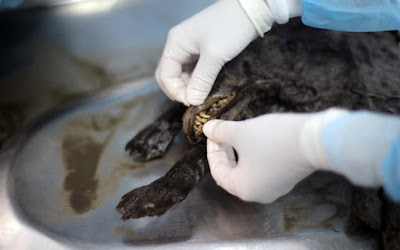
A scientist performs an autopsy of the remains of a puppy, which died 12,460 
years ago and was discovered in Russia's northern Yakutia, at the North-Eastern 
Federal University in Yakutsk (AFP Photo)

Moscow (AFP) - The hunters searching for mammoth tusks were drawn to the steep riverbank by a deposit of ancient bones. To their astonishment, they discovered an Ice Age puppy's snout peeking out from the permafrost.

Five years later, a pair of puppies perfectly preserved in Russia's far northeast region of Yakutia and dating back 12,460 years has mobilised scientists across the world.

"To find a carnivorous mammal intact with skin, fur and internal organs -- this has never happened before in history," said Sergei Fyodorov, head of exhibitions at the Mammoth Museum of the North-Eastern Federal University in the regional capital of Yakutsk.

The discovery of 12,460-year-old puppies
 in Russia could contribute to the lively
 scientific debate over the origin of 
domesticated dogs (AFP Photo)
And the discovery could contribute to the lively scientific debate over the origin of domesticated dogs.

When the hunters stumbled on the first frozen pup in 2011, they alerted Fyodorov who immediately flew out to the remote Arctic tundra, about 4,700 kilometres (2,900 miles) from Moscow and only 130 kilometres from the Laptev Sea, which borders the Arctic Ocean.

Last year he returned for a more thorough look and found the second puppy close to the same spot, farther down the slope. Both had died when they were about three months old.

They most likely come from the same litter, said Fyodorov.

Last week he oversaw the removal of the second puppy's remarkably well-preserved brain -- "the first in the world", he said.

"Puppies are very rare, because they have thin bones and delicate skulls," he said.

The duo have been named the Tumat Dog, after the nearest village to the site.

Fyodorov said a preliminary look at the mammoth remains also found at the dig suggested some had been butchered and burned, hinting at the presence of humans. It remains to be seen, however, whether the puppies were domesticated or wild.

The answer can only be determined by reconstructing their genomes, which would take at least a year.

Grass-eating dogs?

"Thus far, the lineages of wolves that likely gave rise to dogs have not yet been discovered and it's possible that these puppies could be on that lineage, which would be very exciting," said evolutionary biologist Greger Larson of University of Oxford, one of the scientists behind a collaborative project aimed at finding out when and where dogs became the first domesticated animals.

Scientists from the Mammoth Museum of the North-Eastern Federal University
 extract the brain of a puppy, which died 12,460 years ago and was discovered in
Russia's northern Yakutia (AFP Photo)

What makes the dog particularly intriguing is that it managed to become "man's best friend" even before humans became settled farmers.

It is still unclear whether dogs were domesticated in one place or in several places independently, and whether the process started when humans took in cubs or whether wolves themselves gradually drifted to human sites in search of food.

Whatever their precise lineage, the Tumat pups will keep Fyodorov and other scientists busy for some time.

The second puppy's preserved brain will be compared with that of modern dogs and wolves. Parasites found on its body will be analysed, as will the contents of its stomach, which Fyodorov is particularly excited about.

"When we opened it, we were very surprised. The second puppy's stomach is mostly full of twigs and grass," he said, wondering if perhaps the animals were not exclusively carnivorous or whether they started eating grass after they were trapped by a mudslide and began to starve.

"This material is really exceptional and unique," said Mietje Germonpre, a palaeontologist from the Royal Belgian Institute who partnered up with Fyodorov on the project and came to Yakutsk to oversee the autopsy of the second puppy earlier this month.

"The fact that soft tissue is preserved will give much more information compared to information that can be obtained from 'normal' fossils," she said, meaning bones and teeth.

Graphic on the origins of the domestic dog (AFP Photo/Adrian LEUNG, John SAEKI)

Permafrost secrets

Fyodorov lamented the long time it takes to get ancient biological material to suitable labs due to financial constraints, the rugged terrain and red tape which sometimes means that samples reach laboratories only six months later.

"Everyone understands that the tissue of mammoth fauna loses its structure with every passing second, even in the freezer," he said.

Yakutia's melting permafrost is likely to yield up even more treasures in the coming years, he added, saying the number of reported prehistoric finds has grown "severalfold" in the last decade.

Warm and wet weather and flash floods have been a big contributor to the thaw, he said.

"Right now it's 0 degrees (Celsius) here. That should not be the case in March."

As better transport and technology becomes affordable, he said, locals are embarking on expeditions to more and more remote corners of Siberia to look for the precious and lucrative mammoth tusks, which can sell for tens of thousands of dollars and are increasingly prized by Chinese carvers given trade bans on elephant ivory.

In Russia, indigenous tribes are allowed to hunt for ancient remains on their ancestral lands.

"Our land is locked in by permafrost, but little by little it is revealing its secrets," Fyodorov said.

Related Article:


Friday, January 22, 2016

Dolphin circus sparks animal cruelty debate in Central Asia

Yahoo – AFP, Tolkun Namatbayeva, January 21, 2016

Dolphins during a performance at the Moscow Travelling Dolphinarium
(AFP Photo/Vyacheslav Oseledko)

Bishkek (Kyrgyzstan) (AFP) - Inside a travelling aquatic circus in Kyrgyzstan's capital Bishkek, whoops and cheers go up as a dolphin leaps out of a pool and slam-dunks a ball through a basketball net.

Hundreds of people packed inside the Moscow Travelling Dolphinarium to watch dolphins and beluga whales perform acrobatic stunts, against a painted backdrop of blue skies and palm trees.

A beluga whale performs at the Moscow 
ravelling Dolphinarium in Bishkek
(AFP Photo/Vyacheslav Oseledko)
A blonde female announcer dressed as a sailor spurs on the animals like champion athletes.

"A real sportsman doesn't give up so easily," she booms as a beluga named Dandy leaps out of the water but fails to whack a ball hanging on a string with his tail.

But he does not fluff up his second attempt.

"And he's got it this time!" the presenter shouts as the crowd roars in approval over a soundtrack of blaring rock and Russian pop ballads.

While the New Year's show wowed crowds in landlocked Kyrgyzstan, it also fuelled a long-running debate in former Soviet states about cruelty to animals.

Travelling dolphinariums are banned across much of the world but remain popular in the ex-Soviet bloc where forms of circus entertainment prohibited in the West, such as acts with wild animals like lions and bears, continue to thrive despite concerns about animal welfare.

Yet opposition to animal abuse has grown in recent times, with local activists using the Internet to gather data and mobilise opposition to practises they say involve animal cruelty or stress.

Before the Moscow dolphin circus rolled into town, 1,500 people signed an online petition imploring Kyrgyzstan's President Almazbek Atambayev to ban it.

On opening night, a group of protesters picketed the performance with posters featuring drawings of weeping dolphins, some of them by children.

"Why has this dolphin circus ended up in Kyrgyzstan? Because it has nowhere else to go and we are a poor country with lax legislation," Anna Kirilenko of BIOM, an environmentalist non-profit organisation based in Bishkek, told AFP.

Authorities in Bishkek however defended the show.

"Dolphins love to be touched. Training and performances are a form of play for dolphins...they were born in captivity and thus would not survive in the wild," the mayor's office said in a statement.

Before the Moscow dolphin circus rolled into town, 1,500 people signed an online
 petition imploring Kyrgyzstan's President Almazbek Atambayev to ban it (AFP Photo/
Vyacheslav Oseledko)

Video footage secretly recorded by citizen journalists showing a circus whale in the Russian city of Perm being kept in a small metal container for days on end has been used by activists to press their case.

A representative of the Moscow Travelling Dolphinarium denied any connection between the circus and the whale in Perm, saying the company never toured in Russia outside the capital.

Shooting stray dogs

Animal abuse is a recurring theme in Kyrgyzstan -- the second-poorest country to emerge from the breakup of the Soviet Union.

In 2011, authorities in Bishkek announced plans to shoot around 10,000 stray dogs, sparking an international outcry and a number of petitions demanding the creatures be spared.

The government defended the shootings, arguing that housing the dogs or organising a programme of mass sterilisation was too costly.

Neighbouring Tajikistan also has a sometimes unsavoury reputation on animal welfare.

For many years, a white-bearded man patrolled the streets of the capital Dushanbe with a sad-looking muzzled bear, offering rides to passers-by. Both he and his bear died in 2013.

The stress and discomfort suffered by aquatic mammals in travelling circuses has attracted particular attention.

In 2010, a beluga whale called Dale died from heart problems in Kazakhstan while touring with a Russian circus.

Animal-welfare organisations prostest against the Moscow Travelling Dolphinarium 
during their rally outside the dolphinarium in Bishkek (AFP Photo/Vyacheslav Oseledko)

Dale's circus partner lost interest in performing tricks after his death and disappeared from the show shortly afterwards, Kazakh media reported.

'Worst of the worst'

"These travelling dolphin circuses are the worst of the worst in terms of cruelty," said Richard O'Barry, founder of the US-based Dolphin Project that campaigns against dolphin captivity.

"They haul dolphins and whales around in a truck. They live in a coffin-sized box. Then they milk as much money out of them before they die from stress-related diseases."

O'Barry once trained dolphins for the US television show Flipper but turned his back on such displays after the dolphin that most often played the lead character died in what O'Barry believes was a suicide triggered by depression.


Friday, December 11, 2015

Friendship of tiger and goat tugs at Russia's heartstrings

Yahoo – AFP, 10 Dec 2015

Amur the tiger rests close to a goat named Timur in the Primorye Safari Park
(AFP Photo/Dmitry Mezentsev)

Moscow (AFP) - A goat sent to a Russian safari park as live prey for a Siberian tiger has instead befriended the big cat and the two have become inseparable in a story that has captivated Russia.

Amur the tiger and Timur the goat now sleep in the same enclosure in the Primorsky safari park outside the Pacific port city of Vladivostok, eating and playing together in the snow. And this week they even playfully head-butted each other.

The story of the unusual friendship has touched hearts in Russia, with the safari park releasing regular updates on the pair and planning to install webcams in their enclosure.

Staff at the park say the male tiger, who has been given live animals to hunt and eat twice a week, did not touch the billy goat when it entered the enclosure last month because the goat did not show any fear.

"No one had taught the goat to be afraid of tigers," the park said in a statement.

Zoo chief Dmitry Mezentsev, who studies tigers and leopards, described the unlikely friendship as nothing short of a miracle.

"This is a sign from above," Mezentsev told AFP on Thursday.

"People, take a look at yourselves. There are wars everywhere -- Ukraine, Syria. While such different animals can live together in peace."

Mezentsev said staff realised the tiger would not eat the goat after the two had spent three days together.

Timur now sleeps inside the shelter where Amur previously rested, while the tiger spends the night on the roof.

A morning stroll

They meet up in the morning to walk around the spacious enclosure, with the goat usually following the tiger. Over the past few days, they have begun playing together and chasing each other.

On Wednesday, Timur challenged Amur, poking him with his horns.

"The tiger accepted the goat's challenge," the safari park said.

"He pushed his forehead against Timur's horns, the friends butted heads for five seconds without coming to blows, after which Amur calmly went to bask in the sun on the hill."

The tiger has also attempted to teach the goat how to catch prey and has recently taken a great interest in a block of salt given to Timur.

Amur is now being fed live rabbits for lunch -- "out of respect for goats," said Mezentsev.

Many praised the story as a welcome respite from a stream of doom-and-gloom news in a sanctions-hit nation that has been accused of fanning an insurgency in eastern Ukraine and which began a bombing campaign in Syria in September.

Breaking the gloom

"We liked the story of the friendship between the tiger and the goat simply because a normal person cannot always live amid the lies, hatred and humiliation," Gazeta.ru online wrote in an op-ed this week.

"One would like to believe it is possible not to gobble up the weak but be friends with them."

With the exchange rate also keeping Russians awake at night, the mass-circulation Komsomolskaya Pravda on Thursday went as far as to publish a joke about it.

"We are so tired of this rubbish! Any news on the tiger and the goat instead?"

The story has sparked calls for a fundraising campaign for the remote zoo, while many are worried that nature will prevail and Timur will eventually perish.

State news agency TASS quoted Novosibirsk zoo director Rostislav Shilo as saying the chance of the tiger eating the goat was 80 to 85 percent.

Mezentsev, however, begged to disagree.

Sunday, December 6, 2015

Russian priests pose with pet cats in hit calendar

Yahoo – AFP, 5 Dec 2015

A selection of images from the a 2016 calendar put together by an Orthodox
news website, showing priests with their pet cats (
AFP/Artos Fellowship)

In a rare venture into popular culture, bearded Russian Orthodox priests have posed as models for a glossy 2016 calendar -- cuddling their pet cats.

The calendar put together by an Orthodox news website sees 12 smiling priests in dark robes relaxing with their cats -- sitting side-by-side on the sofa, or having the pet sprawled on their chest or draped round their shoulders.

It is the first calendar to depict priests in such a style, said one of the creators, Ksenia Luchenko, a journalist at the Pravmir website who came up with the idea.

She conceded Russia's powerful Church is not usually open to such an informal depiction of its clerics.

"That's why we did it ourselves. We're not linked to official structures."

Religious-themed calendars usually just depict holy icons.

"It's all their own cats -- nothing was staged," Luchenko said of the casting process for the calendar.

"It was whoever had a cat and was ready to pose for a photo."

Nevertheless the cat-owning priests in the charming black-and-white shots by Anna Galperina turned out to be "nice-looking," she added.

The calendar is not officially endorsed by the Russian Orthodox Church.

Senior Church spokesman Vsevolod Chaplin has said it is "not a great sin" but added: "I wouldn't hang such a calendar on my wall," in comments to Russkaya Sluzhba Novostei radio station.

But it has won praise from media, with the Komsomolskaya Pravda tabloid writing that the priests are "kind and twinkly, and the cats are cute and fluffy."

The calendar was even covered by Russian Cosmopolitan magazine.

"Not all priests agreed to do it. Not everyone wants that kind of publicity," Luchenko said.
The calendar called "Pop i Kot" or "Priest and Cat" grew out of a photography book project showing Russian priests in their everyday lives, she said.

"By chance we had a photo of a priest with a cat and I thought: why not do a series?"

It was only after the calendar was completed that the team realised they had a Roman Catholic competitor: an unofficial calendar published in Rome every year featuring handsome priests called the Calendario Romano, she said.

The Russian calendar had an initial print run of 1,000 copies but that looks likely to be extended, Luchenko said.

Several churches have ordered them to sell in their shops, she said.

The creators also plan a presentation with some of the priest models later this month, raising funds for an animal shelter.

Sunday, November 22, 2015

Russia gives France puppy to replace killed police dog

Yahoo – AFP, 21 Nov 2015

Russia has offered to send an Alsatian puppy named Dobrynya (pictured) 
to France in a gesture of solidarity after police dog named Diesel was killed
during a raid on jihadists linked to the Paris attacks (AFP Photo/HAND OUT)

Moscow (AFP) - Russia has offered to send an Alsatian puppy to France in a gesture of solidarity after a police dog was killed during a raid on jihadists linked to the Paris attacks.

Russia's interior minister Vladimir Kolokoltsev said he had written to his French counterpart Bernard Cazeneuve offering to send a puppy named Dobrynya to replace Diesel, a Belgian Shepherd killed in a huge raid north of Paris last Wednesday.

Kolokoltsev said that as "a sign of solidarity with the people and police of France," he was offering the puppy, which "will be able to occupy the place in service of the police dog Diesel killed during a special operation to neutralise terrorists."

The dog is named after a hero of Russian folk legend, Dobrynya Nikitch, famed for his strength, goodness and courage, he added.

The ministry late Friday posted pictures of the small fluffy puppy and a video of him playing with a ball, which can be viewed here: https://mvd.ru/news/item/6802710.

The puppy was also shown on state television on Saturday.

A member of a French special police unit and a police dog during a raid on an
 appartment in the Paris suburn of Saint-Denis on November 18, 2015 following
attacks in the capital city that claimed 130 lives (AFP Photo/Francis Pellier)

Dobrynya is two months old and lives at a police dog centre in the Moscow region, Channel One television reported. He will have to undergo medical checks and quarantine before going to France.

Two dog-handlers from Moscow police's special forces also posed with their dogs and signs with the hashtag "Je Suis Diesel" on the service's Instagram account.

"Our four-legged friends also serve the police, protecting society from terrorist threats," the Moscow police service said.

The hashtag #JeSuisChien (I am a dog) trended on Twitter after French police announced that seven-year-old Diesel died in the raid targeting Abdelhamid Abaaoud, the suspected ringleader of the November 13 attacks in Paris that killed 130 people.

Three people died during the massive operation at the apartment in Saint-Denis north of Paris -- Abaaoud, his cousin Hasna Aitboulahcen, and a suicide bomber who has yet to be identified.

Seven people arrested during the raid were freed on Saturday.

Related Article:


Friday, January 16, 2015

Kitty rescue: Homeless cat praised for saving abandoned baby in Russia (VIDEO)

RT.com, January 15, 2015

Still from Ruptly videoStill from Ruptly video

A baby boy not older than 12 weeks has been found in a box on a staircase in an apartment block in the Russian town of Obninsk. The box was meant for a cat, who – after having found a new soul in misery, warmed up the baby and was worried to let him go.

The baby in the cat box was discovered by one of the neighbors, who had heard what she thought to be loud meowing and rushed to rescue the cat from possible offenders.

Still from Ruptly videoStill from Ruptly video

The furry feline has been living in the apartment block for three years, fed and petted by its residents. The day when she found an unexpected guest in her box was a freezing one, but the baby was very warm, according to the woman, who first discovered the abandoned boy.


"She has been keeping the baby warm for several hours and meowing to call for help," she told Ruptly video agency.


The woman, who turned to be a nurse, said she also found a bag with baby food and diapers. The boy was well and tidily dressed, she added.

But it was the baby's new furry carer who was worried about the boy even after police and medics arrived. She kept close to the baby and didn't want to let it go, the woman said. "When an ambulance worker took the baby to bring him into the car, the cat followed him and pitifully meowed," she shared, also saying the four-pawed adoptive mother tried to jump into the ambulance to follow the boy.

Still from Ruptly videoStill from Ruptly video

The cat then sat for hours on the road by the house waiting for the car to return and bring him back, neighbors said.


The baby boy was taken to one of the hospitals in Obninsk, located some 60 miles from the Russian capital. Doctors said the boy – who might be from six to 12 weeks old – is completely healthy and feeling well. "We have received a lot of feedback from sympathizing residents, who are willing to help and ask if any food, toys and other things are needed," a pediatric nurse told Ruptly.

The police is now trying to identify the baby and is searching for his parents, while the cat – who looks to be expecting herself – is receiving extra care and treated like a hero by the residents.

Saturday, October 11, 2014

Trail of Putin's Siberian tiger picked up in Heilongjiang

Want China Times, Xinhua 2014-10-11

Vladimir Putin speaks at an international investment forum in Moscow, Oct. 3.
(File photo/Xinhua)

Clues that may lead to the whereabouts of a tiger that has allegedly roamed into China after being set free by Russian president Vladimir Putin were spotted in northeastern China's Heilongjiang province, said local forestry authorities.

Hair, feces and tracks possibly left by the tiger were discovered in areas where the beast is suspected to have traveled in the vast forest area of the Lesser Hinggan Mountain, according to Zhang Shusen, an official with the provincial forestry industry bureau.

Further investigation will determine whether the findings belong to Kuzya, who was released into the wild along with two other Siberian tigers by Putin in May, Zhang said.

He added that tiger experts arrived in the area to facilitate tracking, locating and protecting the animal.

The official said the bureau was informed by Russia on Friday that the big cat, tagged with a tracking device, had left Heilongjiang's Luobei region where it was previously observed and moved to the northwestern part of the Lesser Hinggan Mountain.

For the tiger's safety, Kuzya's precise location will not be disclosed to the public, Zhang said.

Fewer than 500 Siberian tigers remain in the wild, mainly in eastern Russia, northeastern China and northern parts of the Korean peninsula. China puts its own number of wild Siberian tigers between 18 and 22, mostly living in the border areas.

Related Article:


Saturday, August 9, 2014

Russian bear grumbles as food sanctions hit Moscow zoo

Yahoo – AFP, 8 Aug 2014

A polar bear eats bread in the Moscow Zoo on August 8, 2014

Moscow (AFP) - Russia's drastic ban on food imports from Europe has claimed it first victims -- the rather choosy animals at Moscow zoo.

Keepers at the zoo, one of Europe's oldest, are scrambling to adjust the menus for its animals, which rely heavily on Dutch vegetables and Polish apples.

"Almost all the animals eat fruits and vegetables except for those who eat fish," said Moscow Zoo spokeswoman Anna Kachurovskaya.

A northern fur seal eats a fish in
 Moscow Zoo on August 8, 2014 (AFP
Photo/Kirill Kudryavtsev)
"Those who eat fish are also in trouble because fish is also embargoed."

With fears of rising food prices hitting poor Russians, the animals have also been caught in the crossfire of the tit-for-tat sanctions war with the West over Russian involvement in Ukraine.

Russian Prime Minister Dmitry Medvedev on Thursday announced the embargo on most food imports from the EU, the United States and several other countries in a measure that includes beef, pork, fruit and vegetable produce, poultry, fish, cheese, milk and dairy products.

The zoo will now have to find new suppliers, in particular for celery and apples, and said it is very concerned about feeding the animals in the winter when Russian produce is not as readily available.

Russian officials have voiced confidence that new suppliers for most imported products can be found, although certain items may be difficult to replace quickly.

Apples are a particular favourite of the zoo's bears, an animal synonymous with Russia that for many symbolises the country's virility and independence.

"So the bear eats apples. It used to eat Polish apples, now it will have to eat Russian ones," Kachurovskaya said. "That is not the problem, the problem is we are uncertain about what we will have to confront in the winter."

"In general we use imported products for the animals for a variety of reasons, including their preferences as well as cost," Kachurovskaya said.

"We are looking at what we can do, but it is not going to be easy."

The zoo, a sprawling grounds in the Moscow city centre which has more than 150 wild animals, celebrates its 150th anniversary this year.

Related Article: