Robber fly - Nature photographer Thomas Shahan specializes in amazing portraits of tiny insects. It isn't easy. Shahan says that this Robber Fly (Holcocephala fusca), for instance, is "skittish" and doesn't like its picture taken.

Nature by Numbers (Video)

"The Greater Akashic System" – July 15, 2012 (Kryon Channelling by Lee Caroll) (Subjects: Lightworkers, Intent, To meet God, Past lives, Universe/Galaxy, Earth, Pleiadians, Souls Reincarnate, Invention: Measure Quantum state in 3D, Recalibrates, Multi-Dimensional/Divine, Akashic System to change to new system, Before religion changed the system, DNA, Old system react to Karma, New system react to intent now for next life, Animals (around humans) reincarnate again, This Animal want to come back to the same human, Akashic Inheritance, Reincarnate as Family, Other Planets, Global Unity … etc.)

Question: Dear Kryon: I live in Spain. I am sorry if I will ask you a question you might have already answered, but the translations of your books are very slow and I might not have gathered all information you have already given. I am quite concerned about abandoned animals. It seems that many people buy animals for their children and as soon as they grow, they set them out somewhere. Recently I had the occasion to see a small kitten in the middle of the street. I did not immediately react, since I could have stopped and taken it, without getting out of the car. So, I went on and at the first occasion I could turn, I went back to see if I could take the kitten, but it was to late, somebody had already killed it. This happened some month ago, but I still feel very sorry for that kitten. I just would like to know, what kind of entity are these animals and how does this fit in our world. Are these entities which choose this kind of life, like we do choose our kind of Human life? I see so many abandoned animals and every time I see one, my heart aches... I would like to know more about them.

Answer: Dear one, indeed the answer has been given, but let us give it again so you all understand. Animals are here on earth for three (3) reasons.

(1) The balance of biological life. . . the circle of energy that is needed for you to exist in what you call "nature."

(2) To be harvested. Yes, it's true. Many exist for your sustenance, and this is appropriate. It is a harmony between Human and animal, and always has. Remember the buffalo that willingly came into the indigenous tribes to be sacrificed when called? These are stories that you should examine again. The inappropriateness of today's culture is how these precious creatures are treated. Did you know that if there was an honoring ceremony at their death, they would nourish you better? Did you know that there is ceremony that could benefit all of humanity in this way. Perhaps it's time you saw it.

(3) To be loved and to love. For many cultures, animals serve as surrogate children, loved and taken care of. It gives Humans a chance to show compassion when they need it, and to have unconditional love when they need it. This is extremely important to many, and provides balance and centering for many.

Do animals know all this? At a basic level, they do. Not in the way you "know," but in a cellular awareness they understand that they are here in service to planet earth. If you honor them in all three instances, then balance will be the result. Your feelings about their treatment is important. Temper your reactions with the spiritual logic of their appropriateness and their service to humanity. Honor them in all three cases.

Dian Fossey's birthday celebrated with a Google doodle

Dian Fossey's birthday celebrated with a Google doodle
American zoologist played by Sigourney Weaver in the film Gorillas in the Mist would have been 82 on Thursday (16 January 2014)
Showing posts with label Culture. Show all posts

Saturday, July 1, 2017

Turkish dog steals hearts at classical concert

Yahoo – AFP, June 30, 2017

A picture taken and released by the Istanbul Foundation for Culture and Arts
 (IKSEV) shows a dog sitting next to the orchestra's musicians during a concert
at the Ancient Ephesus, in Izmir, on June 30, 201 (AFP Photo/Onur ACIMAZ)

Istanbul (AFP) - It's that moment fans of classical music live for, an international orchestra playing a great masterpiece at full pelt.

Until an unexpected guest star arrives.

A stray, and rather loveable, dog.

At the outdoor performance of Felix Mendelssohn's Fourth Symphony in Turkey, the audience were raptly attentive as the Vienna Chamber Orchestra conducted by Ola Rudner tore through the nineteenth century German composer's effervescent score.

The music-loving canine, with the casual air of an experienced performer, ambled across the stage and stopped at the conductor's podium on the stage at the remains of ancient Ephesus close to the Aegean city of Izmir.

The dog stared at an adoring public -- who by now had lost interest in anything else and burst into laughter and applause -- before sitting down by the seat of the first violinist.

Trying to suppress their own laughter, the orchestra gamely played on as if the dog was a regular band member.

And like an experienced performer who has seen it all many times before, the dog settled down and stole the rest of the show with an unmistakable yawn.

The video of the concert this month at the International Izmir Festival has gone viral in Turkey, where the numerous stray cats and dogs across the country are usually treated with considerable respect and respect.

"Cutest moment in classical music," wrote star Turkish classical pianist Fazil Say who was in attendance after performing a Mozart piano concerto before the symphony.

"The most adorable classical music fan. Audience and the orchestra welcome the special guest," he wrote on his Facebook page.


Related Article:

The amazing moment stray dogs showed up at a funeral to pay respects to the kindly lady who used to feed them


Wednesday, December 30, 2015

Thai king's favourite dog dies, after 'insult' arrest

Yahoo – AFP, December 29, 2015

Tongdaeng, the favourite dog of Thailand's ailing monarch has died, days
 after a man was arrested for allegedly making a satirical online remark about
the beloved canine (AFP Photo)

The favourite dog of Thailand's ailing monarch has died, days after a man was arrested under the kingdom's strict royal defamation laws for allegedly making a satirical online remark about the beloved canine.

The dog, called Tongdaeng (Copper), became both a household name and a publishing sensation in Thailand after King Bhumibol Adulyadej adopted her as a stray puppy and penned a heartfelt book about her attributes in 2002.

She was praised for her loyalty and obedience, with the book widely interpreted at the time as a parable about how Thais should live and remember their place within the kingdom's rigid society.

King Bhumibol, 88, is the world's longest-
serving monarch and is widely revered in
 Thailand where his economic and social
 teachings are extensively promoted 
(AFP Photo/Indranil Mukherjee)
Her death was announced in a statement from the veterinary faculty of Kasetsart University late Monday.

"While Khun Tongdaeng was sleeping and relaxing, she died peacefully on 26 December 2015 at 11:10pm at Klai Kangwon Palace," the statement read.

It said she had been ill for the last few years and was just over 17 years old when she passed away.

"Khun" is an honorific in Thailand, roughly translating to "ma'am", and was frequently used by officials and local media when referring to Tongdaeng.

Her death was splashed across Thai newspapers Tuesday, with local media reporting that the king had been informed.

The dog regularly featured in palace photographs while the book about her outsold bestsellers such as Harry Potter in Thailand.

A privately funded animated film based around Tongdaeng and her attributes is currently showing at Thai cinemas.

In his book, Bhumibol described Tongdaeng as a "respectful dog, with proper manners" who was "humble and knows protocol

"She would always sit lower than the king," the book added.

Criticism banned

King Bhumibol, 88, has spent much of the last two years in hospital and is rarely seen in public. But the world's longest-serving monarch remains widely revered in Thailand where his economic and social teachings are extensively promoted.

The monarchy is also shielded from any debate and criticism by one of the world's harshest royal defamation laws.

A 10-metre high sculpture of "Giant John", one of the characters of the film 
"Khun Tongdaeng: The Inspirations", sits outside a shopping mall in Bangkok,
December 9, 2015 (AFP Photo/Nicolas Asfouri)

Anyone convicted of insulting the king, queen, heir or regent, can face up to 15 years in jail on each count.

Analysts say uncertainty as the king's reign enters its twilight years is a major factor in the political chaos that has beset Thailand for the much of the last decade, as competing elites jostle for influence.

Lese majeste prosecutions have soared since the army, which styles itself as the champion of the monarchy, grabbed power in a coup last year.

The boundaries for what counts as a royal insult have also expanded dramatically.

Earlier this month Thanakorn Siripaiboon, 27, was arrested for allegedly making a "satirical" Facebook post about the king and his dog, according to his lawyers.

As is often the case in lese majeste cases, the authorities did not give details on what the post said.

Thanakorn also faces lese majeste, sedition and computer crimes charges for clicking "like" on a doctored photo of the king and sharing it, plus an infographic on a growing corruption scandal engulfing the military.


Related Article:

Question: Dear Kryon: I live in Spain. I am sorry if I will ask you a question you might have already answered, but the translations of your books are very slow and I might not have gathered all information you have already given. I am quite concerned about abandoned animals. It seems that many people buy animals for their children and as soon as they grow, they set them out somewhere. Recently I had the occasion to see a small kitten in the middle of the street. I did not immediately react, since I could have stopped and taken it, without getting out of the car. So, I went on and at the first occasion I could turn, I went back to see if I could take the kitten, but it was to late, somebody had already killed it. This happened some month ago, but I still feel very sorry for that kitten. I just would like to know, what kind of entity are these animals and how does this fit in our world. Are these entities which choose this kind of life, like we do choose our kind of Human life? I see so many abandoned animals and every time I see one, my heart aches... I would like to know more about them.

Answer: Dear one, indeed the answer has been given, but let us give it again so you all understand. Animals are here on earth for three (3) reasons.

(1) The balance of biological life. . . the circle of energy that is needed for you to exist in what you call "nature."

(2) To be harvested. Yes, it's true. Many exist for your sustenance, and this is appropriate. It is a harmony between Human and animal, and always has. Remember the buffalo that willingly came into the indigenous tribes to be sacrificed when called? These are stories that you should examine again. The inappropriateness of today's culture is how these precious creatures are treated. Did you know that if there was an honoring ceremony at their death, they would nourish you better? Did you know that there is ceremony that could benefit all of humanity in this way. Perhaps it's time you saw it.

(3) To be loved and to love. For many cultures, animals serve as surrogate children, loved and taken care of. It gives Humans a chance to show compassion when they need it, and to have unconditional love when they need it. This is extremely important to many, and provides balance and centering for many.

Do animals know all this? At a basic level, they do. Not in the way you "know," but in a cellular awareness they understand that they are here in service to planet earth. If you honor them in all three instances, then balance will be the result. Your feelings about their treatment is important. Temper your reactions with the spiritual logic of their appropriateness and their service to humanity. Honor them in all three cases.

Friday, December 18, 2015

Lone Arab woman takes the reins to tame horses on the Golan

Yahoo - AFP, Majeda El-Batsh, December 17, 2015

Druze horsewoman and trainer Raja Kheir leads a horse back to the stables
 on her ranch -- the only Arab centre in the area -- in the southern foothills
of Mount Hermon, north of the Golan Heights (AFP Photo/Jalaa Marey)

Majdal Shams (AFP) - The grey horse rears its head, rocking left and right, kicking its legs wildly. Sensing danger, Raja Kheir throws herself off and rolls on the ground.

The slender, brown-haired 32-year-old in white jacket and jeans tames horses -- not in itself unusual on the picturesque plains of the Israeli-occupied Golan Heights.

What makes Kheir different is that she is an Arab woman, among the few, or perhaps even the only one from the area taking the reins.

Druze trainer Raja Kheir trains a stray 
horse on September 17, 2015 in the 
southern foothills of Mount Hermon, 
north of the Golan Heights (AFP 
Photo/Jalaa Marey)
Born into a conservative family of Druze -- an offshoot of Shiite Islam -- in the Israeli village of Beit Jann in the Upper Galilee, she now lives and works in Majdal Shams near Syria.

Horses are an important part of the culture in the region's ranches and cattle farms spread among the rugged hills and plains.

Since dawn, Kheir has been in a battle with three-year-old Qamar -- the moon in Arabic -- and eventually succeeds in getting a saddle on her.

When she rides Qamar for the first time, she focuses all her concentration but the horse bucks, causing her to throw herself to the ground.

Hours later, Kheir is making progress. She places her feet in the stirrups and digs her feet gently into the horse's side, repeating this several times while at the same time tapping the animal's stomach.

"It is not enough to put a saddle on a horse to tame it. The important step is to ride it," she tells AFP.

Days in the wilderness

Qamar still isn't ready to listen fully, and many attempts end with another roll on the ground.

But Kheir, who has been riding since she was six, is not discouraged. When she was a child, "everyone called me a tomboy because I wasn't afraid of anything," she says.

She used to spend days in the wilderness near her grandfather's home in Beit Jann, where horses roamed.

There, she says, "my relationship with riding began".

Her journey into taming horses really started eight years ago, when she took a course in the town of Pardes Hanna near Haifa in northern Israel.

Since then she has earned multiple diplomas: she can ride horses, train them and teach them dressage.

Along with a partner, she decided to set up a taming and training centre. Most of her clients are families who have bought horses and need someone to train them for them.

She also trains stray horses found in the Golan.

With Qamar, a stray who arrived only a few days ago, Kheir is in the initial stages -- convincing the horse to accept her presence and to enter the stable.

Horses "like to be free. They don't like to have anything on their backs," she says.

"So when I ride her for the first time she is afraid of me and I am also afraid of her. She doesn't know my reaction and I don't know her.

"When I feel she is going to hurt me, I throw myself off."

- 'Courage above all else' -

Once this hurdle is overcome, the slow process begins of teaching them to be ridden.

Horses are an important part of the culture in the ranches and cattle farms
 spread among the rugged hills and plains of the Israeli-occupied Golan Heights
 (AFP Photo/Jalaa Marey)

"After you place the saddle on a horse it takes two to three weeks to tame them, though not to be able to ride them," she says.

It can take many more weeks for a former stray to get used to everyday things such as the sound of cars.

Kheir awakes at dawn every day to feed the 15 horses at her school in the Golan, near where several other centres are based.

They need to be fed by 7:00 am at the latest, she says, because something as simple as a late meal can upset a horse's stomach and even in rare cases be fatal.

For Kheir, the most important asset in a trainer is courage.

"If a horse feels your fear it will not accept you," she says. "But if he feels you love him, he will protect you."

Once confidence is gained, the rider then has control, she says.

Being a woman and from the Druze minority, she admits it can be difficult in the Israeli equine world which is dominated by Jewish Israelis and men.

When she and her partner set up the ranch -- the only Arab centre in the area -- they even faced acts of sabotage, with a horse and a foal poisoned and pressure put on some people not to sell to them.

"There was a real war against us," Kheir says, deliberately not naming the alleged culprits.

"But we've got all the official papers and our school continues."

Sunday, December 6, 2015

Russian priests pose with pet cats in hit calendar

Yahoo – AFP, 5 Dec 2015

A selection of images from the a 2016 calendar put together by an Orthodox
news website, showing priests with their pet cats (
AFP/Artos Fellowship)

In a rare venture into popular culture, bearded Russian Orthodox priests have posed as models for a glossy 2016 calendar -- cuddling their pet cats.

The calendar put together by an Orthodox news website sees 12 smiling priests in dark robes relaxing with their cats -- sitting side-by-side on the sofa, or having the pet sprawled on their chest or draped round their shoulders.

It is the first calendar to depict priests in such a style, said one of the creators, Ksenia Luchenko, a journalist at the Pravmir website who came up with the idea.

She conceded Russia's powerful Church is not usually open to such an informal depiction of its clerics.

"That's why we did it ourselves. We're not linked to official structures."

Religious-themed calendars usually just depict holy icons.

"It's all their own cats -- nothing was staged," Luchenko said of the casting process for the calendar.

"It was whoever had a cat and was ready to pose for a photo."

Nevertheless the cat-owning priests in the charming black-and-white shots by Anna Galperina turned out to be "nice-looking," she added.

The calendar is not officially endorsed by the Russian Orthodox Church.

Senior Church spokesman Vsevolod Chaplin has said it is "not a great sin" but added: "I wouldn't hang such a calendar on my wall," in comments to Russkaya Sluzhba Novostei radio station.

But it has won praise from media, with the Komsomolskaya Pravda tabloid writing that the priests are "kind and twinkly, and the cats are cute and fluffy."

The calendar was even covered by Russian Cosmopolitan magazine.

"Not all priests agreed to do it. Not everyone wants that kind of publicity," Luchenko said.
The calendar called "Pop i Kot" or "Priest and Cat" grew out of a photography book project showing Russian priests in their everyday lives, she said.

"By chance we had a photo of a priest with a cat and I thought: why not do a series?"

It was only after the calendar was completed that the team realised they had a Roman Catholic competitor: an unofficial calendar published in Rome every year featuring handsome priests called the Calendario Romano, she said.

The Russian calendar had an initial print run of 1,000 copies but that looks likely to be extended, Luchenko said.

Several churches have ordered them to sell in their shops, she said.

The creators also plan a presentation with some of the priest models later this month, raising funds for an animal shelter.

Friday, April 24, 2015

In Mataram Declaration, Belated Recognition of Indigenous Rights

Jakarta Globe, Kennial Caroline Laia,  Apr 23, 2015

The government is finally getting serious about recognizing Indigenous
groups’ forest rights. (Antara Photo/Ahmad Subaidi)

Mataram, West Nusa Tenggara. Proponents of the rights of indigenous groups have hailed a pledge by the Indonesian government to do more to recognize their stewardship of forests, seen as crucial in efforts to stave off deforestation.

Environment and Forestry Minister Siti Nurbaya Bakar made the so-called Mataram Declaration last weekend in a belated response to a May 2013 Constitutional Court ruling relinquishing the state’s default claims to forested areas settled and used by indigenous groups.

“Long before this, civil society organizations and local communities were struggling for the recognition and protection of customary land,” said Abetnego Tarigan, the executive director of the Indonesian Forum for the Environment, or Walhi. “Now the government has shown good faith, and we really appreciate it.”

He said the central and local governments often violated indigenous people’s land rights because the latter lacked title deeds to their land. In many cases, he noted, the people were disenfranchised of their rights, and their land given over to logging, plantation or mining operators.

“There are a few policies that regulate the rights of local communities to the land, such as the 2012 law on customary forests, but they don’t cover the recognition of people’s customary territory, so we need another framework to guarantee it,” Abetnego said. “This declaration should really be a form of political will for all stakeholders to push the recognition and protection of customary forests managed by the people.”

Civic-centered development

At the signing of the declaration on Saturday in Mataram, in West Nusa Tenggara province, Siti said the government and other stakeholders were committed to expediting the process to craft policies that improved the welfare and protection of local communities and conserved the environment.

“These policies are really important,” she said. “President Joko Widodo’s government has indicated that the citizenship concept is a democratic one, in which we seek to bring welfare to the people.”

She said the government was making efforts to involve people, especially indigenous groups, in environmental protection.

“Here, our development must be civic-centered,” Siti said. “This issue has been echoed by the people and environmental organizations, and now the government is listening.”

Under Joko’s 2015-2019 National Mid-Term Development Plan, the administration plans to designate 12.5 million hectares of land for “social forestry,” in which indigenous groups and local communities will commit to sustainable forestry practices, and nine million hectares for agriculture.

“These [social] forests can be developed as community forests, village forests and customary forests,” Siti said, adding that the agricultural land, to be staked out from former logging concessions, would go primarily to subsistence farmers.

Collaborative effort

Siti said it was important for all stakeholders — the central government, regional administrations, civil society organizations and local communities — to work closely together.

“The policy is ready to go, but we can’t do it alone. We need help from other stakeholders to cooperate. For example, I hope the Home Affairs Ministry will help us identify indigenous communities and their problems to ensure that all land is distributed rightly and fairly,” she said.

“We also need civil society organizations to work with the people on mediation, community building and others. Access to welfare for all Indonesians is our responsibility.”

Zudan Arif Fakrulloh, an adviser to the Home Affairs Ministry, said the institution was open to cooperating with the other stakeholders.

“But the identification process isn’t easy. There are a few requirements to meet before we can definitively say that a given community is an indigenous one,” he said. “The process must be really selective. And this is the task of regional leaders.”

Zudan said that for a forest community to qualify, it would have to show some kind of environmentally sustainable practice in its interactions with the forest.

“Here we need experts and help from civil society organizations,” he said.

People first

Siti said the new policy, unlike previous ones, prioritized the role of people in economic development through the exploitation of forests and other natural resources.

“I believe the system will be no longer like the past, when government didn’t put the people at the front of its development plans. Now, we must use dialogue in our approach to developing the economy of this country,” Siti said.

West East Nusa’s Deputy Governor Muhammad Amin welcomed the declaration, but said further talks on the issue were still needed between the central government and regional administrations.

“We realize there hasn’t been a regional policy that recognizes the territorial rights of indigenous people. However, with this declaration, we hope that the people will receive greater consideration in the policy-making process,” he said. “Should the synergy run smoothly, we may be able to achieve an environment-oriented development framework.”

Yansen T.P., the head of Malinau district in North Kalimantan, who was among the more than 30 regional heads attending the Mataram Declaration, said an increasing number of regions across the country were beginning to prioritize land rights protections when crafting new policies.

“We’ve been done a lot for several years now to show our support for our environment,” he said. “We have vast areas of natural resources and considerable local wisdom. The forest we have is the forest we must hold on to. We understand that people depend on the forest and they will try to maintain it. But to do that, we in the regional government have to provide them with legal certainty.”

Yansen said he hoped that future investments would “take the side of the people.”

“We don’t need to exploit all of our natural resources right away. We have to think about our children, grandchildren and our future generations,” he said. “Hopefully the central government’s policy will accelerate the recognition of indigenous people’s right to the forest.”

Test cases

Adi Rozal, the head of Kerinci district in Sumatra’s Jambi province, said his administration had designated 12 swaths of forest as customary forests.

“Now we’re waiting for coordination from the central government to issue a policy that fully mandates the forests for use by the local community,” he said.

Mathius Awoitauw, the head of Jayapura district in Papua province, agreed that while the central government had a key role to play, it was local governments that would serve as the test cases for various frameworks on the issue.

“All we need to do to establish nationwide synergy is to hold regular dialogues to test how capable regional governments and people are in managing their forests. In addition, there should be a regulation that truly guarantees the rights of each region to map its own customary forests,” he said.

In prioritizing the rights of forest-dwelling communities, the government has switched from an earlier paradigm that served large corporations, said Chalil Muhammad, the chairman of the Association for Community and Ecology-Based Law Reform, or Perkumpulan HuMa.

“There’s a need to create a scheme to build rights coordination between the central government, regional governments and the people in an effort to prevent forests from rampant exploitation,” he said. “These stakeholders need to change their mind-set. We need to increase human resource capacity and fix existing forestry policies.”

Edited by Hayat Indriyatno

Saturday, March 21, 2015

Feline Fun for All at Cutie Cats


The cats are the often indifferent stars of the show that is the newly opened
Cutie Cats Cafe in Kemang, South Jakarta. (JG Photos/Lisa Johanna)

Some say the world has gone to the dogs. Nihilism aside, judging from the rapidly growing number of cat cafes popping up around the globe in recent years, the world is obviously going to the cats — and Indonesia is no exception to the overload of fluffy cuteness.

Jakarta cat lovers, go ahead and let out that suppressed squeal of delight (you know you want to) at the news of Cutie Cats Cafe, the first of its kind in the archipelago. Since the late 1990s, Asia has seen a boom in this CATegory of feline-friendly businesses, but Jakarta’s first taste of this growing trend hopes to set itself apart in several ways.

The sheer concept of a cafe where customers pay money to be surrounded by cats is so bizarrely quirky that it had to have come from Japan, the land of all things adorable — with an unconventional twist. But surprisingly enough, the world’s very first cat cafe opened in Taiwan in 1998.

“Japanese tourists coming to Taiwan, they took on the idea and then the first one opened in [the year] 2000-something in Tokyo and that’s actually the place where the most cat cafes are at the moment,” explains Michael Kurtz, co-owner of Cutie Cats Cafe. “There, the people have the same problems [as in Jakarta]; there, the people live in very small places that are very cramped. [So] it’s quite popular for people to go to cat cafes, to sit and relax, and play with the cats of course.”

Japan now boasts more than 150 cat cafes, according to Smithsonian magazine, while Singapore has five. Other cities to join the fray include Bangkok, Melbourne, Sydney, London, Vienna and Munich. Thanks to Michael and his wife Lia Kurtz, the driving force behind their establishment, Jakarta now also has a cozy haven for cat lovers.

(JG Photos/Lisa Johanna)
 Located in Kemang, South Jakarta, the capital’s unofficial center of contemporary art, hipster hangouts and expat housing, Cutie Cats Cafe is a purrfect fit for the area — especially in the row of pet shops, independent boutiques and modern furniture stores on which it’s nestled. For those craving a meal — or a pint — after their visit, Bremer Beer Garden, Tree House and Pizza Barboni are a short stroll away.

The cafe isn’t the easiest to spot; situated above a boutique, the first telltale sign of the place is a narrow glass door with a logo of a smiling yellow cat. Look up, and if you’re lucky you’ll spot one or two of Cutie Cats’ residents lounging against the floor-to-ceiling window of the second floor.

Once through the doors, a hallway leads to a flight of stairs where you’re greeted with that familiar cat smell — one all cat lovers know and love. And though the quaint counter of Mama Cats Kitchen looks inviting with its range of cakes and drinks, all you’ll want to do is dash over to the framed window for a look at the furry occupants on the other side. Before entering, however, you’ll be asked to hand over Rp 55,000 ($4.20) for your first hour of play time, exchange your shoes for a pair of sandals, and spread a few drops of sanitizer on your hands.

Don’t expect a rousing welcome; cats will be cats and though they might give you an apathetic glance, they’re more likely to lay their heads back down on a comfortable pillow, sharpen their claws on one of the room’s many scratching posts, or leap onto a maze of perching platforms fixed to the wall. The best time to have the room and all 16 cats to yourself is at opening time, 10 a.m. Business picks up an hour later, and as per the Jakarta social landscape where nothing is done individually, customers come in hordes.

“Afternoons are quite full, evenings are really full and weekends are packed. We take reservations from people with prepayments,” Michael says, urging guests who have booked their spot to arrive on time. Should the cafe reach its maximum capacity of 20 people, including up to five children and one Cutie Cats employee, you won’t have the option of exceeding your allotted time. The cafe has even had to turn away visitors who show up without a reservation on a busy day.

A month after its launch, Michael says the response has been overwhelming, joking that he and his wife would have created a larger space “if we had known from the very beginning that so many people would come.”

Store manager Lisa concedes that she and her staff were caught completely off guard on opening day.

“It was completely full. People were lining up,” she says. “We actually only expected guests who were friends of [the Kurtz’s] or maybe their relatives, but we immediately received real customers!”

The cafe’s priority remains its brood of 16 cats, which includes a Bengal, several Exotics, Himalayans, Scottish folds, Persians and mixed domestics. Guests are given a strict list of Dos and Don’ts to follow, available in English, Japanese, German and Indonesian: do play with the cats, but use only the toys made available; feel free to take pictures and tag them @cutiecatscafe on Instagram, but don’t use the flash; by all means, pet the cats, but not while they’re asleep; and above all, please don’t pick them up. Ultimately, these rules amount to one holy tenet: The felines are in charge and we are mere congregants of their cuteness.

Even cafe employees are always at the ready to do their bidding, with the start of each day dedicated to their grooming needs — a part of the job Lisa finds most challenging.

“Sometimes [the cats] are on the very top platforms and we have to [coax them down],” she says. “Or they run away and we have to chase them. It can be a real struggle.”

Throughout the day, Lisa and her staff keep a sharp eye on the cafe’s goings on, making sure the cats are treated well and cleaning out their litter boxes as often as needed. Hygiene is another top priority, which is why — unlike many other cat cafes — the kitchen and cake display are kept separate from the play room, Michael explains.

The treats on offer at Mama Cats Kitchen are “foods that cats typically don’t like,” he adds. “We only provide cakes and savory things” to ensure the cats don’t try to sneak a bite.

But that still doesn’t stop Spotty, a black-and-white Persian mix and one of the most active of the bunch, from deftly hopping onto my table and tentatively sniffing at my carrot cake with wide, expectant eyes. The 1-year-old is also one of the more fearless, approaching anyone holding a cup of juice or cupcake with, well, cat-like curiosity. Another spirited member of the family is 6-month-old Argo, a beautiful Bengal who roams around the elevated bridges, leaping gracefully from one platform to another like his wild cousins. Seven-year-old Candy, an Exotic and the eldest of the group, prefers to lounge on the carpet, giving the toys waved in front of her an indignant glance before once again closing her eyes for a snooze. And then there’s the baby: 3-month-old Usagi (rabbit in Japanese) is a gray-and-white Scottish fold who perhaps attracts the most attention for being just so darned adorable.

Come to Cutie Cats Cafe at your own peril; these furry felines will melt your heart and leave you planning your second, and third and fourth trip for more cuteness overload.

Rino Kakinuma, 7, plays with toy poodles, beagles and a golden retriever
at the Dog Heart cafe in Tokyo, February 22, 2015 (AFP Photo/Yoshikazu Tsuno)

Related Articles:


Question: Dear Kryon: I live in Spain. I am sorry if I will ask you a question you might have already answered, but the translations of your books are very slow and I might not have gathered all information you have already given. I am quite concerned about abandoned animals. It seems that many people buy animals for their children and as soon as they grow, they set them out somewhere. Recently I had the occasion to see a small kitten in the middle of the street. I did not immediately react, since I could have stopped and taken it, without getting out of the car. So, I went on and at the first occasion I could turn, I went back to see if I could take the kitten, but it was to late, somebody had already killed it. This happened some month ago, but I still feel very sorry for that kitten. I just would like to know, what kind of entity are these animals and how does this fit in our world. Are these entities which choose this kind of life, like we do choose our kind of Human life? I see so many abandoned animals and every time I see one, my heart aches... I would like to know more about them.

Answer: Dear one, indeed the answer has been given, but let us give it again so you all understand. Animals are here on earth for three (3) reasons.

(1) The balance of biological life. . . the circle of energy that is needed for you to exist in what you call "nature."

(2) To be harvested. Yes, it's true. Many exist for your sustenance, and this is appropriate. It is a harmony between Human and animal, and always has. Remember the buffalo that willingly came into the indigenous tribes to be sacrificed when called? These are stories that you should examine again. The inappropriateness of today's culture is how these precious creatures are treated. Did you know that if there was an honoring ceremony at their death, they would nourish you better? Did you know that there is ceremony that could benefit all of humanity in this way. Perhaps it's time you saw it.

(3) To be loved and to love. For many cultures, animals serve as surrogate children, loved and taken care of. It gives Humans a chance to show compassion when they need it, and to have unconditional love when they need it. This is extremely important to many, and provides balance and centering for many.

Do animals know all this? At a basic level, they do. Not in the way you "know," but in a cellular awareness they understand that they are here in service to planet earth. If you honor them in all three instances, then balance will be the result. Your feelings about their treatment is important. Temper your reactions with the spiritual logic of their appropriateness and their service to humanity. Honor them in all three cases.

Sunday, November 2, 2014

Child jockeys, big stakes on Indonesia's horse-racing island

Yahoo – AFP, Chris McCall, 1 Nov 2014

Sumba child jockeys practice at the Waingapu race track, on Indonesia's 
Sumba island, on September 27, 2014 (AFP Photo/Chris McCall)

Waingapu (Indonesia) (AFP) - Umar Marampa is only 14, but he is already a veteran of horse races on an Indonesian island famed for its schoolboy jockeys who compete on sandy circuits with tiny steeds.

At a recent training session with a group of other riders in Sumba's main city of Waingapu, he put his stocky little horse through its paces, galloping around a track at breakneck speed.

Marampa began racing aged nine and is now relatively old for a Sumba jockey -- some start as young as five. Some of the youngsters were clearly struggling as they sought to control the feisty animals, which stomped around angrily before racing.

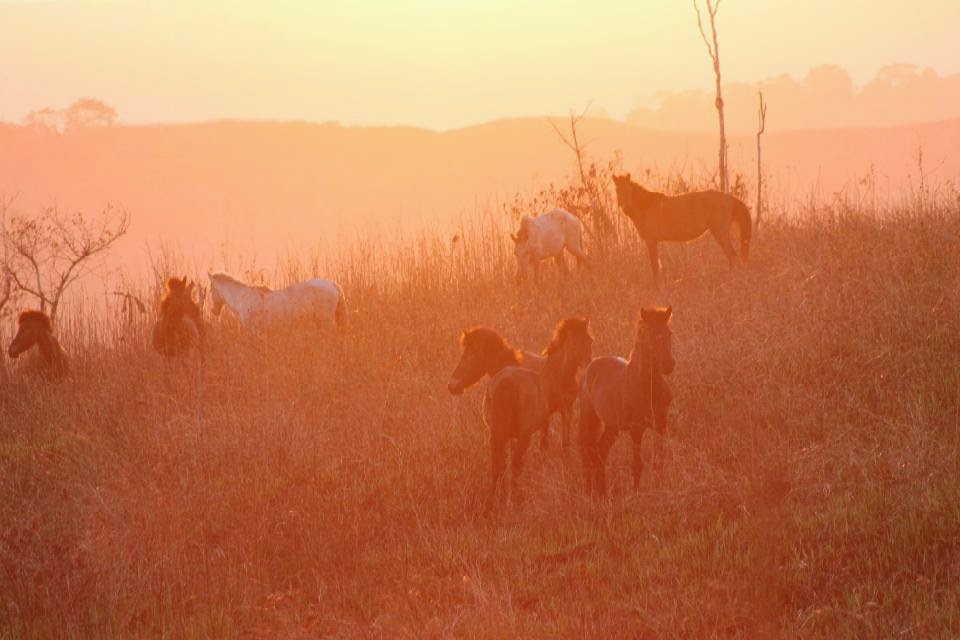
Horses graze in a field on early morning, in
 Waingapu, on Indonesia's Sumba island,
on September 24, 2014 (AFP Photo/
Chris McCall)
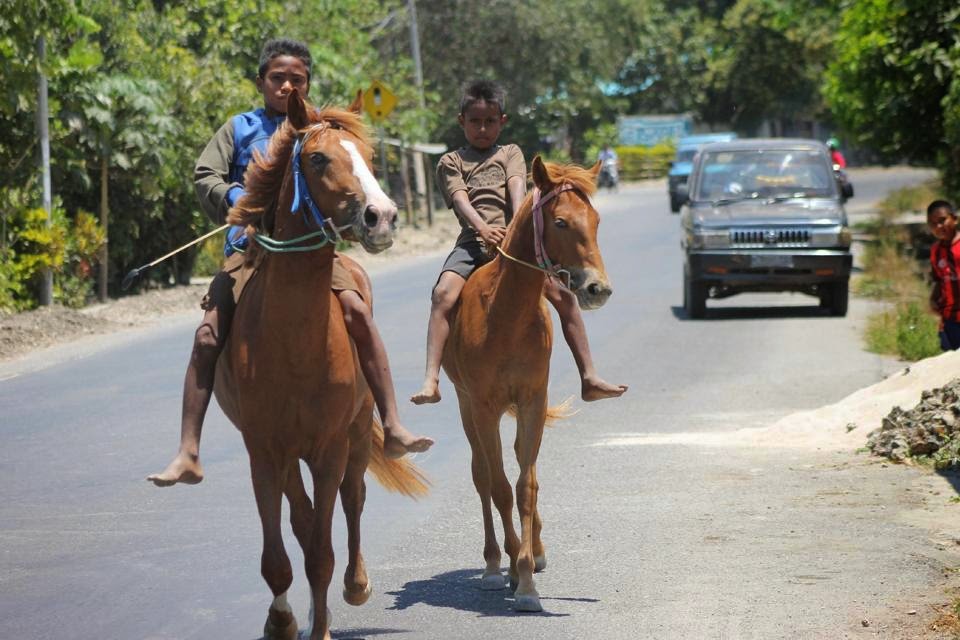
"We start by climbing on horses in the hills. We learn by ourselves," Marampa told AFP, highlighting that horse-riding is deeply ingrained in the local culture of the poor, central Indonesian island, and a source of pride for the young jockeys.

Sumba is famous throughout Indonesia for its child jockeys and 'Sandel' horses named after the sandalwood that was once exported from the island.

The small, fast animals are found across the island, and are widely believed to be descended from steeds once ridden by the fierce Mongol warriors in war.

The influence of horses is everywhere -- one of the focal points of Waingapu is a statue showing boys riding horses, and ceremonial battles on horseback are played out every year, evoking ancient clashes between rival clans on the island.

Races are held frequently and are typically riotous affairs, with lots of illegal gambling and frequent fights when one punter's horse loses. Children occasionally fall from their horses and break limbs, although deaths are rare.

Police sometimes have to step in and cancel events but it would be difficult to axe them all. Not only are horses and horse-racing woven into the fabric of the arid island's local culture, large amounts of money are at stake.

Big cash prizes

Many local people have chosen to invest in racehorses, as cash prizes for important events are as much as 10 million rupiah (about $830) -- a huge amount in a country where many live on less than $2 a day.

As competition intensifies, larger horses, cross-breeds with Australian steeds, have started to appear. They tend to be taller and stronger, and do better.

Child rights activists have long been calling for the practice of youngsters racing to be banned but realise they face an uphill battle against local traditions.

Sumba child jockeys ride their horses to Waingapu race track, on Indonesia's
Sumba island, on September 21, 2014 (AFP Photo/Chris McCall)

"The worst part of all of this is that it puts children in danger," said Arist Merdeka Sirait, chairman of the national commission for child protection.

However local residents insist that precautions are taken to ensure the youngsters are well prepared before they start racing.

When jockeys reach their late teens, they generally retire, and some go on to train younger riders. The boys are slowly introduced to the race track, said Abraham Endruyan Wunu, a local teacher who assists with the training.

A ceremony based on local beliefs is also performed, which is aimed at ensuring they do not feel pain, he added.

However, most adults prefer being spectators to taking part. Civil servant Julianus Amahu said that, while he owns a racehorse himself, he would be reluctant to join a band of youngsters galloping with abandon round a track.

"I would be scared," the 42-year-old admitted.

Monday, July 14, 2014

The Kenya Dayak’s ‘Journey Home’ to Their Tribal Roots

Jakarta Globe, Tunggul Wirajuda, Jul 14, 2014

Filmmaker David Metcalf will host a fundraiser exhibition in August to fund his
 film ‘The Journey Home’, which aims to raise awareness about the importance
 and wisdom of indigenous culture in Indonesia and around the world. (Photo
courtesy of David Metcalf)

To foreign observers the 800 inhabitants of the village of Setulang live in a rustic idyll at the edge of a pristine forest. But these members of the Kenya Dayak that live in the North Kalimantan district of Malinau yearn for a paradise steeped in the traditions of their tribe.

“I left our original homelands when I was a small boy. But I have happy memories of my time growing up in the forests and playing in the rivers,” says Pilius, a village elder, who last saw his ancestral lands in 1969.

The land that Pilius remembers is an area of forests which they call Tala Olen , or “the forbidden forest.”

The tribesmen, particularly the elders, feel a spiritual connection to Tala Olen’s forests, rivers and land, located in an area called Long Saan, which is an eight-day journey by canoe up the Kayan River.

There are strict cultural rules about cutting down the trees in the forest or damaging it in any way, a reverence that has not changed despite their move to Setulang for economic reasons. The draw of Tala Olen is also felt by their descendants who are charmed by the elders’ stories of paradise.

“My grandfather told me many stories of growing up [in Tala Olen ] and how they lived back then. His description of it made it look like paradise,” says Herman, a young villager. “I would love to visit and pay my respects to him.”

But the Kenya Dayak’s ancient way of life and their culture of preserving the forest is under threat. Here in Kalimantan, logging and dam projects are destroying huge swathes of the forest.

Environmentalists estimate that over 52 percent of Kalimantan’s forests has already been lost.

“We don’t exactly know what will happen in the future. Will the next generation keep our agreement [to conserve the land], or will they damage it, and open new land to loggers to serve their self interest?” Kenya Dayak elder Kole Adjang asks.

“ We hope that by example [sic], our great grandchildren will also take care of our land and Tala Olen.”

Taking the Dayak’s home

In the face of these threats to Borneo’s cultural history, photographer David “Dayak Dave” Metcalf is seeking to help reunite the Dayak with their ancestral homelands.

As with many indigenous peoples throughout Indonesia, such as the Asmat and Kamoro tribes of Papua or the Badui in Java, the Kenya are hampered by poverty. As such, they can’t afford the cost of the journey to Tala Olen .

Metcalf seeks to provide the means for the villagers to revisit their homelands, a journey that he intends to chronicle in a film he will title “ The Journey Home .”

“I came up with the idea of granting the tribe their dream of visiting their ancestors’ burial grounds deep in the heart of the forest,” says the Bali-based New Zealander, adding that the journey entails more than the just the nostalgia of homecoming.

“We need to raise funds to make the film. As things currently stand, the logistics are only sufficient to take six elders to Long Saan,” says Metcalf, who is also the author of “ Indonesia’s Hidden Heritage: Cultural Journeys of Discovery ,” a chronicle of his travels through Indonesia.

Metcalf is putting on a fundraiser at the opening of an exhibition on indigenous photography in Jakarta’s Kunstkring Paleis cultural exhibition hall on Aug. 12.

The evening, which will feature eminent Indonesian designer Harry Darsono and New Zealand Ambassador David Taylor, will include performances of traditional Dayak dances.

“We hope that through raising funds to bring the elders back to their ancestral village and making a multimedia documentary about the journey, we can raise awareness of the threats to their unique way of life,” Metcalf says.

He adds that similar events will also be held at the American Club. To date, Metcalf has raised about $2,000 of the estimated $25,000 that he needs for project.

Filmmaker David Metcalf will host a fundraiser exhibition in August to fund his
 film ‘The Journey Home’, which aims to raise awareness about the importance
 and wisdom of indigenous culture in Indonesia and around the world. (Photo
courtesy of David Metcalf)

Collective effort

“The Journey Home” will be shot by a film crew from seven nations; among them New Zealand, Australia and South Africa. They include American documentary filmmaker Jason Houston, who was known for his work with the Dayak in the Malaysian side of Borneo, Robby, a member of the Indonesian world music group Navicula, and Bali-based artist Wolfgang Widmoser, whose work inspired much of the look for the Hollywood blockbuster “Avatar.”

Native American Kevin Locke, an elder from the Lakota Sioux tribe, will also be taking part. While the cultural connection between the Dayak and native Americans is very strong, Locke’s participation marks the first time that a connection between these two cultures has been undertaken.

“One of the primary purposes of [“The Journey Home”] is to raise awareness in Indonesia and other countries about the importance and wisdom of indigenous cultures around the world. This journey is about connecting cultures through art, dance, song and ancient wisdom,” Metcalf says.

“By creating a wider expression and voice for indigenous cultures globally, we can find common ground through music and dance and ancestral prayers.”

Most of all, the film will showcase Kalimantan and its place in the world.

“Kalimantan is Asia’s Amazon, representing 1 percent of the earth’s surface but 5 percent of its flora and fauna, including untold numbers of trees and plants still undiscovered by mankind. As one of the most ecologically diverse landscapes on the planet, we want to raise awareness about the Dayak people that live in Kalimantan’s forests and rivers,” Metcalf says.

“This is all the more imperative, as Kalimantan is also facing the fallout from coal and gold mining, the latter which is poisoning its streams, aside from better known problems like illegal logging and deforestation.”

Metcalf and his team of filmmakers plan to release “The Journey Home” in Indonesia and abroad by the end of this year. He also plans to pitch the film to Discovery Channel and National Geographic.

To help Metcalf and the Kenya Dayaks in their quest, contact him at www.fundrazr.com.

Related Articles:


"... Some of you will walk into the forest and you'll feel it. It surrounds you with its love and beauty. Gaia speaks to you. The trees are pushing out oxygen with a benevolent system of photosynthesis. The plants give you oxygen and you give them carbon dioxide. What a system! Look around. Science will say that system happened by accident - a random occurrence. Do you believe that? What a beautiful system! The trees themselves know who you are. You walk into the forest and you feel it hug you, but perhaps another is next to you who came with a chainsaw. They don't care and they don't feel it. To them, the forest is only a resource. What's the difference between the two of you? There's no judgment here, I'm just asking you. What do you think the difference is? The answer: You're letting multidimensional awareness in and they are not. You see, you are becoming more aware of multidimensional soul communication. In this case, it's your enormous soul energy communicating with the other parts of the planet who are also multidimensional.

When you make the decision that it's OK to feel this energy, it will be there. Most of humanity so far has not made that decision. They block it. The law is this - this communication will come to you only with your allowance. The moment you open the door of allowance, you may begin to feel it. Those are our rules.

It's not just allowance for communication from the creative source, but also from an amazing number of what we would call other benevolent energies. These others are represented by groups with names that you have given them. They also cannot get through to you unless you allow it. That's their rule as well. Your names for them are Pleiadians, Arcturians, Sirians, Hathors or those from Orion. There are many more, but unless you open to the possibility of them, they can't communicate either.

Most of humanity will stand next to you as you communicate and think you're not well. That's the way it looks to them. Listen, dear ones, the benevolent groups who represent your DNA essence [your seed biology] and who know who you are are many. The amount of help you have on this planet is staggering, yet the majority of humanity will not allow awareness of it or let the possibility into their reality.. ..."