Robber fly - Nature photographer Thomas Shahan specializes in amazing portraits of tiny insects. It isn't easy. Shahan says that this Robber Fly (Holcocephala fusca), for instance, is "skittish" and doesn't like its picture taken.

Nature by Numbers (Video)

"The Greater Akashic System" – July 15, 2012 (Kryon Channelling by Lee Caroll) (Subjects: Lightworkers, Intent, To meet God, Past lives, Universe/Galaxy, Earth, Pleiadians, Souls Reincarnate, Invention: Measure Quantum state in 3D, Recalibrates, Multi-Dimensional/Divine, Akashic System to change to new system, Before religion changed the system, DNA, Old system react to Karma, New system react to intent now for next life, Animals (around humans) reincarnate again, This Animal want to come back to the same human, Akashic Inheritance, Reincarnate as Family, Other Planets, Global Unity … etc.)

Question: Dear Kryon: I live in Spain. I am sorry if I will ask you a question you might have already answered, but the translations of your books are very slow and I might not have gathered all information you have already given. I am quite concerned about abandoned animals. It seems that many people buy animals for their children and as soon as they grow, they set them out somewhere. Recently I had the occasion to see a small kitten in the middle of the street. I did not immediately react, since I could have stopped and taken it, without getting out of the car. So, I went on and at the first occasion I could turn, I went back to see if I could take the kitten, but it was to late, somebody had already killed it. This happened some month ago, but I still feel very sorry for that kitten. I just would like to know, what kind of entity are these animals and how does this fit in our world. Are these entities which choose this kind of life, like we do choose our kind of Human life? I see so many abandoned animals and every time I see one, my heart aches... I would like to know more about them.

Answer: Dear one, indeed the answer has been given, but let us give it again so you all understand. Animals are here on earth for three (3) reasons.

(1) The balance of biological life. . . the circle of energy that is needed for you to exist in what you call "nature."

(2) To be harvested. Yes, it's true. Many exist for your sustenance, and this is appropriate. It is a harmony between Human and animal, and always has. Remember the buffalo that willingly came into the indigenous tribes to be sacrificed when called? These are stories that you should examine again. The inappropriateness of today's culture is how these precious creatures are treated. Did you know that if there was an honoring ceremony at their death, they would nourish you better? Did you know that there is ceremony that could benefit all of humanity in this way. Perhaps it's time you saw it.

(3) To be loved and to love. For many cultures, animals serve as surrogate children, loved and taken care of. It gives Humans a chance to show compassion when they need it, and to have unconditional love when they need it. This is extremely important to many, and provides balance and centering for many.

Do animals know all this? At a basic level, they do. Not in the way you "know," but in a cellular awareness they understand that they are here in service to planet earth. If you honor them in all three instances, then balance will be the result. Your feelings about their treatment is important. Temper your reactions with the spiritual logic of their appropriateness and their service to humanity. Honor them in all three cases.

Dian Fossey's birthday celebrated with a Google doodle

Dian Fossey's birthday celebrated with a Google doodle
American zoologist played by Sigourney Weaver in the film Gorillas in the Mist would have been 82 on Thursday (16 January 2014)
Showing posts with label Justice. Show all posts

Thursday, February 20, 2020

Bird traders face fine, jail for dyeing parrots different colours

DutchNews, February 19, 2020 

A yellow-headed Amazon. Photo: Lizzy Foulkes via Wikimedia Commons
A father and son from Zaandam accused of fraudulently exporting parrots by dyeing their feathers and beaks different colours and falsifying paperwork are facing a €7,500 fine and a year in prison respectively, broadcaster NOS reports. 

The public prosecutor said the pair, who trade in exotic birds, had been flaunting export rules for years, particularly when it came to health tests and certificates. The paperwork is necessary, officials say, to protect countries against bird flu, virulent Newcastle disease and psittacosis, which can also affect people. 

The son also stands accused of dyeing certain parrot species different colours in order to export them to countries which restrict the import of some parrots but not of others. 

Apart from dyeing the animals’ feathers he also dyed the beaks of 28 yellow headed Amazons so they would look like a yellow-crowned Amazon which are subject to less stringent import rules. 

In 2015 and 2016 the son was caught at Schiphol trying to ship a consignment of painted birds to Taiwan, many of which dead or dying. 

Complaints about fraudulent dealings by the two have been accumulating since 2008, NOS said.

Thursday, November 7, 2019

Malaysia hands jail term to laundrette cat killer

Yahoo – AFP, November 6, 2019
A Malaysian man was sentenced to 34 months in jail for killing a pregnant cat
by stuffing it into a laundrette dryer (AFP Photo/Jeff Haynes)

Kuala Lumpur (AFP) - A Malaysian man who killed a pregnant cat by putting it into a laundrette dryer has been sentenced to 34 months in jail, official media reported, in a case that sparked outrage.

K. Ganesh was handed the prison term Tuesday after being found guilty of breaking animal protection laws at the self-service laundry outside Kuala Lumpur in September last year, official news agency Bernama reported.

He will remain free on bail for now as he plans to appeal.

The 42-year-old was the second man to be sentenced over the killing after a taxi driver was jailed for two years for the crime in January.

Malaysians reacted with fury when CCTV footage went viral showing the cat being stuffed into the dryer late at night.

Two men then inserted tokens into the machine to set it running and left. A female customer later found the animal's carcass and the matter was reported to the police.

Sentencing Ganesh, Judge Rasyihah Ghazali said: "I hope this sentence will serve as a lesson to the accused and the public to not be cruel to animals."

He was also fined 40,000 ringgit ($9,700), Bernama reported late Tuesday. AFP could not immediately contact Ganesh's lawyers.

A third person was earlier detained over the killing but prosecutors dropped the case.

Tuesday, October 29, 2019

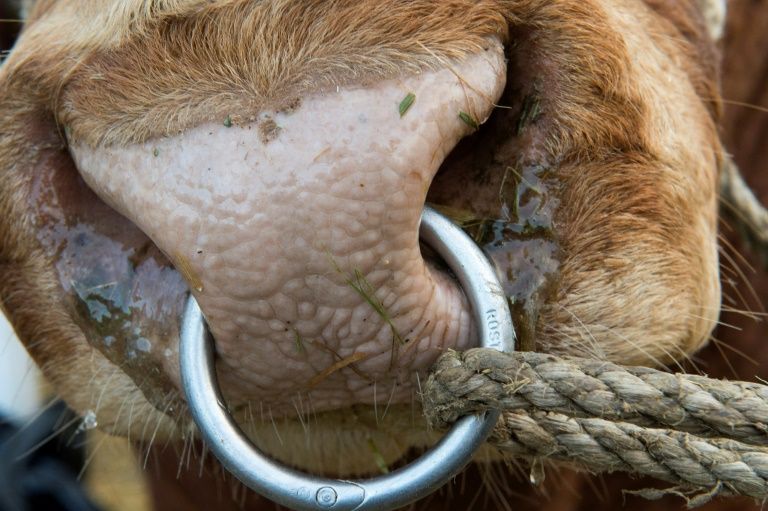
'Justice for Jerry': Runaway bull charms Croatia

Yahoo – AFP, October 28, 2019

The bull, dubbed "Jerry", escaped from a Croatian slaughterhouse last Friday
and has been on the lam ever since (AFP Photo/Thierry Zoccolan)

Zagreb (AFP) - The plight of a fugitive one-year-old bull named Jerry has won hearts in Croatia after the animal escaped from a slaughterhouse last Friday and has been on the lam ever since.

Charmed by the 650-kilogramme (1,433-pound) brown bovine's jailbreak, Croatians are calling for his life to spared.

"Justice for Jerry" and "Hang in there Jerry!" read some of the comments rooting for the bull on social media.

A cat-and-mouse game has emerged as police, veterinarians and hunters help search for the bull, who was nicknamed after the mouse in the iconic Tom and Jerry cartoon series.

The bull's owner, Ivan Bozic, has pledged to save the animal's life if he is captured.

"Since he managed to escape a certain death he will certainly stay alive," he told local media.

The owner of the slaughterhouse, based outside the coastal town of Split, said he is still baffled at how the animal managed to escape.

"I simply don't know how it happened. Apparently, pure force defeated technology," Petar Skejo told local media of how the bull appeared to have slipped out of a corral where cattle intended for slaughter are kept.

He took off into the woods and was later seen by locals near a hill, but again evaded capture.

"We wanted to catch him alive but when we approached him he jumped skilfully like a cat on a rock... and disappeared in the bushes," Skejo told state-run HRT television.

One politician, MP Ivan Pernar, has also come out in support for the beast.

"Jerry I wish you all the luck in the world," he wrote on Facebook.

Saturday, July 27, 2019

Seven dead tigers found in car in Vietnam

Yahoo – AFP, July 26, 2019

Three Vietnamese men were arrested after police found seven dead tigers
in their car (AFP Photo/Nam GIANG)

Hanoi (AFP) - A haul of frozen tiger carcasses found in a car in Hanoi has led to the arrest of a key wildlife trafficking suspect, Vietnamese state media said Friday, as the country tries to tackle a well-worn smuggling route from Laos.

Nguyen Huu Hue, who is believed to have smuggled animals in from neighbouring Laos for years, was arrested Thursday with two other people after seven dead tigers were discovered in their vehicle at a parking lot, according to Cong An Nhan Dan newspaper.

"Hue set up a company... which sells building material as a cover for the illegal trading of tigers and wildlife," Cong An Nhan Dan, the official mouthpiece of the Ministry of Public Security, reported.

All seven tigers appeared to be cubs, according to photos of the seizure.

It was not immediately clear if the dead tigers had come from the wild or from the many illegal tiger farms in Laos, which supply much of Asia's demand for tiger meat and parts.

Police have previously busted several other members of the same wildlife trafficking ring, which has been running for several years from a central province which shares a border with Laos.

Vietnam is both a consumption hub and popular smuggling route for illegal wildlife -- from tigers to elephant tusks, pangolins and rhino horn.

Some of it is destined for domestic consumption in Vietnam, while the rest is smuggled on to China.

Tiger parts are used for traditional medicine or jewellery in Vietnam, where the once-large population of the endangered cats has dwindled dramatically.

Their bones are commonly boiled down and mixed with rice wine to make an elixir believed to treat arthritis and promote strength.

The smugglers' arrest in Hanoi follows a record seizure in Singapore this week of nearly nine tonnes of ivory and a huge stash of pangolin scales destined for Vietnam.

Hanoi has long vowed to crack down on the illegal wildlife trade, though conservationists say the black market persists thanks to weak law enforcement.

Saturday, October 6, 2018

Dutch dog supplier ‘to make payment’ to injured Palestinian boy: NRC

DutchNews, October 5, 2018

Photo: Depositphotos.com 

A Dutch dog supplier is going to pay compensation to a Palestinian boy bitten by one of its animals on the command of the Israeli army, reports the NRC

‘Four Winds Policedog Center’ in Geffen has reportedly reached a financial settlement with the boy because it sold the dog to the army. 

The company reportedly said in a statement that it ‘regrets the incident’ in 2014 and its physical and psychological consequences on the young man, Hamzeh Hashem. 

The NRC claims that the firm does not admit legal liability, stating that the dog was trained by the Israeli army, but was paying Hashem ‘as a contribution to his recovery’ and as a gesture of goodwill. 

Four Winds’ website claims that it trains dogs ‘to a high level to help reduce terrorism and crime’ but it has now reportedly stopped supplying the Israeli army. 

Hashem had sued the company through Dutch lawyer Liesbeth Zegveld, who told NRC that this is ‘the first time a Dutch firm has paid for violence in the occupied Palestinian territories.’ 

DutchNews.nl has contacted Four Winds K9 – the current business name of the company which has an identical website to Four Winds Policedogs Center – and Liesbeth Zegveld to confirm the report.

Thursday, June 21, 2018

Minister pledges action after slaughterhouse animal abuse is revealed

DutchNews, June 20, 2018

Photo: Despositphotos.com 

Dutch farm minister Carola Schouten says she will tighten up the rules on abattoir closures and increase fines for animal cruelty following revelations about conditions in Dutch slaughterhouses. 

An item on RTL Nieuws, based on government inspectors’ reports, said that 48 fines had been handed down to 19 abattoirs which process cows, sheep and pigs over the past two years because of serious animal welfare issues. 

Inspectors had seen several instances of pigs being placed in vats of very hot water when they were anaesthetised but still alive and trying to swim. The animals were then held under the water by slaughterhouse workers until they drowned. 

In another case, calf was skinned alive. The inspector wrote: ‘despite the calf’s movements, the slaughterman went ahead with removing the skin from its head.’ 

There were also 16 cases of animals being dismembered while they were still alive because their carotid artery had not been properly cut, RTL Nieuws said.   

Millions

Every year some 15 million pigs, 2 million cows and 500,000 sheep are killed in the Netherlands’ 180 slaughterhouses. 

Fines for breaking the law range from €500 for a ‘slight infringement’ to €10,000 for a very serious or repeat offences. 

MPs from across the political spectrum have now called on the minister to get tough. In particular, they say fines should be increased and abattoirs which are multiple offenders should be closed down. 

‘This is absolute horror for the animals,’ said Esther Ouwehand of the pro-animal PvdD. ‘We are supposed to believe that everything is so well arranged here in the Netherlands. But a slaughterhouse which skins an animal alive, drowns them in a piping hot bath or chucks them in the bin should be shut down.’

Friday, May 11, 2018

Bangladesh puppy killer sentenced

Yahoo – AFP, May 10, 2018

Activists have in recent years successfully campaigned to stop mass cullings
of street dogs in Dhaka and other cities (AFP Photo/MUNIR UZ ZAMAN)

A Bangladeshi security guard was handed a jail sentence on Thursday for burying alive two dogs and their 14 puppies, in what activists hailed as the country's first ever animal cruelty conviction.

Mohammad Siddique, who buried the dogs in polythene sacks, "was sentenced to six months in jail and fined 200 taka ($2.50)," prosecutor Forkan Mia told AFP after the trial in Dhaka.

Animal rights campaigners, who have long lobbied for replacing the South Asian country's colonial-era laws on animal maltreatment, said they hoped the sentence would act as a deterrent.

"The fact that this case was heard by the magistrate is a major achievement," said Rakibul Haq Emil from animal rights group the PAW Foundation, who brought the case.

"I am sure it will send a warning message that it won't be easy to get away with cruel treatment to animals in Bangladesh," he said.

The bodies of the dogs were discovered in October in a Dhaka neighbourhood. But despite outrage from campaigners, police were initially reluctant to take up the case.

Cruelty towards animals is commonplace in Bangladesh but activists have in recent years successfully campaigned to stop mass cullings of street dogs in the capital and other major cities.

Friday, December 29, 2017

Cambodian cops ruffle feathers by eating 92 fighting cocks

Yahoo – AFP, December 28, 2017

Cambodian netizens cried foul over the court order to kill the seized cocks
(AFP Photo/GIANLUIGI GUERCIA)

Cambodian police ruffled feathers on Thursday after they killed -- and ate -- 92 roosters that were seized earlier this month during a raid on an illegal cockfighting ring allegedly run by a relative of premier Hun Sen.

The birds were rounded up by police after they shuttered the two rural cockfighting dens on December 4 and arrested Hun Sen's nephew-in-law Thai Phany.

Thai Phany, a Cambodian-Australian citizen, was charged with running an illegal gambling operation -- a rare legal move against a member of Hun Sen's powerful family.

But while the raids were welcomed in a country teeming with official corruption, a court order to slaughter all 92 birds set off a flurry of criticism Thursday as netizens cried foul over the animals being given a harsher sentence than the people involved.

Scores of people were initially detained in the police raid, but most have since been released after receiving light suspended sentences, according to local media.

"Warrant to kill chickens! Where are the chicken owners, aren't they freed?" Hing Soksan wrote on Facebook, where photos of the slaughter have been circulating.

"The court's achievement by the end of 2017: death sentence for 92 fighting cocks," another Facebook user quipped about a justice system many decry as toothless against the graft underpinning Hun Sen's authoritarian regime.

Roeun Nara, Kandal province's deputy police chief, confirmed that the birds were killed on Wednesday following a warrant from the provincial court.

"We gave the chickens to our forces to eat," he told AFP, brushing off the online criticism.

The court document, seen by AFP on Thursday, said the slaughter was ordered "to prevent the offense from happening again and to speed up the investigation proceedings."


Tuesday, June 13, 2017

Costa Rica says no to animal cruelty

Yahoo – AFP, June 11, 2017

People celebrated in the streets of San Jose after a new law which establishes
 fines and prison sentences for those who harm an animal (AFP Photo/Ezequiel
BECERRA)

San José (AFP) - Thousands of animal lovers packed a major San Jose avenue Sunday, many with pups in tow, to celebrate Costa Rica's new animal cruelty law and its fines and jail time for violators.

Bikers, animal rights activists and many animal lovers were on hand dancing to traditional tunes to support the law, signed this month by the Central American nation's President Luis Guillermo Solis.

"We have got to demand that there be no more impunity; that whoever abuses an animal be punished," Solis said, raising cheers from the crowd.

The parade marshal for the day was Duke, a dog that became well known in local media after someone hacked him with a machete and left him for dead.

In another grim case, local teenagers seriously injured a toucan, pummeling its bill with stones.

"We have just seen too many horrific acts against animals. So it's time that we have a law to ensure that they are punished," said Antonio Pacheco, who turned up with his sweater-wearing schnauzer Tony in tow.

Cockfighting and dog fights also have been outlawed, and can earn criminals jail time.

Thursday, April 13, 2017

Taiwan bans eating dogs and cats

Yahoo – AFP, April 12, 2017

The tradition of eating dog meat dates back hundreds of years in many
Asian countriesView photos (AFP Photo/Hoang Dinh Nam)

Taiwan has banned the eating of dogs and cats, lawmakers said Wednesday, as pressure grows to improve animal welfare after a spate of cruelty cases that stirred public outrage.

Parliament passed legislation to outlaw the consumption, purchase or possession of dog and cat meat, with offenders facing a fine of up to Tw$250,000 ($8,170).

Authorities can also name and shame those who break the law.

"This shows that Taiwan is a society with advanced animal welfare," said lawmaker Wang Yu-min who proposed the new rules.

The bill also hiked the penalty for killing or abusing animals to a maximum two-year jail term and a stiff fine of Tw$2 million.

Dog consumption -- believed by some in Taiwan to help boost male potency -- was common on the island decades ago but has become less popular amid growing calls to protect animal rights.

In 2001, Taiwan amended its animal protection law to ban the slaughter of pets -- which included dogs and cats -- for food, although there was no penalty on eating or buying the meat.

More than 10,000 canines are killed every year at China's notorious dog meat
festival in Yulin (AFP Photo/JOHANNES EISELE)

Sales of pet meat were banned at the end of 2003.

But a string of much-publicised animal abuse cases have continued to triggered deep public concern and demands for tougher protection laws.

Last year, the military was forced to apologise after a video surfaced of three soldiers torturing and strangling a stray dog to death with an iron chain, prompting several street protests.

And in 2014, a male hippo famous for regularly performing at a private zoo in central Taiwan died after breaking a leg and sustaining other injuries during transportation, sparking a public outcry.

Reactions to the new law were mixed, with some deeming it unfair to only single out cats and dogs for better protection.

"This is the cute animal protection law? only cute animals are protected while the rest deserve to die?" read one message posted on Apple Daily's website.

Dog meat consumption is also common in countries such as China, Indonesia,
Vietnam and South Korea (AFP Photo/SONNY TUMBELAKA)

"Why doesn't the parliament amend laws to toughen punishment on drunk driving, fraud and homicide? what a lousy job it is doing," said another post.

Dog meat consumption is also common in countries such as China, Vietnam and South Korea.

Last year, China's most notorious dog meat festival drew crowds despite international outrage, as more than 10,000 dogs were killed at the event in conditions activists described as brutal.

South Koreans are believed to consume somewhere between 1.5 million - 2.5 million dogs every year, but the meat farming industry is in decline, with little demand among the younger generation.

In Vietnam, cat meat -- known locally as "little tiger" -- is also a delicacy and although officially banned it is widely available in specialist restaurants.

Saturday, December 17, 2016

Dutch Supreme Court upholds ban on fur farming

DutchNews, December 16, 2016

The Dutch Supreme Court has rejected a claim from fur farmers that the pending ban on fur farming conflicts with their human rights. 

The ban on fur farming was introduced in the Netherlands in 2013 and included an 11-year changeover period. In 2014 a lower court found in favour of fur farmers who are furious at being ordered to shut down their companies without compensation.

The state appealed against that ruling and last year the appeal court said the new legislation does take the interest of fur farmers sufficiently into account because of the 11-year changeover period. 

Fur farmers then took their case to the Supreme Court which has now upheld the ban again. ‘There is a balance between the fundamental rights of mink farmers and the general interest which is served by the new law,’ the court said in its ruling. 

The Netherlands has some 160 fur farms producing five million pelts a year. The sector employs some 1,400 people. The Netherlands is the third biggest fur farming nation in the world behind Denmark and China.

Related Articles:


Thursday, September 22, 2016

No exceptions to cosmetics animal testing ban: top EU court

Yahoo – AFP, September 21, 2016

The European Court of Justice said EU law bars any cosmetic product containing
 ingredients which have been tested on animals, wherever that may occur (AFP
Photo/Emmanuel Dunand)

Brussels (AFP) - The EU's top court on Wednesday ruled that there can be no exceptions to a ban on animal testing by cosmetics manufacturers in the bloc.

The case arose in Britain after three companies sought to market cosmetics that were developed for sale in China and Japan using animal tests outside the European Union.

The European Court of Justice said EU law bars any cosmetic product containing ingredients which have been tested on animals, wherever that may occur.

"The Court states next that EU law makes no distinction depending on where the animal testing was carried out," the Luxembourg-based ECJ said in a statement.

The law aims to promote the use of alternative methods to meet consumer safety standards and that "objective would be seriously compromised if the prohibitions... could be circumvented by carrying out the animal testing in third countries," it said.

The European Federation for Cosmetic Ingredients (EFCI), which brought the case, had argued that the companies did not break the law since the animal testing had been carried out to comply with regulations in third countries.

Tuesday, September 20, 2016

Dutch fur farm ban must go back to court, advocate general says

DutchNews, September 19, 2016

A legal case in which the Dutch fur farmers association took on the state to have an impending ban overturned must be heard again, the advocate general said on Monday. 

The appeal court which upheld the ban on fur farming last year did not take the financial impact on individual fur farmers sufficiently into account, Paul Vlas said in his recommendations. The advice of the advocate general is not binding but generally accepted by the Supreme Court. 

The ban on fur farming was introduced in the Netherlands in 2013 and included an 11-year changeover period. In 2014 a lower court  found in favour of fur farmers who are furious at being ordered to shut down their companies without compensation. 

The state appealed against that ruling and last year the appeal court said the new legislation does take the interest of fur farmers sufficiently into account because of the 11-year changeover period.

Financial damage

However, the advocate general said on Monday the appeal court ‘wrongly limited its reasoning to the question of whether the changeover period would limit the damage to fur farmers in general’. 

The Supreme Court will publish its ruling in December. 

The Netherlands has some 160 fur farms producing five million pelts a year. The sector employs some 1,400 people. The Netherlands is the third biggest fur farming nation in the world behind Denmark and China.

Related Article:


Wednesday, December 23, 2015

Indonesia punishes firms over deadly forest fires

Yahoo – AFP, December 22, 2015

Indonesia is punishing more than 20 companies in an unprecedented move for
starting deadly forest fires that killed 19 people (AFP Photo/Adek Berry)

Jakarta (AFP) - Indonesia is punishing more than 20 companies in an unprecedented move for starting deadly forest fires that killed 19 people, a government official said Tuesday.

Three companies have been shut down permanently after having their licences revoked over their role in the blazes that choked vast expanses of southeast Asia with acrid haze and cost Indonesia $16 billion.

It is the first time the government has revoked company licences over forest fires, an annual occurrence caused by slash-and-burn land clearance.

The environment ministry also froze the operations of 14 companies and said they face closure if they do not meet the government’s demands over fire prevention.

Several other companies have been given a strong warning and will be put under close supervision.

"We have sanctioned 23 companies in total, ranging from administrative sanctions to license revocation, while 33 others are still in the process, they could have their licenses revoked too if they are found guilty," environment ministry official Kemal Amas told AFP.

The ministry has been investigating 276 companies in total since the fires broke out in September.

Three companies have been shut down permanently by Indonesia after having
 their licences revoked over their role in the blazes that choked vast expanses of 
southeast Asia with acrid haze (AFP Photo/Adek Berry)

"We need firmer law enforcement so that this catastrophe does not repeat itself, it’s been going on for 18 years but nobody has learnt their lesson," Amas said.

Amas said the ministry was also working hard to restore the forests and farmland destroyed in the fires.

Activists welcomed the government’s new commitment to punish firms.

The Indonesian Forum for Environment said it was unheard of for the government to revoke licences, as many companies previously avoided facing trial.

"The minister has the courage to not only freeze the companies' operation but also chase the owners in a civil case, this is great and this must be guarded carefully," Kurniawan told AFP.

"In the past some people were named suspects, but for them to actually lose their licenses, this is the first time," he said.

More than half a million people suffered acute respiratory infections in Indonesia because of the haze, while many in neighbouring Singapore and Malaysia also fell ill.

Wednesday, November 11, 2015

Dutch appeal court upholds fur farming ban

DutchNews, November 10, 2015

Photo: Romoro via Depositphotos.com
The ban on fur farming introduced in the Netherlands in 2013 has been upheld by the appeal court in The Hague. 

A lower court last year found in favour of fur farmers who are furious at being ordered to shut down their companies without compensation. The appeal court, however, said on Tuesday that the new legislation does take the interest of fur farmers sufficiently into account because of the 11 year changeover period. 

Fur farmers said in a reaction to Tuesday’s ruling that they will take the issue to the high court. ‘We have already said that we will pursue this case to the bitter end,’ a spokesman for the fur farmers association NFE told news agency ANP.

 ‘We are extremely puzzled as to why last year the court found in our favour and now opinions have changed. This is both a surprise and a disappointment, because we had not expected it,’ the spokesman said.

The ban on fur farming came into effect on January 15, 2013 and included an 11-year transition for existing companies. 

The Netherlands has some 160 fur farms producing five million pelts a year. The sector employs some 1,400 people. The Netherlands is the third biggest fur farming nation in the world behind Denmark and China.

Wednesday, September 9, 2015

S.Africa animal rights group tries to stop big game hunt

Yahoo – AFP, 8 Sep 2015

South African animal rights group the NSPCA has obtained a warrant in its attempt 
to stop a week-long large game hunt that could see hundreds of animals die (AFP
Photo/Issouf Sanogo)

Johannesburg (AFP) - South African animal rights group the NSPCA on Monday said it has obtained a warrant in its attempt to stop a week-long large game hunt that could see hundreds of animals die.

Game such as gemsbuck, wildebeest, warthogs, and impalas have already been killed in the hunt, the group said, which is set to take place on a private reserve in the Limpopo region.

Critics say the method of killing, which involves tracking the beasts then driving them toward hunters waiting on special platforms, though legal is cruel as animals are often only wounded and then left to die a slow and painful death.

The NSPCA was granted a warrant by a South African court, and can bring charges against the organisers if they see signs of cruelty towards animals during the hunt.

"Our team has successfully obtained a warrant to gain access to the farms for the next four days," the National Council of Societies for the Prevention of Cruelty to Animals in South Africa said on its Facebook page.

During a week-long game hunt animals are driven toward hunters waiting on 
special platforms, and though legal is cruel as animals are often only wounded 
and then left to die a slow and painful death (AFP Photo/Alexander Joe)

"Please be assured that we are doing everything possible to stop the hunt."

The controversy comes just over two months after Cecil the lion was killed by an American recreational game hunter in Zimbabwe, causing a global outcry against inhumane hunting.

The NSPCA said some animals have already been killed during the organised hunt.

"We can confirm that 18 animals were killed today, including gemsbuck, eland, wildebeest, warthogs, impala and duiker," said the Facebook post.


Walt Palmer, left, and one of his many trophies.

Thursday, July 16, 2015

Conflict of interest claims over Malaysian timber imports

DutchNews.nl, July 15, 2015

Dutch government ministers have accused environmental groups Greenpeace and the World Wildlife Fund of having a conflict of interest in the approval of imports of Malaysian timber, Trouw reports. 

The government said earlier this week the Netherlands will support the import of Malaysian timber with an MTCS certificate rather than FCS certification, which is backed by the environmental groups. 

Junior environment minister Wilma Mansveld and junior economic affairs minister Sharon Dijksma say in a parliamentary briefing that ‘in concrete terms, several NGOs which were involved in founding the FSC certification system want to promote it’. 

This, the ministers imply, is why Greenpeace and the WWF do not support MTCS certification. 

However, WWF spokesman Jaap van der Waarde told Trouw the accusations of a conflict of interest are ‘incomprehensible’. 

‘The fact that my organisation forms part of the board of another certification system is irrelevant,’ he said. ‘The Malaysian certification system does not do the job.’ 

Economic interests

Malaysian forests are still being cut down and ‘it would appear that if the economic interests are big enough, certification systems do not need to meet Dutch sustainability targets,’ he told the paper. 

Successive Dutch governments have wrestled with the approval of Malaysian timber and both an independent commission and the Dutch courts have ruled there is no question of Malaysian timber being harvested sustainably, Trouw says. 

The ministers argue that the problems have now been solved and that a ‘final check’ will be made to ensure Malaysian timber imported into the Netherlands does come from sustainable sources.

Wednesday, June 10, 2015

Indian court bans Mumbai's horse-drawn carriages

Yahoo – AFP, 9 June 2015

Mumbai's ornate horse-drawn carriages are nearing the end of the road after a
 court in the Indian city ruled them illegal, saying owners must wind up operations
within a year (AFP Photo/Punit Paranjpe)

Mumbai's ornate horse-drawn carriages are nearing the end of the road after a court in the Indian city ruled them illegal, saying owners must wind up operations within a year.

The silver-coloured Victorias -- styled on open carriages used during Queen Victoria's reign -- have been plying Mumbai's streets since British colonial times, and for years have been a tourist attraction.

But on Monday the Bombay High Court agreed with animal welfare groups, who had petitioned for a ban citing poor treatment of the horses, that the practice was cruel.

"We hold that the use of horse-driven carriages... for joy rides is completely illegal," read the court verdict.

It ordered the city government to "ensure that the use of such horse-driven carriages... shall be completely stopped on expiry of a period of one year from today".

The court also ruled that all related stables must be closed down and directed local authorities to come up with a scheme to help the estimated 700 people involved in the trade.

The jazzy carriages were once a mode of transport for former Bombay's wealthy classes, but they now carry tourists around the historic Colaba district and Marine Drive promenade in the south of the city.

A horse-drawn carriage is pictured on the city's iconic Marine Drive promenade
in Mumbai (AFP Photo/Indranil Mukherjee)

They are often seen outside the luxury Taj Mahal Palace hotel and Gateway of India monument and have also appeared in several Bollywood movies.

But concerns over unlicensed stables and poor treatment of the horses saw the Animals and Birds Charitable Trust, with the support of PETA India, lodge a case in Mumbai's top court.

PETA, People for the Ethical Treatment of Animals, had claimed the horses were often malnourished, denied adequate rest or veterinary care and were forced to stand in their own waste in sub-standard stables.

Manilal Valliyate, from PETA India, applauded the decision, saying "Mumbai's Victoria industry is inherently cruel and dangerous".

Related Article: