Robber fly - Nature photographer Thomas Shahan specializes in amazing portraits of tiny insects. It isn't easy. Shahan says that this Robber Fly (Holcocephala fusca), for instance, is "skittish" and doesn't like its picture taken.

Nature by Numbers (Video)

"The Greater Akashic System" – July 15, 2012 (Kryon Channelling by Lee Caroll) (Subjects: Lightworkers, Intent, To meet God, Past lives, Universe/Galaxy, Earth, Pleiadians, Souls Reincarnate, Invention: Measure Quantum state in 3D, Recalibrates, Multi-Dimensional/Divine, Akashic System to change to new system, Before religion changed the system, DNA, Old system react to Karma, New system react to intent now for next life, Animals (around humans) reincarnate again, This Animal want to come back to the same human, Akashic Inheritance, Reincarnate as Family, Other Planets, Global Unity … etc.)

Question: Dear Kryon: I live in Spain. I am sorry if I will ask you a question you might have already answered, but the translations of your books are very slow and I might not have gathered all information you have already given. I am quite concerned about abandoned animals. It seems that many people buy animals for their children and as soon as they grow, they set them out somewhere. Recently I had the occasion to see a small kitten in the middle of the street. I did not immediately react, since I could have stopped and taken it, without getting out of the car. So, I went on and at the first occasion I could turn, I went back to see if I could take the kitten, but it was to late, somebody had already killed it. This happened some month ago, but I still feel very sorry for that kitten. I just would like to know, what kind of entity are these animals and how does this fit in our world. Are these entities which choose this kind of life, like we do choose our kind of Human life? I see so many abandoned animals and every time I see one, my heart aches... I would like to know more about them.

Answer: Dear one, indeed the answer has been given, but let us give it again so you all understand. Animals are here on earth for three (3) reasons.

(1) The balance of biological life. . . the circle of energy that is needed for you to exist in what you call "nature."

(2) To be harvested. Yes, it's true. Many exist for your sustenance, and this is appropriate. It is a harmony between Human and animal, and always has. Remember the buffalo that willingly came into the indigenous tribes to be sacrificed when called? These are stories that you should examine again. The inappropriateness of today's culture is how these precious creatures are treated. Did you know that if there was an honoring ceremony at their death, they would nourish you better? Did you know that there is ceremony that could benefit all of humanity in this way. Perhaps it's time you saw it.

(3) To be loved and to love. For many cultures, animals serve as surrogate children, loved and taken care of. It gives Humans a chance to show compassion when they need it, and to have unconditional love when they need it. This is extremely important to many, and provides balance and centering for many.

Do animals know all this? At a basic level, they do. Not in the way you "know," but in a cellular awareness they understand that they are here in service to planet earth. If you honor them in all three instances, then balance will be the result. Your feelings about their treatment is important. Temper your reactions with the spiritual logic of their appropriateness and their service to humanity. Honor them in all three cases.

Dian Fossey's birthday celebrated with a Google doodle

Dian Fossey's birthday celebrated with a Google doodle
American zoologist played by Sigourney Weaver in the film Gorillas in the Mist would have been 82 on Thursday (16 January 2014)
Showing posts with label Monkeys. Show all posts

Thursday, March 5, 2020

Rare albino orangutan spotted in Borneo rainforest

Yahoo – AFP, March 4, 2020

Alba, the world’s only known albino orangutan, was released back into the wild
in late 2018 (AFP Photo/Handout)

The world's only known albino orangutan has been spotted alive and well in a Borneo rainforest, more than a year after she was released into the wild, conservationists say.

Alba, a blue-eyed primate covered in fuzzy white hair, was taken in 2017 from a cage where she was being kept as a pet by villagers in Indonesia's section of Borneo, known as Kalimantan.

Alba was released back into the wild in late 2018.

This week, the Borneo Orangutan Survival Foundation said Alba was spotted as it monitored three other orangutans who were recently released.

"After we learned that she can build nests, forage independently and is no longer dependent on human assistance we concluded that she can survive in the forest," said Indra Exploitasia, the environment ministry's director of biodiversity conservation.

Alba's rescue was some rare positive news for the critically endangered species, which has seen its habitat shrink drastically over the past few decades largely due to the destruction of forests for logging, paper, palm oil and mining.

Plantation workers and villagers are sometimes known to attack the animals because they see them as a pest, while poachers also capture them to sell as pets.

Wednesday, September 18, 2019

Indonesia's toxic haze affecting Borneo's orangutans – rescuers

Yahoo – AFP, 17 September 2019

Orangutans at a rehabilitation centre in Nyaru Menten, central Kalimantan are
showing signs of respiratory illness as a result of choking forest fires

Massive forest fires in Indonesia that have caused a toxic haze to spread as far as Singapore and peninsular Malaysia are also seriously affecting endangered orangutans and their habitat, a rescue foundation said Tuesday.

Jakarta has deployed thousands of troops as temporary fireman and deployed dozens of water-bombing aircraft to battle blazes that are turning pristine forest into charred landscape in Sumatra and Borneo islands.

The fires -- usually started by illegal burning to clear land for farming -- have unleashed a choking haze across parts of southeast Asia.

The Borneo Orangutan Survival Foundation said Tuesday that the haze was affecting hundreds of great apes in its care at rescue centres and wildlife re-introduction shelters.

"The thick smoke does not only endanger the health of our staff... but also it affects the 355 orangutans we currently care for", the foundation said in a statement, referring to just once cetre in Kalimantan.

The toxic haze was so bad in parts of Kalimantan that rescuers at an 
Orangutan shelter were keeping the great apes indoors for much of the day

"As many as 37 young orangutans are suspected to have contracted a mild respiratory infection," it added.

Conditions were so bad at their Samboja Lestari facility in East Kalimantan that outdoor activities for the animals had been restricted to a few hours a day.

Orangutans have been particularly vulnerable to commercial land clearances and have seen their natural habitat shrink dramatically in the last few decades.

The population of orangutan in Borneo has plummeted from about 288,500 in 1973 to about 100,000 today, according to the International Union for Conservation of Nature.

The toxic smoke caused by the forest fires is an annual problem for Indonesia and its neighbours, but has been worsened this year by particularly dry weather.

On Borneo island, which Indonesia shares with Malaysia and Brunei, pollution levels were "hazardous", according to environment ministry data.

Hundreds of schools across Indonesia and Malaysia were shut.

Monday, July 15, 2019

Let's talk about gay penguins: Munich zoo joins Pride week

Yahoo – AFP, Pauline CURTET, July 13, 2019

Biologists say giraffes are bisexual. In some groups, 90 percent of the acts
observed are in fact homosexual in nature (AFP Photo/Christof STACHE)

Munich (Germany) (AFP) - Organisers of this year's Gay Pride week in Munich have a group of rather wild partners -- penguins, giraffes and lions at the city zoo where tours are being run about same-sex love in the animal kingdom.

The Munich zoo has joined Pride week with an unusual look into the intimate lives of all creatures great and small, seeking to boost tolerance among humans.

"It is important for us to talk about" homosexuality in the animal kingdom and show that same-sex love has its place in Nature, said Munich zoo spokesman Dennis Spaeth.

"Because unfortunately in Germany we see more and more people from the reactionary right attacking LGBTQI rights."

While even mostly-Catholic Bavaria has grown more accepting and lawmakers legalised gay marriage in 2017, non-heterosexuals are sometimes still a target for violence.

Police recorded 91 attacks based on the victim's sexual orientation last year.

In the safe confines of the zoo, the first stop on the Pride tour is the giraffes. The blotchy animals spare visitors only occasional curious glances from behind their long eyelashes as they enjoy a meal of hay.

"Giraffes are bisexual. In some groups, 90 percent of the acts observed are in fact homosexual in nature," explained biologist Guenter Strauss.

The Munich zoo has joined Pride week with an unusual look into the intimate lives
of all creatures great and small, seeking to boost tolerance among humans (AFP 
Photo/Christof STACHE)

A few enclosures down, there is little to distinguish a male-male couple of black-faced Humboldt penguins squatting together from other, mixed pairs.

That is until the guide points out that with no egg to care for, the pair has taken to brooding a rock instead.

This is no one-off fling, as "penguins conduct homosexual relationships that can last a whole lifetime, something very rare in the animal kingdom," said Strauss.

Scientific taboo

In fact, hundreds of animal species, from elephants to snakes and birds, display homosexual behaviour.

But unlike most humans, the sexual preference of our four-legged or feathered friends is often quite fluid.

"Among people, we grow up with a specific sexual orientation. That's often not true for animals," said Strauss.

Unlike most humans, the sexual preference of our four-legged or feathered friends 
is often quite fluid (AFP Photo/Christof STACHE)

"They are in fact bisexual. They adopt certain sexual behaviour at specific moments."

One case in point are lions, and the zoo's male big cat greets the group with a loud roar.

"Servus!" responded Strauss in a regional greeting redolent of traditional, conservative Bavarian culture.

"Eight percent of sex acts among lions are homosexual. As for lionesses, they only show lesbian behaviour when they're kept in captivity," he explained.

While same-sex love among animals is commonplace, the topic was long a taboo for scientists of more hidebound eras.

"On one expedition to the South Pole at the start of the 20th century, a doctor saw males (penguins) copulating -- but he left out the pages dealing with the behaviour when he published the results of his research," Strauss recounted.

Considered unpalatable back then, the valuable pages were only rediscovered "eight or nine years ago" in a library in Britain, he added.

Times have changed since then.

London Zoo, for its contribution to Pride week, mounted a banner above its penguin beach, declaring: "Some penguins are gay. Get over it," a nod to a human anti-homophobic campaign.

Friday, March 8, 2019

Chimps' cultural diversity threatened by humans, study says

Yahoo – AFP, March 7, 2019

Researchers who studied 144 chimpanzee communities in Equatorial Africa found
31 behaviors that varied from one group to another (AFP Photo/ISSOUF SANOGO)

Washington (AFP) - Like humans, chimpanzees are culturally diverse but those differences are being eroded by human incursion, international researchers say in a groundbreaking study published Thursday.

The striking results, published in the American journal "Science," show that the behavioral diversity of chimpanzees was reduced by an average 88 percent in areas with the highest human impact, compared to remote pristine forests.

In the tropical rainforests and savanna woodlands that are the chimpanzees' natural habitat, the researchers observed 31 behaviors that were not universal or innate among chimpanzees and varied from one group to another, in a total of 144 chimpanzee communities studied in 17 Equatorial African countries where the animals live.

Reflecting the diversity, not all communities of chimpanzees use the same tools to hunt or dig. Neither do they extract termites and ants in the same way. Ditto for honey and nuts. Their use of stones, ponds and caves also varies.

Researchers assume this diversity is passed between individuals within the group.

They based their findings on existing studies supplemented with their own field observations of 46 communities over the past nine years.

Such data had never before been compiled on chimpanzee behavior, the researchers said. Until now, scientists have focused on the loss of genetic diversity, or human-caused population decline.

Their findings mean that the more humans disturbed the environment with roads, infrastructure, deforestation, agriculture, plantations and so on, the less chimpanzee behavior was diverse.

For instance, researchers have observed areas where nut cracking had ceased.

"These are very noisy behaviors, and hunters could locate you easily," Hjalmar Kuehl, an ecologist at the German iDiv research center and the Max Planck Institute for Evolutionary Anthropology, told AFP as a hypothesis of why the behavior may have been lost.

Another example of noisy and potentially vulnerable behavior: "accumulative stone throwing" by chimpanzees in Guinea-Bissau, a form of communication where chest-pumping apes throw rocks at trees.

Fishing for algae with sticks, seen in Guinea, is also threatened by encroaching humans.

"Our findings suggest that strategies for the conservation of biodiversity should be extended to include the protection of animal behavioral diversity as well," said Kuehl.

He proposes to create "Chimpanzee cultural heritage sites," a concept that can be extended to other species with high degrees of cultural variability, including orangutans or whales.

Sunday, December 23, 2018

Rare albino orangutan released back into the wild

Yahoo – AFP, December 21, 2018

'Alba', the only albino orangutan ever recorded in the world, was rescued by
environmentalists from a cage where she was being kept as a pet by villagers
(AFP Photo/Handout)

Jakarta (AFP) - The world’s only known albino orangutan has been released back into the jungle more than a year after she was found emaciated and bloody in a remote corner of Borneo, an Indonesian NGO said Friday.

Environmentalists rescued "Alba" from a cage where she was being kept as a pet by villagers in Central Kalimantan in April last year.

She was found with dry blood smeared around her nose -- the result of her violent capture -- and weighed just 8 kilogrammes, the Borneo Orangutan Survival Foundation (BOSF) said.

The blue-eyed primate, covered in fuzzy white hair, was on Wednesday returned to the wild with her best friend, Kika, after leaving their rehabilitation centre.

The blue-eyed primate, covered in fuzzy white hair, returned to the wild with her best 
friend, Kika, after more than a year in a rehabilitation centre (AFP Photo/Handout)

"So far she's showing good signs of adapting," Nico Hermanu, a BOSF spokesman, told AFP.

"She's been climbing trees as high as 35 metres (about 115 feet) and has been eating fruit from the forest."

Kika and Alba -- who is six years old and now 28 kilos -- will be monitored by conservation teams at Bukit Baka Bukit Raya National Park.

The rescue is a rare spot of bright news for the critically endangered species, which has seen its habitat shrink drastically over the past few decades largely due to the destruction of forests for logging, paper, palm oil and mining.

The rescue is a rare spot of bright news for the critically 
endangered species, which has seen its habitat shrink 
drastically over the past few decades largely due to
the destruction of forests (AFP Photo/Handout)

The population of orangutans in Borneo has plummeted from about 288,500 in 1973 to about 100,000 today, according to the International Union for Conservation of Nature.

A string of fatal attacks on the great apes this year have been blamed on farmers and hunters.

Four Indonesian men were arrested over the killing of an orangutan shot some 130 times with an air rifle in February.

Borneo police have also arrested two rubber plantation workers and accused them of shooting an orangutan multiple times before decapitating it.

Plantation workers and villagers are sometimes known to attack the animal because they see it as a pest, while poachers also capture them to sell as pets.


Albino orangutans are rare on Borneo island, where most have
reddish-brown hair (AFP Photo/HANDOUT)

Related Article:


Tuesday, December 18, 2018

75,000 cacti, monkeys and ivory seized in anti wildlife trafficking campaign

DutchNews, December 17, 2018

Photo: Depositphotos.com

Some 75,000 cacti, monkeys, coral and kilos of ivory are among the items seized by Dutch officials in a major drive against wildlife trafficking, which took place between September and mid November. 

Operation Toucan is a national campaign in support of the CITES endangered species treaty, which also aims to build up a better picture of smuggling routes and boost public awareness about the illegal trade in plants and animals. 

This year, officials, police and customs experts were involved in raids across the country and on the Dutch Caribbean islands. In total, there were 217 separate investigations. 

The haul of illegal goods ranged from Korean face creams containing endangered types of the Aloe plant, a parcel containing six live snakes from the US and two dead toucans which had been sent from Uruguay to the Netherlands. 

Officials also picked up two live monkeys which were being kept as pets. Officials also confiscated rare tropical hardwood which was to be used as wall panelling and took coral from tourists on Bonaire who were planning to take it home. On the last day of the campaign, police seized seven kilos of ivory at a collectors fair in Utrecht. 

New this year was the involvement of the Meld Misdaad Anoniem crime tip-off hotline, the nature and farm ministry said. 

The ministry also said on Monday that from next March all trading in raw ivory in the Netherlands will be banned. Selling ivory dating from 1990 onwards was already illegal but this will be extended to cover the entire trade because of fraud with certificates and the difficulty in differentiating between new and old ivory, the minister said. 

The ministry is also working to set up a network of places where people can hand over ivory or plants and animals which may be on the CITES list.

Sunday, September 16, 2018

Friday, January 26, 2018

Friday, June 23, 2017

Man stopped on Thai border with orangutans, tortoises, raccoons

Yahoo – AFP, June 22, 2017

The tiny orangutans rescued at the Thai border were less than six
months old (AFP Photo/Handout)

Thai wildlife officers have arrested a Malaysian man attempting to smuggle two baby orangutans, 51 tortoises and six raccoons into the kingdom across its southern border, officials said Thursday.

The animals were packed into plastic boxes and suitcases loaded into Ismail Bin Ahmad's car, officials said.

The 63-year-old was stopped Wednesday as he was attempting to drive through a border checkpoint in Thailand's southern Songkhla province -- part of an insurgency-torn region known as a funnel for drugs, weapons and other contraband.

"The suspect said he was hired to transport the animals from (neighbouring) Perlis state in Malaysia to Hat Yai (in Thailand) for 1,000 baht ($33 dollars)," Prach Kongthong, a wildlife officer manning the checkpoint, told AFP.

The tiny orangutans were less than six months old and will be transferred to a local shelter, he added.

The seized animals, including orangutans, were packed into suitcases and plastic
boxes (AFP Photo/Handout)

Orangutans are native to the islands of Borneo and Sumatra but they are often illegally smuggled throughout mainland Southeast Asia, either for private zoos or as pets.

Most of the 51 rescued reptiles were Indian star tortoises -- an endangered species from South Asia coveted for its star-patterned shell.

Thailand has long served as a transit hub for wildlife products bound for major markets like Vietnam and China, where exotic animal parts are often used in folk medicines.

Thai police frequently seize trafficked animals and wildlife products but they usually only catch low-level couriers, leaving the smuggling kingpins behind the lucrative trade at large.

In December Thai police rescued two baby orangutans in a sting operation that saw undercover officers pose as buyers over a mobile phone messaging app.

Wednesday, May 3, 2017

Rare albino orangutan rescued on Borneo island

Yahoo – AFP, May 2, 2017

Albino orangutans are rare on Borneo island, where most have
reddish-brown hair (AFP Photo/HANDOUT)

A rare albino orangutan has been rescued on the Indonesian part of Borneo island where villagers were keeping the white-haired, blue-eyed creature in a cage, a protection group said Tuesday.

In an extremely unusual discovery, authorities picked up the female, estimated to be five years old, in a remote village in Kapuas Hulu district.

The Borneo Orangutan Survival Foundation (BOSF), which is caring for the critically endangered ape -- believed to be albino -- said the organisation had never before in its 25-year history taken in such an orangutan.

Normal Bornean orangutans have reddish-brown hair.

Villagers said they captured the ape -- who has not yet been named -- on Thursday. Authorities rescued the ape two days later.

"Orangutans are rare, and an albino orangutan is even rarer," Nico Hermanu, a BOSF spokesman, told AFP.

"Since BOSF was founded 25 years ago, we had never before taken in an albino orangutan at our rehabilitation centre."

Orangutans on Borneo have seen their habitat shrink dramatically as the
 island's rainforests are increasingly turned into oil palm, rubber or paper 
plantations (AFP Photo/HANDOUT)

Pictures showed dried blood around the creature's nose, with the foundation saying the injury could have been sustained when the ape was fighting the villagers' attempts to capture it.

The orangutan has been taken to BOSF's rehabilitation centre for further assessment. Almost 500 orangutans are kept at the centre.

The Bornean orangutan, which along with the Sumatran orangutan are Asia's only great apes, is classified by the International Union for Conservation of Nature as "critically endangered" -- just one step away from extinction.

Around 100,000 are estimated to live on Borneo, which is divided between Malaysia, Brunei and Indonesia, down from 288,500 in 1973 and with their numbers expected to shrink to 47,000 by 2025, according to the IUCN.

The creatures have seen their habitat shrink dramatically as the island's rainforests are increasingly turned into oil palm, rubber or paper plantations, and are sometimes targeted by villagers who view them as pests.

Friday, February 24, 2017

Baby orangutan rescued after being kept as a pet

Yahoo – AFP, February 23, 2017

Seven-month-old Vena was rescued by wildlife officals and environmentalists
from someone who had illegally kept her as a pet (AFP Photo/ADEK BERRY)

Baby primate Vena shyly turned her head away from a bottle as two vets tried to feed her, the latest Bornean orangutan rescued in Indonesia after being kept as a pet.

Villagers on the Indonesian part of jungle-clad Borneo island often keep the critically endangered apes as pets even though the practice is illegal.

Wildlife officials and environmentalists rescued seven-month-old Vena earlier in February from someone in Kendawangan district who had been looking after her.

Vena is now being cared for at a centre run by NGO International Animal Rescue (IAR), whose staff ensure she stays clean by regularly changing her diapers and feed her bottles of milk mixed with vitamin supplements.

Last year IAR saved 22 orangutans that were either kept as pets or whose natural jungle habitat had been destroyed by huge forest fires started to clear land for plantations.

Even when they are well looked after, such as in Vena's case, environmentalists stress keeping orangutans as pets is bad because it means they will later struggle to survive in the wild.

"Many people don't realise that keeping orangutans as pets is illegal and could make them lose their instincts for living in the wild," said Ruswanto, an official from the wildlife protection agency who like many Indonesians goes by one name.

Villagers on the Indonesian part of jungle-clad Borneo island often keep
orangutans as pets even though the practice is illegal (AFP Photo/ADEK BERRY)

Vena was being kept as a pet by a lady called Bariah, who found the ape in a neighbouring village. She was rescued after villagers reported the case to authorities.

It was the second time Bariah, a mother of seven, was caught illegally caring for a baby ape -- she already had to give one up to IAR in 2016.

"I know orangutans are protected, I was not killing or harming them, I was only taking care of them," the 50-year-old told AFP.

After being rescued, young apes are sent to a "jungle school", where they spend years learning to fend for themselves before being released into the wild.

Rampant logging and the rapid expansion of paper and palm oil operations have reduced their habitat, with about 100,000 estimated to remain in the wild on Borneo, which is divided between Indonesia, Malaysia and Brunei.

The International Union for the Conservation of Nature last year changed its classification of the Bornean orangutan from "endangered" to "critically endangered".

Wednesday, January 11, 2017

Oh deer: monkey caught in flagrante delict-doe

Yahoo – AFP, January 10, 2017

Picture released on January 10, 2017 by the Issekinicho publishing house shows
 an inter-species sexual behaviour between a male Japanese macaque and female
sika deer, in Yakushimaru, Japan (AFP Photo/Alexandre Bonnefoy)

Paris (AFP) - Scientists on Tuesday revealed the "highly unusual" behaviour of a male monkey filmed trying to have sex with female deer in Japan -- a rare case of inter-species nookie.

Sex between animals from different species is uncommon, but exceptional cases are known to occur, chiefly in domesticated and captive animals, scientists reported in the journal Primates.

Mating is usually driven by the need to procreate, while sex across the species line is mostly fruitless or yields sterile offspring.

For the new study -- only the second on the phenomenon of inter-species sex -- a Japanese macaque or "snow monkey" was filmed mounting at least two female Sika deer much larger than itself.

Without penetration, the young monkey makes sexual movements while riding on the does' backs on Japan's Yakushima Island.

On some occasions its impertinence was tolerated but at other times the deer bolted and ran. The monkey ejaculated on the backs of the does, which licked the seminal fluid, researchers said.

"No ambiguity is possible, it is clearly sexual behaviour," study co-author Marie Pele of the University of Strasbourg, France, told AFP.

Furthermore, the monkey appeared to "guard" the targets of its affection, chasing away other male macaques.

The scientists speculated the behaviour may be driven by "mate deprivation" in a community where competition for females is stiff, boosted by a surge of hormones in the breeding season.

"Sometimes young males, like the one in the study, do not have access to females in their social group as these are claimed by older males," said Pele.

"This young macaque... did not have access to females, but was very excited. It took advantage of the presence of the doe."

Snow monkeys and Sika deer live in close proximity at Yakushima -- the deer eat food the monkeys drop from the trees, and sometimes feed on their faeces.

The team said further study is necessary to understand the origins of interspecies sexual behaviour, including zoophilia -- when humans are sexually attracted to animals.

The only other published scientific study on inter-species sexual behaviour was the much-publicised 2014 report of fur seals forcing themselves on penguins in Antarctica, the authors said.

A video of the monkey and the deer can be seen here: http://www.edge-cdn.net/video_1106810?playerskin=37016

Friday, August 5, 2016

Orangutan Infant Found Abandoned in C. Kalimantan

Jakarta Globe, Norjani & Ratri M. Siniwi, August 05, 2016

A baby orangutan held by a resident of West Kalimantan's Kubu Raya district, in
this October 2015 file photo. (Antara Photo/Jessica Helena Wuysang)

Jakarta. An infant Bornean orangutan was found abandoned in a rubber plantation in Sampit, Central Kalimantan, on Thursday morning (04/08).

"At sunset [last night], I heard what sounded like someone wailing, which turned out to be the orangutan. It was sitting in a rubber tree in my plantation. Then this morning I saw that there was no mother, and I took it to Sampit and reported it [to the authorities]," local resident Martono said, as reported by state-run news agency Antara.

The Central Kalimantan Natural Resources Conservation Agency (BKSDA) went to Martono's house to examine the infant, and established that it is an 18-month-old female. Infant orangutans are completely dependent on their mothers for the first two years of their lives.

"An orangutan mother would never leave her child. We cannot conclude whether the mother was killed, but what is clear is that the infant has been rescued,"Sampit BKSDA post commander Muriansyah said.

According to Martono, it was his first time seeing an orangutan in the area, as most of the trees in his rubber plantation have burned down, making it hard for the animals to survive and find food. He said he pitied the infant as she looked malnourished, and suspected that she was starving.

"I was scared that the baby [orangutan] would die [from hunger]; I reported it so the officials could save her. I gave her a banana, but she only ate a little of it," Martono said.

The infant has been taken to the BKSDA regional office at Pangkalan Bun in West Kotawaringin district. According to the officials, orangutans can take up to two years of rehabilitation before they are ready to be released into their natural habitat.

The Natural Resources Conservation Agency (BKSDA) in Central Kalimantan claims that this is the 10th orangutan reported by Sampit residents so far this year.

The Bornean orangutan is a cousin of the Sumatran orangutan, both of which have been listed in the International Union for Conservation of Nature's Red List of critically endangered animals, due to population loss driven by hunting and habitat degradation.

Friday, November 20, 2015

US government ends research on all chimpanzees

Yahoo – AFP, 19 Nov 2015

Captive chimpanzees were listed as endangered by the US Fish and Wildlife
Service last year (AFP Photo/Yasuyoshi Chiba)

Washington (AFP) - Chimpanzees will no longer be used for US government research and the remaining 50 chimps in federal custody will be sent to a sanctuary for retirement, health authorities said.

The decision by the National Institutes of Health came two and a half years after the agency announced it would phase out most of its biomedical research using chimpanzees, which are humans' closest living relative and share 98 percent of the same genes.

Since 2013, no new applications for research using chimps have been approved, and last year, captive chimps were listed as endangered by the US Fish and Wildlife Service.

The NIH said the endangered designation requires researchers to obtain an extra permit for any experiments that could harm the animal, and that no such permits have been sought.

"As a result of these numerous changes over the last few years and the significantly reduced demand for chimpanzees in NIH-supported biomedical research, it is clear that we've reached a tipping point," NIH director Francis Collins said in a statement.

"In accordance with NIH's commitment in June 2013, I have reassessed the need to maintain chimpanzees for biomedical research and decided that effective immediately, NIH will no longer maintain a colony of 50 chimpanzees for future research."

The NIH-owned chimps are "now eligible for retirement" at the Federal Sanctuary System operated by Chimp Haven in Keithville, Louisiana, Collins said.

The NIH said it will continue to use other non-human primates for research.


Thursday, October 15, 2015

Pregnant chimp adopts orphan in 'unheard of' act

Yahoo – AFP, 14 Oct 2015

Baby chimp Boon - who was orphaned when his mother Soona died shortly after 
he was born on October 9, 2015 - clings to his new adopted mother Zombi in 
Monarto Zoo, southeast of Adelaide, Australia (AFP Photo/David Mattner)

Sydney (AFP) - An Australian zoo Wednesday unveiled a baby chimp adopted by a pregnant female in an "unheard of" act after his mother died during birth.

The baby, whose name Boon means blessing, was orphaned when mum Soona died shortly after he was born at Monarto Zoo, southeast of Adelaide, late last week.

The adoption of another female's baby by a 
pregnant female, an "unheard of" act amoungst
 chimps, has happened at Monarto Zoo in
Australia (AFP Photo/David Mattner)
But in a heartwarming twist, the "strong" and "healthy" infant was immediately adopted by fellow chimp Zombi, who had remained by Soona's side as she died.

The zoo's senior primate keeper Laura Hanley said she did not know of anywhere else in the world where a pregnant chimpanzee had taken on the role of surrogate to another infant, so close to a birth of her own.

"I'm humbled by what we've seen from the chimpanzee troop over the last few days -- it's unheard of to see a heavily pregnant chimpanzee adopt an orphaned newborn infant," she said in a statement as the "miracle" baby made his public debut.

"From the minute she first cradled the newborn, she's been amazing -- grooming, supporting and nursing the little man as though he was her own.

"The unique situation certainly reinforces the strong bond our chimps share and the similarities these amazing creatures have with their closest living relative, us."

Hanley said she was optimistic Zombi would continue to care for Boon once her own baby was born later this month.

Monday, July 13, 2015

Liberia's 'Planet of the Apes' chimps facing starvation

Yahoo – AFP,  Zoom Dosso, 12 July 2015

Chimpanzees used by The New York Blood Centre for testing and released on 
Monkey Island in Liberia face starvation as the island has no fresh water or food
and the US body has withdrawn funding for their care (AFP Photo/Zoom Dosso)

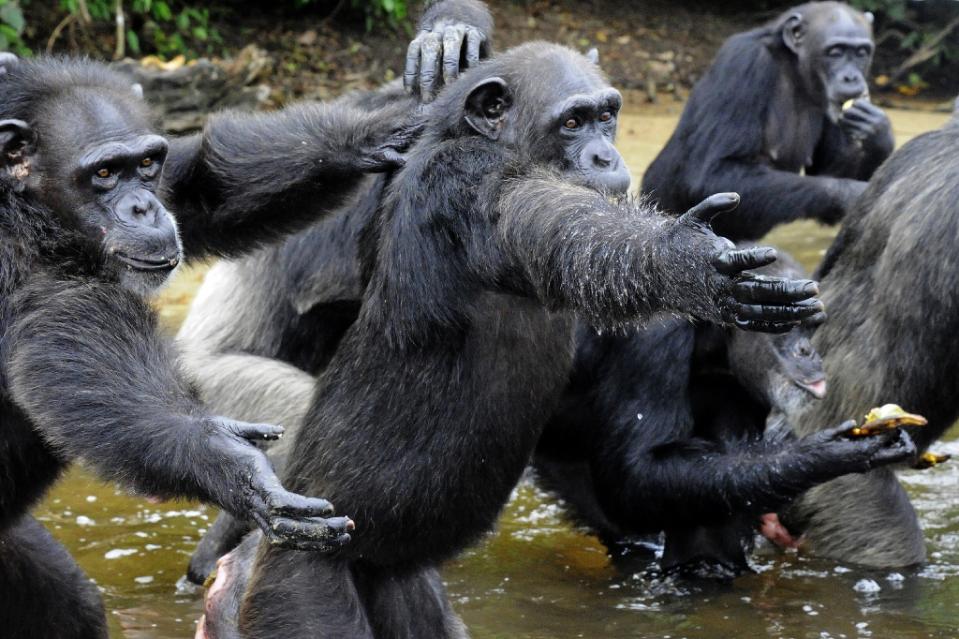
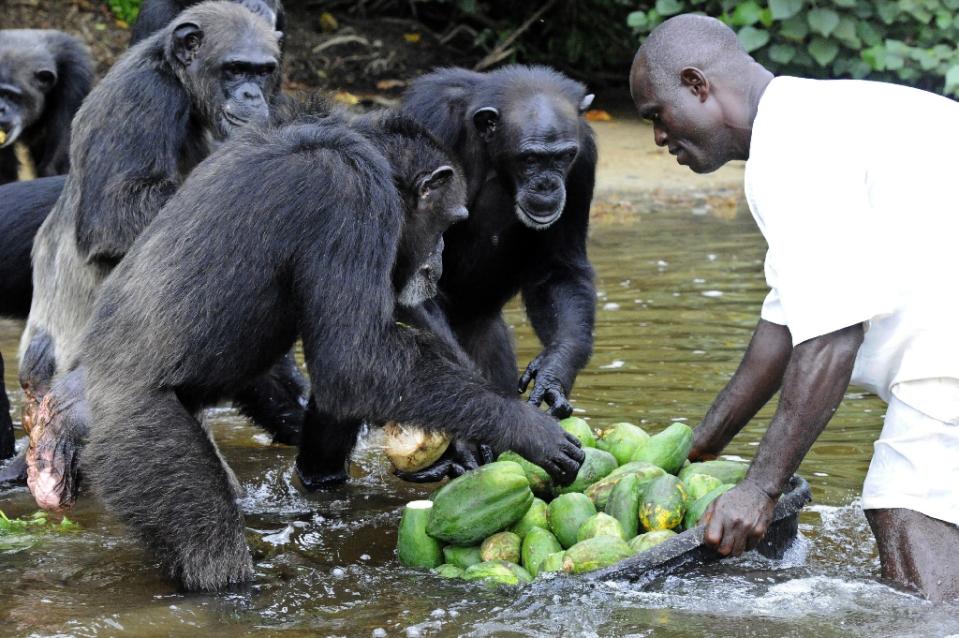
Monkey Island (Liberia) (AFP) - A speedboat laden with fruit approaches and four chimpanzees come bounding over from the dense forest, screeching excitedly as volunteers throw them pineapple and mango chunks.

The apes are part of a colony of former research lab captives enjoying retirement uncaged on an atoll deep in the jungle of southern Liberia, known as Monkey Island.

The only significant inhabitants of the six islets, the chimps have been living an idyllic existence, fed by human volunteers on their very own 'Planet of the Apes' -- a nickname given to the archipelago by local media.

Chimpanzees are fed on Monkey Island, a 
celebrated colony of former research lab
 captives on an atoll deep in the jungle of
 southern Liberia, n June 29, 2015 (AFP
Photo/Zoom Dosso)
But the colony of 66 chimps has been at the centre of an international storm since the New York-based blood bank funding it announced in March it was stopping the cash.

The New York Blood Center (NYBC), which carried out about 30 years of biomedical research on the animals, had publicly committed to their lifelong care after they were retired in 2005.

The Humane Society of the United States (HSUS) is supporting the colony through emergency fundraising as the Liberian government and the blood bank lock horns over who should be responsible for their care.

"NYBC may believe that people will forget and that this will go away, but I can assure you that it won't," HSUS vice-president Kathleen Conlee told AFP in an email from Washington DC.

"They are absolutely responsible for the long-term care of these chimpanzees."

Conlee described the chimps' care costs -- estimated at $30,000 (27,000 euros) a month -- as "a mere drop in the bucket for this organisation that has hundreds of millions in revenue annually".

'Moral obligation'

The Liberia Biomedical Research Institute (LBRI) entered into an agreement with the NYBC in 1974 to carry out research in a lab about 65 kilometres (40 miles) southeast of Monrovia, capturing or buying the chimpanzees.

The research project had gained a world class reputation in the field of viral infections, particularly hepatitis, by the time it ended and the NYBC appeared to make a commitment to the chimps in retirement as a reward for their contribution.

NYBC director Alfred Prince wrote in the American Society of Primatologists Bulletin in 2005 that Monkey Island was to become "a dedicated full-time sanctuary".

The New York Blood Centre, which carried out 30 years of biomedical research 
on this colony of 66 chimpanzees in Liberia, has said it is to stop funding the feeding
and care of the animals - which now face starvation (AFP Photo/Zoom Dosso)

"NYBC recognises its responsibility to provide an endowment to fund the sanctuary for the lifetime care of the chimpanzees," he wrote.

The chimps are entirely reliant on humans for their survival, as there is no year-round fresh water supply or enough food on their islets.

LBRI head Fatorma Bolay said initial emergency funding from the HSUS, pooled with cash from other sources, had probably saved the animals from dehydration and starvation.

World-renowned chimpanzee expert Jane Goodall sent an open letter to the NYBC in May urging the organisation to consider its "moral obligation" to continue funding the chimps' care.

"I find it completely shocking and unacceptable that NYBC would abandon these chimpanzees and discontinue support for even their basic needs," she wrote.

AFP emailed and telephoned the NYBC but the centre did not respond to requests for comment.

'No different from humans'

John Abayomi Zeonyuway, a volunteer at the institute, showed AFP the animals' care routine on a recent visit to Monkey Island, a 25-minute speedboat ride up the John River from Roberts International Airport.

As the boat approached the first of the islets, a nine square-kilometre patch of jungle known as Island Five, a welcoming party of four chimps began screeching and jumping up and down excitedly.

World-renowned chimpanzee expert Jane Goodall sent an open letter to the New York
 Blood Centre in May urging the organisation to consider its "moral obligation" to
continue funding the chimps' care (AFP Photo/Zoom Dosso)

"This is their way of saying that the food is here," Zeonyuway explained as he threw pawpaws, bananas and other fruit for the animals.

Zeonyuway visits the colony every second day, and each time he does a mental roll call to ensure all are present and in good health.

"I can't see Samanta. Bullet is here -- he's already eating," he called out to his crew as the rest of the residents came to join the feast.

The boat then proceeded to Island Four, 15 minutes away, where the clan of 10 apes included four unplanned babies, the result of failed vasectomies, according to the HSUS.

Birth control efforts have since been stepped up so that the population doesn't grow further.

At all six of the islands the routine was the same: an excited greeting and a feast for the animals.

"The chimps are part of me. I am glued to them because I see them every other day," Zeonyuway told AFP.

"They are no different from humans. They fight and they make peace. They need help, they need attention. We cannot afford to lose these animals to hunger and sickness."