Robber fly - Nature photographer Thomas Shahan specializes in amazing portraits of tiny insects. It isn't easy. Shahan says that this Robber Fly (Holcocephala fusca), for instance, is "skittish" and doesn't like its picture taken.

Nature by Numbers (Video)

"The Greater Akashic System" – July 15, 2012 (Kryon Channelling by Lee Caroll) (Subjects: Lightworkers, Intent, To meet God, Past lives, Universe/Galaxy, Earth, Pleiadians, Souls Reincarnate, Invention: Measure Quantum state in 3D, Recalibrates, Multi-Dimensional/Divine, Akashic System to change to new system, Before religion changed the system, DNA, Old system react to Karma, New system react to intent now for next life, Animals (around humans) reincarnate again, This Animal want to come back to the same human, Akashic Inheritance, Reincarnate as Family, Other Planets, Global Unity … etc.)

Question: Dear Kryon: I live in Spain. I am sorry if I will ask you a question you might have already answered, but the translations of your books are very slow and I might not have gathered all information you have already given. I am quite concerned about abandoned animals. It seems that many people buy animals for their children and as soon as they grow, they set them out somewhere. Recently I had the occasion to see a small kitten in the middle of the street. I did not immediately react, since I could have stopped and taken it, without getting out of the car. So, I went on and at the first occasion I could turn, I went back to see if I could take the kitten, but it was to late, somebody had already killed it. This happened some month ago, but I still feel very sorry for that kitten. I just would like to know, what kind of entity are these animals and how does this fit in our world. Are these entities which choose this kind of life, like we do choose our kind of Human life? I see so many abandoned animals and every time I see one, my heart aches... I would like to know more about them.

Answer: Dear one, indeed the answer has been given, but let us give it again so you all understand. Animals are here on earth for three (3) reasons.

(1) The balance of biological life. . . the circle of energy that is needed for you to exist in what you call "nature."

(2) To be harvested. Yes, it's true. Many exist for your sustenance, and this is appropriate. It is a harmony between Human and animal, and always has. Remember the buffalo that willingly came into the indigenous tribes to be sacrificed when called? These are stories that you should examine again. The inappropriateness of today's culture is how these precious creatures are treated. Did you know that if there was an honoring ceremony at their death, they would nourish you better? Did you know that there is ceremony that could benefit all of humanity in this way. Perhaps it's time you saw it.

(3) To be loved and to love. For many cultures, animals serve as surrogate children, loved and taken care of. It gives Humans a chance to show compassion when they need it, and to have unconditional love when they need it. This is extremely important to many, and provides balance and centering for many.

Do animals know all this? At a basic level, they do. Not in the way you "know," but in a cellular awareness they understand that they are here in service to planet earth. If you honor them in all three instances, then balance will be the result. Your feelings about their treatment is important. Temper your reactions with the spiritual logic of their appropriateness and their service to humanity. Honor them in all three cases.

Dian Fossey's birthday celebrated with a Google doodle

Dian Fossey's birthday celebrated with a Google doodle
American zoologist played by Sigourney Weaver in the film Gorillas in the Mist would have been 82 on Thursday (16 January 2014)

Tuesday, January 19, 2016

Dog bless you: pets head to church in Spain

Yahoo – AFP, January 18, 2016

A priest blesses a dog to mark San Anton Abad's Day in Churriana, near Malaga
on January 17, 2016 (AFP Photo/Jorge Guerrero)

Madrid (AFP) - Dogs, cats, rabbits and even iguanas, many decked out in colourful sweaters to keep warm, trooped into Spanish churches for a blessing on the Day of Saint Anthony, patron saint of animals.

Pet-owners lined up around the block of the Church of San Anton in central Madrid to wait for a priest who stood at the entrance of the building to sprinkle holy water on their animals.

"For those of us who are believers we believe it provides health and well-being to the animal as well as their owner," said 40-year-old waiter Francisco Javier Carvajal Aceves as he waited in line with his 13-month-old Chihuahua Lula cradled in his arms.

Spanish churches offered the traditional
 blessing on the Day of Saint Anthony, 
patron saint of animals (AFP Photo/
Jorge Guerrero)
"Animals also are beings created by God and deserve to be blessed," he added as other dogs waiting with their owners barked in the background.

Aceves said he has come to the church every year to have his pets blessed since he moved to Madrid from Mexico 16 years ago.

He dressed his dog in a red and white sweater, while other pet-owners brought their dogs in brightly-coloured coats or with bows in their fur.

One woman brought a grey rabbit inside a red gym bag to be blessed, an elderly man cradled a white dove in his hand and a young man took an iguana in a shoebox.

Blanca, a 54-year-old decorator, waited for half an hour for her turn to have her Labrador Retriever blessed by a priest.

"You always have to wait because a lot of people in Madrid have pets and everyone wants to come to have them blessed," she said.

"You have to come every year to be blessed so they will live for many more years. A dog, an animal provides great company, gives you much pleasure, they behave better than humans sometimes. If you don't have a dog you don't understand."

After having their pets blessed, the faithful lined up outside a church window to buy bread rolls that were baked according to a secret recipe that keeps them soft.

People wait with their dogs to be blessed by a priest on San Anton Abad's Day 
(Saint Anthony), in Churriana, near Malaga on January 17, 2016 (AFP Photo/
Jorge Guerrero)

Each parishioner received three buns, one of which is traditionally kept for a year alongside a coin to ensure work and health and to guarantee the blessing of the saint.

The church celebrated several masses throughout the day in honour of Saint Anthony which were attended by pets and their owners.

The festival has been celebrated in Madrid largely uninterrupted since the 19th century. It is also held in other parts of Spain, such as the Balearic Islands in the Mediterranean and the northern city of Burgos.

Related Article:

Question: Dear Kryon: I live in Spain. I am sorry if I will ask you a question you might have already answered, but the translations of your books are very slow and I might not have gathered all information you have already given. I am quite concerned about abandoned animals. It seems that many people buy animals for their children and as soon as they grow, they set them out somewhere. Recently I had the occasion to see a small kitten in the middle of the street. I did not immediately react, since I could have stopped and taken it, without getting out of the car. So, I went on and at the first occasion I could turn, I went back to see if I could take the kitten, but it was to late, somebody had already killed it. This happened some month ago, but I still feel very sorry for that kitten. I just would like to know, what kind of entity are these animals and how does this fit in our world. Are these entities which choose this kind of life, like we do choose our kind of Human life? I see so many abandoned animals and every time I see one, my heart aches... I would like to know more about them.

Answer: Dear one, indeed the answer has been given, but let us give it again so you all understand. Animals are here on earth for three (3) reasons.

(1) The balance of biological life. . . the circle of energy that is needed for you to exist in what you call "nature."

(2) To be harvested. Yes, it's true. Many exist for your sustenance, and this is appropriate. It is a harmony between Human and animal, and always has. Remember the buffalo that willingly came into the indigenous tribes to be sacrificed when called? These are stories that you should examine again. The inappropriateness of today's culture is how these precious creatures are treated. Did you know that if there was an honoring ceremony at their death, they would nourish you better? Did you know that there is ceremony that could benefit all of humanity in this way. Perhaps it's time you saw it.

(3) To be loved and to love. For many cultures, animals serve as surrogate children, loved and taken care of. It gives Humans a chance to show compassion when they need it, and to have unconditional love when they need it. This is extremely important to many, and provides balance and centering for many.

Do animals know all this? At a basic level, they do. Not in the way you "know," but in a cellular awareness they understand that they are here in service to planet earth. If you honor them in all three instances, then balance will be the result. Your feelings about their treatment is important. Temper your reactions with the spiritual logic of their appropriateness and their service to humanity. Honor them in all three cases.

New York deal to limit horse-drawn carriage rides

Yahoo – AFP, January 18, 2016

New York's horse carriage industry, which mainly takes tourists through Central Park,
has come under criticism from animal welfare agencies (AFP Photo/Spencer Platt)

New York (AFP) - New York reached a deal that will almost halve the number of horses licensed to perform carriage rides in Central Park after the mayor called them inhumane to animals.

The agreement, which will keep the industry alive, comes after Mayor Bill de Blasio promised two years ago to abolish the rides popular with tourists, loved-up couples and immortalized in movies.

The deal, which will start to come into effect from June 1 and take three years to be fully implemented, will reduce from 180 to 110 the number of licensed horses by December 1, the city council said.

The ultimate goal is to reduce the number to 95 and to give 75 horses a long-term home in Central Park stables, therefore banning public horse rides on the streets of Manhattan.

"We are pleased to have reached an agreement in concept on the future of New York's horse carriage industry," said the mayor's office said.

"We look forward to working together on the final details of this legislation and getting this passed," it added in a statement.

The agreement demands that by October 1 2018 stables will be established in Central Park to house 68 carriages and 75 horses, the city council said.

New York reached a deal late that will almost halve the number of horses licensed
 to perform carriage rides in Central Park after the mayor called them inhumane to
animals (AFP Photo/Jewel Samad)

Horses not at work must be on furlough outside the city, and no carriage can operate for longer than nine hours a day by December 1.

NYClass, one of the groups demanding a ban on carriage rides, has collected more than 35,800 signatures in an online petition.

The petition calls the carriage horse industry "cruel, inhumane and unsafe" and demands the horses to be retired to sanctuaries.

"Horses do not belong in a congested, urban setting where they constantly breathe exhaust while dodging dangerous traffic," it says.

The group was not immediately reachable for comment to the deal.


Mumbai's ornate horse-drawn carriages are nearing the end of the road after a
 court in the Indian city ruled them illegal, saying owners must wind up operations
within a year (AFP Photo/Punit Paranjpe)

Related Articles:


Sunday, January 17, 2016

Rampaging elephants force Myanmar villagers into tree-top refuges

Yahoo – AFP, January 16, 2016

Residents stand near a tree house in the Kyauk Ye village on the outskirts
of Yangon on January 14, 2016 (AFP Photo/Ye Aung Thu)

Taik Kyi (Myanmar) (AFP) - Pushed from their forest home by encroaching farm land, wild elephants are driving fearful villagers in a Myanmar township to seek refuge in tree houses while the animals storm their rice paddies looking for food.

The elephants have trampled crops, destroyed homes and even, villagers say, killed people in their path -- forcing families in Kyat Chuang to build new shelters made of wood and bamboo on higher ground.

"We have had to move our huts into the trees, so we are safe," explained San Lwin, who dashes several metres up a tree to his thatch-roofed shelter when the elephants are near.

Villagers in Kyat Chaung, a farming community 100 kilometres north of Yangon, told AFP they yearned for the days before the elephant rampages started three years ago.

A man climbs up to a tree house in Taik Kyi village on the outskirts of 
Yangon on January 14, 2016 (AFP Photo/Ye Aung Thu)

Now they scamper up home-made bamboo ladders to their elevated huts whenever they hear the thundering sound of elephant feet, which is usually several times a week.

"We want them to be taken away ... so we can live peacefully," said Than Shin, a 57-year-old farmer.

Spurred by the loss of their forest habitats, the elephants, and villagers they have been terrorising, are some of the casualties of Myanmar's alarming rate of deforestation, one of the fastest in the region.

The country lost almost 20 percent of its forest cover between 1990 and 2010, according to the UN Food and Agriculture Organisation.

Experts say the chief drivers of forest loss are logging and large-scale land concessions for commercial agriculture handed out under decades of opaque junta rule.

Myanmar's population of wild Asian elephants is thought to be one of the largest in the region, according to the World Wildlife Fund.

Wild elephants are driving fearful villagers in a Myanmar township to seek
refuge in tree houses (AFP Photo/Ye Aung Thu)

But the endangered species is increasingly threatened by habitat loss, a thirst for ivory, and traffickers who smuggle the animals into Thailand for the tourist industry.

The newly-elected National League for Democracy (NLD) -- the pro-democracy party of Aung San Suu Kyi that swept to a thumping majority in landmark elections in November -- said Thursday it would address Myanmar's medley of environmental issues after assuming office later this year.

"We will try to restore the environment in Myanmar that has been ruined for many decades," Soe Nyunt, vice chairman of the NLD's Environmental Conservation Committee told AFP.

"It will not be easy," he added.

Wednesday, January 13, 2016

Florida retirement comes early for Ringling circus elephants

Yahoo – AFP, January 11, 2016

Elephants walk in the arena during a Ringling Bros. and Barnum & Bailey
Circus performance in Washington (AFP Photo/Andrew Caballero-Reynolds)

Miami (AFP) - Ringling Brothers, America's best-known circus, announced Monday it will relocate all of its elephants to a conservation center in Florida by May, advancing the retirement date for the giant pachyderms by more than a year.

"Feld Entertainment announced today that all of the Asian elephants from their traveling circus units will be moved to their permanent home at the Ringling Brothers Center for Elephant Conservation in Florida in May 2016," the parent company for the circus said in a statement.

"There they will join the rest of the Ringling Brothers' herd of Asian elephants, for a total of 42 at the conservation center."

The 145-year old "Greatest Show on Earth" -- bowing to criticism from animal rights groups -- announced in March that it would phase out use of their emblematic elephants, long a centerpiece of their annual traveling show.

Feld Entertainment originally had said the elephants would be gradually withdrawn from the big top and completely gone only by 2018, but it now has accelerated that retirement date.

However, some animal rights advocates, including People for the Ethical Treatment of Animals (PETA) said sending the animals to the Ringling's conservation center is a far from satisfactory outcome.

"It's not all sunshine and roses for the 'retired' elephants," PETA said in a statement.

"At Ringling's grandiosely named Center for Elephant Conservation elephants will no doubt still be chained on a daily basis, be forced to breed, be deprived of opportunities to interact and socialize normally, and continue to live in fear of being hit with bullhooks," the statement said.

It urged Ringling to send the elephants to a bona fide animal sanctuary with conditions similar to those they would find in their natural habitat.

"Pulling elephants from the road is a step in the right direction, but... the elephants should be taken to legitimate sanctuaries, and all the animal acts should come to an end."

Ringling Brothers in 2011 had to pay a $270,000 fine after receiving citations over how it treated its animals, among other infractions over the years.

An increasing number of US towns and cities have adopted anti-elephant ordinances forbidding circus acts with elephants to enter the municipal limits.

The circus said it would continue to feature other animals in its acts, including tigers, lions, horses, dogs and camels.

Related Articles:


A day this elephant will never forget: Anne's retirement begins as campaign to build safe-haven for circus animals is launched


Question: Dear Kryon: I live in Spain. I am sorry if I will ask you a question you might have already answered, but the translations of your books are very slow and I might not have gathered all information you have already given. I am quite concerned about abandoned animals. It seems that many people buy animals for their children and as soon as they grow, they set them out somewhere. Recently I had the occasion to see a small kitten in the middle of the street. I did not immediately react, since I could have stopped and taken it, without getting out of the car. So, I went on and at the first occasion I could turn, I went back to see if I could take the kitten, but it was to late, somebody had already killed it. This happened some month ago, but I still feel very sorry for that kitten. I just would like to know, what kind of entity are these animals and how does this fit in our world. Are these entities which choose this kind of life, like we do choose our kind of Human life? I see so many abandoned animals and every time I see one, my heart aches... I would like to know more about them.

Answer: Dear one, indeed the answer has been given, but let us give it again so you all understand. Animals are here on earth for three (3) reasons.

(1) The balance of biological life. . . the circle of energy that is needed for you to exist in what you call "nature."

(2) To be harvested. Yes, it's true. Many exist for your sustenance, and this is appropriate. It is a harmony between Human and animal, and always has. Remember the buffalo that willingly came into the indigenous tribes to be sacrificed when called? These are stories that you should examine again. The inappropriateness of today's culture is how these precious creatures are treated. Did you know that if there was an honoring ceremony at their death, they would nourish you better? Did you know that there is ceremony that could benefit all of humanity in this way. Perhaps it's time you saw it.

(3) To be loved and to love. For many cultures, animals serve as surrogate children, loved and taken care of. It gives Humans a chance to show compassion when they need it, and to have unconditional love when they need it. This is extremely important to many, and provides balance and centering for many.

Do animals know all this? At a basic level, they do. Not in the way you "know," but in a cellular awareness they understand that they are here in service to planet earth. If you honor them in all three instances, then balance will be the result. Your feelings about their treatment is important. Temper your reactions with the spiritual logic of their appropriateness and their service to humanity. Honor them in all three cases.

Saturday, January 9, 2016

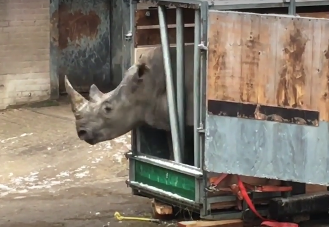
Rhino tries to escape at Dutch zoo, sends zoo keepers running

DutchNews, January 8, 2016

Photo: Screen shot Niehe Media
video via YouTube
A rhino about to be transported from Emmen zoo to a new location tried to break out of its transport box, forcing zoo keepers to flee. 

The rhino, one of the three being moved to the zoo’s new site on the outskirts of the town, was too strong for the wooden crate and repeatedly bashed against the metal bars, creating a large gap. 

It is not clear when the film was taken, but Emmen zoo has been closed to the public since the beginning of this year while the animals are moved. 

Once at the new zoo, the rhino is shown cautiously moving into its new enclosure. The new look zoo will open to the public in March.


Wednesday, December 30, 2015

Thai king's favourite dog dies, after 'insult' arrest

Yahoo – AFP, December 29, 2015

Tongdaeng, the favourite dog of Thailand's ailing monarch has died, days
 after a man was arrested for allegedly making a satirical online remark about
the beloved canine (AFP Photo)

The favourite dog of Thailand's ailing monarch has died, days after a man was arrested under the kingdom's strict royal defamation laws for allegedly making a satirical online remark about the beloved canine.

The dog, called Tongdaeng (Copper), became both a household name and a publishing sensation in Thailand after King Bhumibol Adulyadej adopted her as a stray puppy and penned a heartfelt book about her attributes in 2002.

She was praised for her loyalty and obedience, with the book widely interpreted at the time as a parable about how Thais should live and remember their place within the kingdom's rigid society.

King Bhumibol, 88, is the world's longest-
serving monarch and is widely revered in
 Thailand where his economic and social
 teachings are extensively promoted 
(AFP Photo/Indranil Mukherjee)
Her death was announced in a statement from the veterinary faculty of Kasetsart University late Monday.

"While Khun Tongdaeng was sleeping and relaxing, she died peacefully on 26 December 2015 at 11:10pm at Klai Kangwon Palace," the statement read.

It said she had been ill for the last few years and was just over 17 years old when she passed away.

"Khun" is an honorific in Thailand, roughly translating to "ma'am", and was frequently used by officials and local media when referring to Tongdaeng.

Her death was splashed across Thai newspapers Tuesday, with local media reporting that the king had been informed.

The dog regularly featured in palace photographs while the book about her outsold bestsellers such as Harry Potter in Thailand.

A privately funded animated film based around Tongdaeng and her attributes is currently showing at Thai cinemas.

In his book, Bhumibol described Tongdaeng as a "respectful dog, with proper manners" who was "humble and knows protocol

"She would always sit lower than the king," the book added.

Criticism banned

King Bhumibol, 88, has spent much of the last two years in hospital and is rarely seen in public. But the world's longest-serving monarch remains widely revered in Thailand where his economic and social teachings are extensively promoted.

The monarchy is also shielded from any debate and criticism by one of the world's harshest royal defamation laws.

A 10-metre high sculpture of "Giant John", one of the characters of the film 
"Khun Tongdaeng: The Inspirations", sits outside a shopping mall in Bangkok,
December 9, 2015 (AFP Photo/Nicolas Asfouri)

Anyone convicted of insulting the king, queen, heir or regent, can face up to 15 years in jail on each count.

Analysts say uncertainty as the king's reign enters its twilight years is a major factor in the political chaos that has beset Thailand for the much of the last decade, as competing elites jostle for influence.

Lese majeste prosecutions have soared since the army, which styles itself as the champion of the monarchy, grabbed power in a coup last year.

The boundaries for what counts as a royal insult have also expanded dramatically.

Earlier this month Thanakorn Siripaiboon, 27, was arrested for allegedly making a "satirical" Facebook post about the king and his dog, according to his lawyers.

As is often the case in lese majeste cases, the authorities did not give details on what the post said.

Thanakorn also faces lese majeste, sedition and computer crimes charges for clicking "like" on a doctored photo of the king and sharing it, plus an infographic on a growing corruption scandal engulfing the military.


Related Article:

Question: Dear Kryon: I live in Spain. I am sorry if I will ask you a question you might have already answered, but the translations of your books are very slow and I might not have gathered all information you have already given. I am quite concerned about abandoned animals. It seems that many people buy animals for their children and as soon as they grow, they set them out somewhere. Recently I had the occasion to see a small kitten in the middle of the street. I did not immediately react, since I could have stopped and taken it, without getting out of the car. So, I went on and at the first occasion I could turn, I went back to see if I could take the kitten, but it was to late, somebody had already killed it. This happened some month ago, but I still feel very sorry for that kitten. I just would like to know, what kind of entity are these animals and how does this fit in our world. Are these entities which choose this kind of life, like we do choose our kind of Human life? I see so many abandoned animals and every time I see one, my heart aches... I would like to know more about them.

Answer: Dear one, indeed the answer has been given, but let us give it again so you all understand. Animals are here on earth for three (3) reasons.

(1) The balance of biological life. . . the circle of energy that is needed for you to exist in what you call "nature."

(2) To be harvested. Yes, it's true. Many exist for your sustenance, and this is appropriate. It is a harmony between Human and animal, and always has. Remember the buffalo that willingly came into the indigenous tribes to be sacrificed when called? These are stories that you should examine again. The inappropriateness of today's culture is how these precious creatures are treated. Did you know that if there was an honoring ceremony at their death, they would nourish you better? Did you know that there is ceremony that could benefit all of humanity in this way. Perhaps it's time you saw it.

(3) To be loved and to love. For many cultures, animals serve as surrogate children, loved and taken care of. It gives Humans a chance to show compassion when they need it, and to have unconditional love when they need it. This is extremely important to many, and provides balance and centering for many.

Do animals know all this? At a basic level, they do. Not in the way you "know," but in a cellular awareness they understand that they are here in service to planet earth. If you honor them in all three instances, then balance will be the result. Your feelings about their treatment is important. Temper your reactions with the spiritual logic of their appropriateness and their service to humanity. Honor them in all three cases.

Smoking bad for pets, study shows

Yahoo – AFP, December 29, 2015

Smoking is bad for pets too, the University of Glasgow said, citing an ongoing
study into the effects of second-hand smoke on dogs and cats (AFP Photo/
Viktor Drachev)

London (AFP) - Smoking is bad for pets too, the University of Glasgow said Tuesday, citing an ongoing study into the effects of second-hand smoke on dogs and cats.

Research under way at the Scottish institution has found that pets living in a smoky environment have a higher risk of health problems including some animal cancers, cell damage and weight gain.

"Pet owners often do not think about the impact that smoking could have on their pets," said Clare Knottenbelt, professor of small animal medicine and oncology.

"Our findings show that exposure to smoke in the home is having a direct impact on pets.

"It risks ongoing cell damage, increasing weight gain after castration and has previously been shown to increase the risk of certain cancers."

While dogs can take in significant amounts of smoke, the university study shows cats are "even more affected".

"This may be due to the extensive self-grooming that cats do, as this would increase the amount of smoke (chemicals) taken in to the body," said Knottenbelt.

The research so far has found that while outdoor access made little difference for cats, smoking away from them did reduce the amount taken into the body.

It has found that when smokers light up fewer than 10 times a day, nicotine levels dropped significantly, but were nonetheless noticeably higher than in cats from non-smoking homes.

An examination of the testicles of castrated dogs found that a gene, which acts as a marker of cell damage, was higher in dogs living in smoking homes.

Dogs living with a smoker also gained more weight after neutering.

The finished research paper is expected to be published in 2016.

Sunday, December 27, 2015

Joy for Berlin family as cat returns for Christmas

Yahoo – AFP, December 26, 2015

Elena Hanke poses for a photo with her cat Miko at the animal refuge centre in
 Berlin on December 26, 2105. The cat has being found again after it went missing
in 2008. (AFP Photo/Bernd Von Jutrczenka)

Berlin (AFP) - Forget the return of Star Wars. For a family in Berlin, this Christmas saw the return of Miko -- a cherished black and white cat who went missing in the German capital in 2008.

"A family from Berlin-Charlottenburg (neighbourhood) this year experienced a Christmas story with a particularly 'happy ending'," announced an association for the protection of animals on Saturday.

"They learned on Christmas day that their cat Miko had been found -- seven years later," said the group which runs a refuge for animals where the cat was identified.

Miko had been discovered by people in Berlin's Kreuzberg neighbourhood -- just a few kilometres from its old home turf -- and taken to the refuge where workers were able to contact the owners because the cat had an identity chip.

Elena Hanke was 11 years old when she searched in vain for missing Miko. Along with her father and sister Jennifer she came to the shelter to recover the long-lost pet, the association said.

After years as a runway, Miko was "a bit too thin", but still healthy, the veterinarian at the refuge told the delighted family.

Wednesday, December 23, 2015

Indonesia punishes firms over deadly forest fires

Yahoo – AFP, December 22, 2015

Indonesia is punishing more than 20 companies in an unprecedented move for
starting deadly forest fires that killed 19 people (AFP Photo/Adek Berry)

Jakarta (AFP) - Indonesia is punishing more than 20 companies in an unprecedented move for starting deadly forest fires that killed 19 people, a government official said Tuesday.

Three companies have been shut down permanently after having their licences revoked over their role in the blazes that choked vast expanses of southeast Asia with acrid haze and cost Indonesia $16 billion.

It is the first time the government has revoked company licences over forest fires, an annual occurrence caused by slash-and-burn land clearance.

The environment ministry also froze the operations of 14 companies and said they face closure if they do not meet the government’s demands over fire prevention.

Several other companies have been given a strong warning and will be put under close supervision.

"We have sanctioned 23 companies in total, ranging from administrative sanctions to license revocation, while 33 others are still in the process, they could have their licenses revoked too if they are found guilty," environment ministry official Kemal Amas told AFP.

The ministry has been investigating 276 companies in total since the fires broke out in September.

Three companies have been shut down permanently by Indonesia after having
 their licences revoked over their role in the blazes that choked vast expanses of 
southeast Asia with acrid haze (AFP Photo/Adek Berry)

"We need firmer law enforcement so that this catastrophe does not repeat itself, it’s been going on for 18 years but nobody has learnt their lesson," Amas said.

Amas said the ministry was also working hard to restore the forests and farmland destroyed in the fires.

Activists welcomed the government’s new commitment to punish firms.

The Indonesian Forum for Environment said it was unheard of for the government to revoke licences, as many companies previously avoided facing trial.

"The minister has the courage to not only freeze the companies' operation but also chase the owners in a civil case, this is great and this must be guarded carefully," Kurniawan told AFP.

"In the past some people were named suspects, but for them to actually lose their licenses, this is the first time," he said.

More than half a million people suffered acute respiratory infections in Indonesia because of the haze, while many in neighbouring Singapore and Malaysia also fell ill.

Friday, December 18, 2015

Lone Arab woman takes the reins to tame horses on the Golan

Yahoo - AFP, Majeda El-Batsh, December 17, 2015

Druze horsewoman and trainer Raja Kheir leads a horse back to the stables
 on her ranch -- the only Arab centre in the area -- in the southern foothills
of Mount Hermon, north of the Golan Heights (AFP Photo/Jalaa Marey)

Majdal Shams (AFP) - The grey horse rears its head, rocking left and right, kicking its legs wildly. Sensing danger, Raja Kheir throws herself off and rolls on the ground.

The slender, brown-haired 32-year-old in white jacket and jeans tames horses -- not in itself unusual on the picturesque plains of the Israeli-occupied Golan Heights.

What makes Kheir different is that she is an Arab woman, among the few, or perhaps even the only one from the area taking the reins.

Druze trainer Raja Kheir trains a stray 
horse on September 17, 2015 in the 
southern foothills of Mount Hermon, 
north of the Golan Heights (AFP 
Photo/Jalaa Marey)
Born into a conservative family of Druze -- an offshoot of Shiite Islam -- in the Israeli village of Beit Jann in the Upper Galilee, she now lives and works in Majdal Shams near Syria.

Horses are an important part of the culture in the region's ranches and cattle farms spread among the rugged hills and plains.

Since dawn, Kheir has been in a battle with three-year-old Qamar -- the moon in Arabic -- and eventually succeeds in getting a saddle on her.

When she rides Qamar for the first time, she focuses all her concentration but the horse bucks, causing her to throw herself to the ground.

Hours later, Kheir is making progress. She places her feet in the stirrups and digs her feet gently into the horse's side, repeating this several times while at the same time tapping the animal's stomach.

"It is not enough to put a saddle on a horse to tame it. The important step is to ride it," she tells AFP.

Days in the wilderness

Qamar still isn't ready to listen fully, and many attempts end with another roll on the ground.

But Kheir, who has been riding since she was six, is not discouraged. When she was a child, "everyone called me a tomboy because I wasn't afraid of anything," she says.

She used to spend days in the wilderness near her grandfather's home in Beit Jann, where horses roamed.

There, she says, "my relationship with riding began".

Her journey into taming horses really started eight years ago, when she took a course in the town of Pardes Hanna near Haifa in northern Israel.

Since then she has earned multiple diplomas: she can ride horses, train them and teach them dressage.

Along with a partner, she decided to set up a taming and training centre. Most of her clients are families who have bought horses and need someone to train them for them.

She also trains stray horses found in the Golan.

With Qamar, a stray who arrived only a few days ago, Kheir is in the initial stages -- convincing the horse to accept her presence and to enter the stable.

Horses "like to be free. They don't like to have anything on their backs," she says.

"So when I ride her for the first time she is afraid of me and I am also afraid of her. She doesn't know my reaction and I don't know her.

"When I feel she is going to hurt me, I throw myself off."

- 'Courage above all else' -

Once this hurdle is overcome, the slow process begins of teaching them to be ridden.

Horses are an important part of the culture in the ranches and cattle farms
 spread among the rugged hills and plains of the Israeli-occupied Golan Heights
 (AFP Photo/Jalaa Marey)

"After you place the saddle on a horse it takes two to three weeks to tame them, though not to be able to ride them," she says.

It can take many more weeks for a former stray to get used to everyday things such as the sound of cars.

Kheir awakes at dawn every day to feed the 15 horses at her school in the Golan, near where several other centres are based.

They need to be fed by 7:00 am at the latest, she says, because something as simple as a late meal can upset a horse's stomach and even in rare cases be fatal.

For Kheir, the most important asset in a trainer is courage.

"If a horse feels your fear it will not accept you," she says. "But if he feels you love him, he will protect you."

Once confidence is gained, the rider then has control, she says.

Being a woman and from the Druze minority, she admits it can be difficult in the Israeli equine world which is dominated by Jewish Israelis and men.

When she and her partner set up the ranch -- the only Arab centre in the area -- they even faced acts of sabotage, with a horse and a foal poisoned and pressure put on some people not to sell to them.

"There was a real war against us," Kheir says, deliberately not naming the alleged culprits.

"But we've got all the official papers and our school continues."