Robber fly - Nature photographer Thomas Shahan specializes in amazing portraits of tiny insects. It isn't easy. Shahan says that this Robber Fly (Holcocephala fusca), for instance, is "skittish" and doesn't like its picture taken.
"The Greater Akashic System" – July 15, 2012 (Kryon Channelling by Lee Caroll)(Subjects: Lightworkers, Intent, To meet God, Past lives, Universe/Galaxy, Earth, Pleiadians, Souls Reincarnate, Invention: Measure Quantum state in 3D, Recalibrates, Multi-Dimensional/Divine, Akashic System to change to new system, Before religion changed the system, DNA, Old system react to Karma, New system react to intent now for next life, Animals (around humans) reincarnate again, This Animal want to come back to the same human, Akashic Inheritance, Reincarnate as Family, Other Planets, Global Unity … etc.)
Question:Dear Kryon: I live in Spain. I am sorry if I will ask you a question you might have already answered, but the translations of your books are very slow and I might not have gathered all information you have already given. I am quite concerned about abandoned animals. It seems that many people buy animals for their children and as soon as they grow, they set them out somewhere. Recently I had the occasion to see a small kitten in the middle of the street. I did not immediately react, since I could have stopped and taken it, without getting out of the car. So, I went on and at the first occasion I could turn, I went back to see if I could take the kitten, but it was to late, somebody had already killed it. This happened some month ago, but I still feel very sorry for that kitten. I just would like to know, what kind of entity are these animals and how does this fit in our world. Are these entities which choose this kind of life, like we do choose our kind of Human life? I see so many abandoned animals and every time I see one, my heart aches... I would like to know more about them.
Answer:Dear one, indeed the answer has been given, but let us give it again so you all understand. Animals are here on earth for three (3) reasons.
(1)The balance of biological life. . . the circle of energy that is needed for you to exist in what you call "nature."
(2)To be harvested. Yes, it's true. Many exist for your sustenance, and this is appropriate. It is a harmony between Human and animal, and always has. Remember the buffalo that willingly came into the indigenous tribes to be sacrificed when called? These are stories that you should examine again. The inappropriateness of today's culture is how these precious creatures are treated. Did you know that if there was an honoring ceremony at their death, they would nourish you better? Did you know that there is ceremony that could benefit all of humanity in this way. Perhaps it's time you saw it.
(3)To be loved and to love. For many cultures, animals serve as surrogate children, loved and taken care of. It gives Humans a chance to show compassion when they need it, and to have unconditional love when they need it. This is extremely important to many, and provides balance and centering for many.
Do animals know all this? At a basic level, they do. Not in the way you "know," but in a cellular awareness they understand that they are here in service to planet earth. If you honor them in all three instances, then balance will be the result. Your feelings about their treatment is important. Temper your reactions with the spiritual logic of their appropriateness and their service to humanity. Honor them in all three cases.
Dian Fossey's birthday celebrated with a Google doodle
American zoologist played by Sigourney Weaver in the film Gorillas in the Mist would have been 82 on Thursday (16 January 2014)
Conservationists
have released three more orangutans into the wild in East Kalimantan, the third
such release this year.
The three
endangered primates — Casey, Lesan and Mail — were flown by helicopter from the
Samboja Lestari Orangutan Reintroduction and Rehabilitation Program in Samboja
subdistrict, run by the Borneo Orangutan Survival Foundation, to the Kehje
Sewen forest straddling East Kutai and Kutai Kartanegara districts.
Before
their release at 8 a.m. on Tuesday, they were placed in a cage overnight to
adapt to the new environment, the BOSF said in a statement on Wednesday.
The release
was attended by several senior government officials, including Forestry
Minister Zulkifli Hasan, Environment Minister Balthasar Kambuaya and Hatta
Rajasa, the coordinating minister for the economy.
The three
orangutans were the first batch of six orangutans from East Kalimantan
scheduled to be released in April and May. The other three orangutans — Abbie,
Hamzah and Berlian — will be released next month.
The BOSF
plans to release 30 orangutans this year and next from the Samboja Lestari rehabilitation
center. It has already released 15 orangutans from its rehabilitation center in
Nyaru Menteng, Central Kalimantan — four in February and 11 in March — into the
Batikap protected forest in Murung Raya district.
The
foundation plans to release a total of 40 orangutans from Nyaru Menteng.
There are
still 160 orangutans at Samboja Lestari waiting to be released back into the
wild, and at least 70 others that cannot be released because of illness or
injuries, or waiting for available land for a suitable habitat.
“If there
is sufficient land for them, the target to release all the orangutans from the
rehabilitation center by 2015 can be achieved,” said Aschta Boestani Tajudin,
the Samboja Lestari program manager.
The 2015
target date, she added, is in line with the Orangutan Conservation Action Plan
2007-17, announced in 2007 by President Susilo Bambang Yudhoyono.
A farmer sprays pesticide in a paddy field in Ngoro village in Mojokerto, East Java, in this file photo. According to the People’s Coalition for Food Sovereignty (KRKP) Indonesian farmers use pesticides with alarming frequency — an average 5.7 times per growing season. (Antara Photo)
Indonesian
farmers use an alarming amount of pesticides — including some with illegal
toxic chemicals — on their crops, the People’s Coalition for Food Sovereignty
(KRKP) said on Thursday.
The NGO
cited a 2011 survey of 306 farmers in Central Java that found that farmers used
pesticides an average of 5.7 times per growing season.
“That is a
very high use for farms,” KRKP official Said Abdullah said in Jakarta on
Thursday.
Pesticides
are big business in Indonesia. The local market reaches about Rp 6 trillion
($654 million) a year, Said said. That market includes 350 brands of
fungicides, 600 brands of herbicides and 800 brands of insecticides registered
with the Indonesian authorities, according to Ministry of Agriculture’s
Pesticide Commission numbers.
And these
figures don't even include products that enter the country illegally, Said
said.
“Between 10
and 12 percent of pesticides circulating [in Indonesia] are illegal,” he said.
Many of
these chemicals contain harmful substances like organochlorine and
organophosphate, Said said.
The one
chemical, organophosphate, is considered hazardous, even in low doses, and its
use is highly-regulated, or banned outright, in 23 counties. Organochlorine was
present in the pesticide DDT, a chemical that caused massive ecological damage
in the United States before its use was banned in the 1960s.
He called
on farmers to adopt more environmentally-conscious and sustainable farming
methods.
(Reuters) -
A coalition of more than 2,000 U.S. farmers and food companies said Wednesday
it is taking legal action to force government regulators to analyze potential
problems with proposed biotech crops and the weed-killing chemicals to be
sprayed over them.
Dow
AgroSciences, a unit of Dow Chemical, and Monsanto Co. are among several global
chemical and seed companies racing to roll out combinations of genetically
altered crops and new herbicides designed to work with the crops as a way to
counter rapidly spreading herbicide-resistant weeds that are choking millions
of acres of U.S. farmland.
Dow and
Monsanto say the new chemical combinations and new crops that tolerate those
chemicals are badly needed by corn, soybean and cotton farmers as weeds
increasingly resist treatments of the most commonly used herbicide -
glyphosate-based Roundup.
"They
(farmers) need this new technology," said Dow AgroScience Joe Vertin,
global business leader for Dow's new herbicide-protected crops called
"Enlist."
But critics
say key ingredients in these new herbicides - 2,4-D for Dow and dicamba for
Monsanto - already are in use in the marketplace and have proved damaging to
"non-target" fields because they are hard to keep on target. Wind,
heat and humidity can move the chemical particles miles down the road, damaging
gardens, crops, trees. Many farms have suffered significant damage in recent
years even though the chemicals are currently sprayed under tight restrictions.
"These
are the most dangerous chemicals out there," said John Bode, a Washington
lawyer hired by the Save Our Crops Coalition. Bode served as assistant
Secretary of Agriculture in the Reagan administration.
Unlike many
other protestors of new biotech crops, the coalition comprises many grower
groups that use and support biotechnology. This is not a biotech complaint,
they say, but one focused on the danger of the chemicals to be used with the
biocrops.
"The danger
that 2,4-D and dicamba pose is a real threat to crops...nearly every food
crop," said Steve Smith, director of agriculture at Red Gold, the world's
largest canned tomato processor, and a leader of the Save Our Crops Coalition.
The
coalition represents more than 2,000 farmers and groups such as the Indiana
Vegetable Growers Association, the Ohio Produce Growers and Marketers
Association, and major food processors Seneca and Red Gold.
Over the
last four years, more than $1 million in damages have been filed in lawsuits
and insurance claims by Midwestern growers who have suffered crop losses due to
2,4-D and dicamba that has drifted onto their farms, Smith said.
Those
losses would increase with the new herbicide-tolerant crops because farmers
would then be spraying more of the herbicides and later in the growing season,
the coalition says.
In their
legal petitions, the group is asking the Department of Agriculture (USDA) to
conduct an environmental impact study on the ramifications of a release of a new
2,4-D tolerant corn that is to be accompanied by Dow's new herbicide mix
containing both 2,4-D and glyphosate. It wants a similar environmental impact
statement on the dicamba and glyphosate herbicide tolerant crops being
developed by Monsanto.
The coalition
is also demanding the Environmental Protection Agency (EPA) conduct a
Scientific Advisory Panel (SAP) meeting and appoint advisors to the panel to
address herbicide spray drift.
The legal
petitions are provided for as part of the regulatory process and require a
response from the agencies before petitioners can file suit to force a
response.
Dow's plans
to roll out as early as 2013 its 2,4-D tolerant corn and new 2,4-D based
herbicide as the "Enlist Weed Control System" is a hot button issue
for many groups because of high profile problems in the past with 2,4-D, which
was a component of Agent Orange defoliant used in Vietnam.
A separate
petition started by the Center for Food Safety says that 2,4-D, will
"likely harm people and their children, including farmers, and the
environment" and says USDA has not properly assessed the impacts of Dow's
plan for a new 2,4-D based crop system.
Dow
AgroSciences executives say the fears are unwarranted as their herbicide
formulation does not have the problematic "drift" and volatility
problems that other 2,4-D formulations have that cause farms even miles away to
be impacted when one farmer sprays the herbicide on his fields.
Dow says as
long as farmers use their formulation under their specifications, they would
not have the same problems associated with current versions of 2,4-D on the
market.
"We're
highly into stewardship and want to be sure the farmers get this right,"
said Dow spokeswoman Kenda Resler-Friend.
"Nobody
wants trouble with their neighbor. They want to do the right thing." Kenda
Resler-Friend.
Coalition
members say no matter how good Dow's formulation might be, generic versions of
2,4-D on the market will be much cheaper and many farmers will use those more
volatile versions on the new 2,4-D tolerant crops.
"Recalibration of Free Choice"– Mar 3, 2012 (Kryon Channelling by Lee Caroll) - (Subjects: (Old) Souls, Midpoint on 21-12-2012, Shift of Human Consciousness, Black & White vs. Color, 1 - Spirituality (Religions) shifting, Lose a Pope “soon”, 2 - Humans will change react to drama, 3 - Civilizations/Population on Earth, 4 - Alternate energy sources (Geothermal, Tidal (Pedal wheels), Wind), 5 – Financials Institutes/concepts will change (Integrity – Ethical) , 6 - News/Media/TV to change, 7 – Big Pharmaceutical company will collapse “soon”, (Keep people sick), (Integrity – Ethical)8 – Wars will be over on Earth, Global Unity, … etc.) - New !
Spain's King Juan Carlos poses in front of a dead elephant on a hunting trip in Botswana, Africa. Photograph: Target Press/Barcroft Media
While
ordinary Spaniards cope with harsh austerity, recession and soaring
unemployment, the country's royal family has been enjoying expensive hunting
trips, one of which resulted in King Juan Carlos ending up in hospital.
The
74-year-old monarch's fall in a park in Botswana provided an excuse for Spanish
newspapers, who normally treat their royal family with kid gloves, to plaster
their pages with photos of the king standing proudly in front of a dead
elephant.
The photograph
came from the website of Botswana-based Rann Safaris, which had been taken down
by Sunday. The pictures, taken before the latest hunting trip, also showed the king with two dead water buffalo.
Shoots with
Rann Safaris cost upwards of $8,700 (£5,500) a week, with an elephant costing a
further $15,000 to kill. A day out with professional hunter Jeff Rann, pictured
with the king, costs a further $2,000.
The king's
accident, after which he was flown back to Madrid for a hip operation, came
days after his grandson, 13-year-old Froilán Marichalar, shot himself through
the foot while hunting in Spain.
The child
also had to be hospitalised after doctors removed the contents of a 36-calibre
shotgun cartridge from his foot. Newspapers reported that it was illegal for a
13-year-old to handle that type of gun.
The king's
hunting trip, which officials described as "private", has caused a
storm of angry comment from animal lovers and those wanting to know how much it
had cost.
A
promotional video on YouTube shows Rann shooting elephants – which can be
killed with licences bought at auction from the Botswana government – in the
Okavango delta.
"You
have to manage the world's animal populations, to their betterment," says
Rann, who did not answer queries from the Guardian. "We are trying to
improve their habitat."
King Juan
Carlos has been involved in hunting scandals before. Six years ago officials
dismissed as "ridiculous" allegations that he had shot a drunken
Russian bear that had been plied with honey and vodka.
The family
also has a troubled history with guns. The king shot and killed his own brother
in an accident when he was a teenager.
Anglo-Dutch
food giant Unilever has announced it will phase out the use of factory-farmed
chicken in its products.
In Dutch,
factory-farmed chickens are commonly known as plofkip - blown-up chicken –
because they are bred and drugged to grow so large so fast that they are ready
for slaughter in just 42 days. Their organs and legs cannot keep up with their
accelerated rate of growth, so heart attacks, organ failure and leg deformities
are common.
Unilever
informed animal rights organisation Wakker Dier that it plans to start phasing
out the use of factory-farmed animals in the first quarter of next year,
beginning with its chicken hot dogs and later following with its soups and
other food products.
Unilever
has told Wakker Dier that the industrially farmed chicken will be replaced with
chicken which qualifies for at least one star in the Dutch ‘better life’ meat
production rankings. One-star chickens are not bred as quickly and have access
to a covered outdoor area.
Soldiers stand along the Indian Ocean coastline following a tsunami warning in Somalia’s capital Mogadishu on Wednesday. The powerful 8.6 magnitude earthquake and a series of strong aftershocks struck off Indonesia on Wednesday, sending people scurrying from buildings as far away as southern India. (Reuters Photo)
The massive
earthquake off Indonesia surprised scientists: Usually this type of jolt isn’t
this powerful. The biggest earthquakes tend to occur in subduction zones where
one plate of the Earth’s crust dives under another. This grind produced the
2004 magnitude-9.1 Indian Ocean disaster and the magnitude-9 Japan quake last
year.
Wednesday’s
magnitude-8.6 occurred along a strike-slip fault line similar to California’s
San Andreas Fault. Scientists say it’s rare for strike-slip quakes, in which
blocks of rocks slide horizontally past each other, to be this large.
“It’s
clearly a bit of an odd duck,” said seismologist Susan Hough of the U.S.
Geological Survey in Pasadena, Calif.
As one of
the world’s most seismically active places, Indonesia is located on the Pacific
“Ring of Fire,” an arc of volcanos and fault lines encircling the Pacific
Basin. Pressure builds up in the rocks over time and is eventually released in
an earthquake.
Wednesday’s
quake was followed by a magnitude-8.2 aftershock. Both were strike-slip quakes.
“A week
ago, we wouldn’t have thought we could have a strike-slip earthquake of this
size. This is very, very large,” said Kevin Furlong, a professor of geosciences
at Penn State University.
So large,
in fact, that the main shock went into the history books. Record-keeping by the
USGS National Earthquake Information Center ranks Wednesday’s shaker as the
11th largest since 1900. It’s probably the largest strike-slip event though
there’s debate about whether a similar-sized Tibet quake in 1950 was the same
kind.
A
preliminary analysis indicates one side of the fault lurched 70 feet past the
other — a major reason for the quake’s size. By contrast, during the 1906 magnitude-7.8
San Francisco earthquake along the San Andreas — perhaps the best known
strike-slip event — the ground shifted 15 feet.
The Sumatra
coast has been rattled by three strong strike-slip quakes since 2004, but
Wednesday’s was the largest.
Indonesia
issued a tsunami warning Wednesday after an earthquake with a preliminary
magnitude of 8.5 hit waters off westernmost Aceh province.
Said, an
official at Indonesia’s Meteorology and Geophysics Agency who goes by only one
name, said a tsunami warning has been issued for Aceh, West Sumatra, North
Sumatra, Lampung and Bengkulu. The tsunami was expected to reach Aceh at 4:31
p.m.
According
to Metro TV, traffic was chaotic Wednesday afternoon in Banda Aceh as people
flee coastal areas for higher ground in the east. Power and internet is
reportedly down in the provincial capita.
In Padang,
hospitals are reportedly evacuating patients from the building.
Thailand
issued an evacuation order Wednesday for its Andaman coast, a popular tourist
destination, after a massive earthquake off Indonesia triggered a tsunami
alert.
Thailand’s
National Disaster Warning Center advised people in the area to move to higher
places and stay as far away as possible from the sea.
People on
Twitter said tremors were felt in Singapore, Thailand, Malaysia and India.
High-rise apartments and offices on Malaysia’s west coast shook for at least a
minute. In Bangalore, India hundreds of office workers left their buildings,
workers there said.
The U.S.
Geological Survey said the powerful quake was centered 20 miles (33 kilometers)
beneath the ocean floor around 308 miles (495 kilometers) from Aceh’s
provincial capital.
The
National Oceanic and Atmospheric Administration issued a tsunami warning for
the following 27 countries: Indonesia, India, Sri Lanka, Australia, Burma,
Thailand, Maldives, United Kingdom, Malaysia, Reunion, Seychelles, Pakistan,
Somalia, Oman, Madagascar, Iran, United Arab Emirates, Yemen, Comores,
Bangladesh, Tanzania, Mozambique, Kenya, Crozet Islands, Kerguelen Islands,
South Africa and Singapore.
Indonesia
straddles a series of fault lines that makes the vast island nation prone to
volcanic and seismic activity.
A giant
9.1-magnitude quake off the country on Dec. 26, 2004, triggered a tsunami in
the Indian Ocean that killed 230,000 people, nearly three quarter of them in
Aceh.
JG/ AP/ Reuters/ AFP
Residents
of Banda Aceh flee shortly after a powerful
earthquake hit the western coast of
Sumatra in Banda Aceh
THRIVE is
an unconventional documentary that lifts the veil on what's REALLY going on in
our world by following the money upstream -- uncovering the global
consolidation of power in nearly every aspect of our lives. Weaving together
breakthroughs in science, consciousness and activism, THRIVE offers real
solutions, empowering us with unprecedented and bold strategies for reclaiming
our lives and our future.
"Recalibration of Free Choice"– Mar 3, 2012 (Kryon Channelling by Lee Caroll) - (Subjects: (Old) Souls, Midpoint on 21-12-2012, Shift of Human Consciousness, Black & White vs. Color, 1 - Spirituality (Religions) shifting, Lose a Pope “soon”, 2 - Humans will change react to drama, 3 - Civilizations/Population on Earth, 4 - Alternate energy sources (Geothermal, Tidal (Pedal wheels), Wind), 5 –Financials Institutes/concepts will change (Integrity – Ethical) , 6 - News/Media/TV to change, 7 – Big Pharmaceutical company will collapse “soon”, (Keep people sick), (Integrity – Ethical)8 – Wars will be over on Earth, Global Unity, … etc.) - New !
Jakarta Globe, Fidelis
E. Satriastanti, April 01, 2012
A worker feeds orangutans at the Borneo Orangutan Survival Foundation in this file photo. Eleven endangered orangutans were released into the wild in Central Kalimantan on Saturday. (Antara Photo)
A total of
11 orangutans aged from 8 to 24 years old were released into the wild at
Batikap forest in Murung Raya district of Central Kalimantan on Saturday. It
was the second release by the Borneo Orangutan Survival Foundation, which was
also joined by the provincial forestry agency and the local administration.
The
foundation aims to return 49 orangutans to the jungle this year, foundation
spokeswoman Meirini Sucahyo told BeritaSatu on Saturday.
“There are
25 orangutans left that will be released in the next months ,” she said.
The
Saturday release was performed by two teams. Beforehand they were tested for
TB, hepatitis, HIV, herpes and other sexually transmitted diseases as a
precaution. The first team transported Bang Jagur, Bunga, Kali, Mama Tata and
Tata in the morning and the second team went with Ompong, Jojo, Heldi, Komeng,
Yaya and Ika.
“They are
all anesthetized first and transported on helicopters,” Meirini said, adding
that 15 people were involved in the release.
Afterwards,
the foundation tracks the animals two to three times a week in the jungle. The
monitoring team will observe for
behavioral changes among the primates and see how they are adapting to their
new environment.
Experts say
there are about 50,000 to 60,000 orangutans left in the wild, 80 percent of
them in Indonesia and the rest in Malaysia.
They are
faced with the threat of extinction from poaching and the rapid destruction of
their forest habitat, driven largely by palm oil and paper plantations.
Conservationists
in the region have been raising awareness about the plight of the endangered
orangutans for some time.
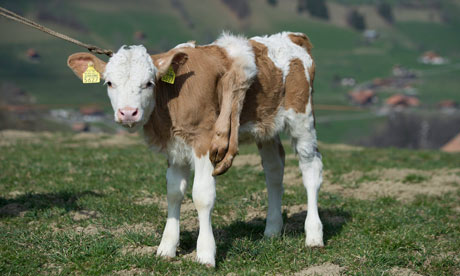
Seven-week-old
cow with two extra limbs doing well despite vet's predictions that she would
not survive
guardian.co.uk,
Associated Press, Thursday 29 March 2012
Six-legged calf Lilli has become a minor celebrity in her native Switzerland. Photograph: Peter Schneider/EPA
A
six-legged calf has defied the odds by thriving despite a vet's prediction at
birth that it would not survive.
Seven-week-old
Lilli is a minor celebrity in her native Switzerland after local media were
splashed with images of the calf frolicking in a sunny field.
Farmer
Andreas Knutti from Weissenburg, 19 miles south of the capital, Bern, says he
couldn't bring himself to euthanise the animal because she was "so full of
life".
He told
Swiss daily Blick on Thursday that a curve in her spine means that Lilli may
never become a normal milk cow.
But Knutti
says that if the calf stays healthy she will still be allowed to join the
others when they head for alpine pastures this summer.
Yangon
(ANTARA News/Xinhua-OANA) - Myanmar has banned mining of mineral resources
along the country`s four major river courses or near these river banks in a bid
to preserve natural environment, according to an order of the Ministry of Mines
made public Thursday.
The four
rivers are Ayeyawaddy, Thanlwin, Chindwin and Sittoung.
Exploration
and production of minerals including gems and jewelry along the river courses
or closer than 90 meters to the river banks is prohibited, the order said.
The order
added that the measure is aimed at emergence of clean environment of the four
rivers to enable smooth flow of river water and facilitate water transport and
tourism.
Australian
researchers have been astonished to discover a cure-all right under their noses
— a honey sold in health food shops as a natural medicine.
Far from
being an obscure health food with dubious healing qualities, new research has
shown the honey kills every type of bacteria scientists have thrown at it,
including the antibiotic-resistant “superbugs” plaguing hospitals and killing
patients around the world.
Some
bacteria have become resistant to every commonly prescribed antibacterial drug.
But scientists found that Manuka honey, as it is known in New Zealand, or jelly
bush honey, as it is known in Australia, killed every bacteria or pathogen it
was tested on.
It is
applied externally and acts on skin infections, bites and cuts.
The honey
is distinctive in that it comes only from bees feeding off tea trees native to
Australia and New Zealand, said Dee Carter, from the University of Sydney’s
School of Molecular and Microbial Biosciences.
The
findings are likely to have a major impact on modern medicine and could lead to
a range of honey-based products to replace antibiotic and antiseptic creams.
Professor
Carter’s two sons, Marty, 8 and Nicky, 6, think it’s funny the way their mother
puts honey on their sores. But she swears by it, telling stories of how quickly
it cures any infection.
“Honey
sounds very homey and unscientific, which is why we needed the science to
validate the claims made for it,” she said.
The
curative properties of various types of honey have been known to indigenous
cultures for thousands of years, and dressing wounds with honey was common
before the advent of antibiotics.
"Most
bacteria that cause infections in hospitals are resistant to at least one
antibiotic, and there is an urgent need for new ways to treat and control
surface infections," Professor Carter said.
"New
antibiotics tend to have short shelf lives, as the bacteria they attack quickly
become resistant. Many large pharmaceutical companies have abandoned antibiotic
production because of the difficulty of recovering costs. Developing effective
alternatives could therefore save many lives."
Professor
Carter said the fascinating thing was that none of the bacteria researchers
used to test the honey, including superbugs such as flesh-eating bacteria,
built up any immunity.
She said a
compound in the honey called methylglyoxal -- toxic on its own -- combined in
unknown ways with other unidentified compounds in the honey to cause
"multi-system failure" in the bacteria.
The results
of the research project are published in this month's European Journal of
Clinical Microbiology and Infectious Diseases.
Does
Monsanto know what it is doing? Do, we, the public have all the facts? Is genetically
modified food safe? Are food products which contain it clearly labelled? Is
Monsanto, knowingly or unknowingly, destroying the biosphere? Is genetically
modified produce a health hazard? For those who do not wish to get scared,
please do not read on.
Monsanto.
Haven't we heard that name before? Yes, do you remember who created Agent
Orange? Do you remember who created DDT? Do you remember who created Aspartame?
If we are
what we eat, then we have a right to know the answers to these questions. And
there are more. Why are cancers of the digestive system rising exponentially?
Let us start with Monsanto's wonderful herbicide, Roundup.
The journal
Current Microbiology has just released a report (1) on a substance called
Glyphosate, created by Monsanto in the 1970s and used in Roundup. The report is
shocking. It reveals that studies prove that Glyphosate is altering and
destroying the micro-organisms in the soil, which has a potential effect upon
the health of crops growing in it.
So
devastating are the effects, according to the report, that some bacteria have
disappeared from certain areas where Roundup was used to spray vast areas of
land and apart from this, use of the product has spurred the appearance of
superweeds, meaning that in turn farmers have to use greater and greater
concentrations of the product. The soil is as a result being rendered barren
for future generations.
Far more
worrying are fears that the use of this herbicide is killing organisms whose
benefit on a planetary scale has not yet been fully investigated and whose
elimination from the ecological chain may have very serious consequences.
But this is
just the tip of the iceberg. What happens to Glyphosate? It works its way down
through the topsoil to the groundwater below and from there finds its way into
our water supply - underground water currents and springs. This is not
conjecture: virtually all rain samples tested in the USA contain Glyphosate.
What does
the US Department of Agriculture do? Why, nothing! And this, despite the fact
that other investigations have warned that Glyphosate can be carcinogenic,
reducing fertility and increasing risk of cancer because it is genotoxic,
damaging the DNA chain.
The problem
is not only restricted to the USA. Superweeds have lasting damaging effects
upon the soil and nowadays already cover millions of hectares in the USA,
Argentina, Australia, Brazil, Chile, the EU and South Africa.
Cancer,
infertility, barren land, destruction of DNA, destruction of micro-organisms
which may be crucial for the planet's ecosystem, superweeds...what else? Well
it appears we have been here before. In fact, Monsanto has just agreed to pay
out 93 million USD for the effects of an explosion at its plant in Nitro, West
Virginia involving the herbicide 2,4,5-T which contained the toxic agent
dioxin. But there are still 80,000 property damage claims against the firm.
In fact, an
investigation of the Nitro Residents v. Monsanto case reveals some horrific
allegations which involve contamination of the environment, cover-ups,
falsification of studies...you name it. But hey, as a government contractor,
Monsanto has always enjoyed government immunity in the USA.
And what
was that about Monsanto not serving Genetically Engineered (GE) food in its own
canteens? Well, when we take into consideration that Glyphosate destroys human
kidney cells at concentrations 450 times lower than the concentration used in
agricultural applications... and when we consider the very little information
available on the real potential dangers lurking behind GE foodstuffs, it is
hardly surprising.
What is
unacceptable is that while the long-term effects of consumption of GE food are
still not available, GE seeds are spreading round the planet on wind currents
and on aquifers. Remember the respected scientist Arpad Pusztai?
Arpad
Pusztai is an expert in biochemistry and nutrition who worked at the Rowett
Research Institute in Aberdeen, Scotland. When he released information about
his discovery that Genetically Modified potatoes create severe damage to the
immune system and organs of rats, he was suspended, threatened with a lawsuit
and handed a gagging order, while his findings were denied or distorted. The
gagging order was later lifted and when he went public again there was a
massive recall of products. The US consumer was, of course, the last to know.
Before I
finish, a question: Why do mice, rats, geese, cows, pigs, elk and squirrels
avoid eating GM foods when given the choice?
Who would
like to be a Monsanto shareholder now? I sure as heck wouldn't.
(1) Effects
of Roundup® and Glyphosate on Three Food Microorganisms: Geotrichum candidum,
Lactococcus lactis subsp. cremoris and Lactobacillus delbrueckii subsp.
bulgaricus
"Recalibration of Free Choice"– Mar 3, 2012 (Kryon Channelling by Lee Caroll) - (Subjects: (Old) Souls, Midpoint on 21-12-2012, Shift of Human Consciousness, Black & White vs. Color, 1 - Spirituality (Religions) shifting, Lose a Pope “soon”, 2 - Humans will change react to drama, 3 - Civilizations/Population on Earth, 4 - Alternate energy sources (Geothermal, Tidal (Pedal wheels), Wind), 5 – Financials Institutes/concepts will change (Integrity – Ethical) , 6 - News/Media/TV to change, 7 – Big Pharmaceutical company will collapse “soon”, (Keep people sick), (Integrity – Ethical)8 – Wars will be over on Earth, Global Unity, … etc.) - New !
Critically endangered Bali starlings (Leucopsar rothschildi), also known as Bali mynah, perch inside a cage at a zoo in Surabaya, East Java, Indonesia in this file photo. (AP Photo/Trisnadi)
A survey of
animal markets in Java and Bali has found that the illegal trade in protected
birds is not only continuing unchecked, but is picking up speed.
And not
only are more protected birds being traded, but there is also a greater variety
of being offered, according to ProFauna Indonesia, which visited eight markets
on the islands in the first two months of the year.
In
February, the animal protection group found more than 62 protected birds on
sale in the markets, up from 41 in January. There were 15 different species in
February, from 12 in January.
The markets
visited included Splendid market in Malang and Turi market in Surabaya, both in
East Java, Pramuka, Jatinegara and Barito markets in Jakarta, and Satria market
in Denpasar.
Pramuka,
Jatinegara and Satria had the most protected birds for sale, according to
ProFauna.
Protected
birds such as white-bellied sea eagles, black-winged starlings, flame-fronted
barbets, spotted kestrels, Bali starlings, black eagles and banded pittas were
easily available in the markets, the group said.
It said a
white-bellied sea eagle cost about Rp 500,000 ($55), while flame-fronted
barbets and black eagles could fetch anywhere from Rp 100,000 to Rp 500,000.
The group
said that it also found other protected animals being sold illegally. These
included Javan langurs and slow lorises, which were among 109 primate species
being traded. Javan langurs were being sold for Rp 250,000.
“The
illegal wildlife trade in bird markets must be curbed,” said Rosek Nursahid,
chairman of ProFauna Indonesia.
The country
has laws against the trade in protected species, with offenders facing up to
five years in prison and a fine of up to Rp 100 million.
However,
these laws are often openly flouted, with protected species being sold out in
the open at animal markets across the country with little apparent fear of
arrest or prosecution by the sellers or their customers.