Robber fly - Nature photographer Thomas Shahan specializes in amazing portraits of tiny insects. It isn't easy. Shahan says that this Robber Fly (Holcocephala fusca), for instance, is "skittish" and doesn't like its picture taken.

Nature by Numbers (Video)

"The Greater Akashic System" – July 15, 2012 (Kryon Channelling by Lee Caroll) (Subjects: Lightworkers, Intent, To meet God, Past lives, Universe/Galaxy, Earth, Pleiadians, Souls Reincarnate, Invention: Measure Quantum state in 3D, Recalibrates, Multi-Dimensional/Divine, Akashic System to change to new system, Before religion changed the system, DNA, Old system react to Karma, New system react to intent now for next life, Animals (around humans) reincarnate again, This Animal want to come back to the same human, Akashic Inheritance, Reincarnate as Family, Other Planets, Global Unity … etc.)

Question: Dear Kryon: I live in Spain. I am sorry if I will ask you a question you might have already answered, but the translations of your books are very slow and I might not have gathered all information you have already given. I am quite concerned about abandoned animals. It seems that many people buy animals for their children and as soon as they grow, they set them out somewhere. Recently I had the occasion to see a small kitten in the middle of the street. I did not immediately react, since I could have stopped and taken it, without getting out of the car. So, I went on and at the first occasion I could turn, I went back to see if I could take the kitten, but it was to late, somebody had already killed it. This happened some month ago, but I still feel very sorry for that kitten. I just would like to know, what kind of entity are these animals and how does this fit in our world. Are these entities which choose this kind of life, like we do choose our kind of Human life? I see so many abandoned animals and every time I see one, my heart aches... I would like to know more about them.

Answer: Dear one, indeed the answer has been given, but let us give it again so you all understand. Animals are here on earth for three (3) reasons.

(1) The balance of biological life. . . the circle of energy that is needed for you to exist in what you call "nature."

(2) To be harvested. Yes, it's true. Many exist for your sustenance, and this is appropriate. It is a harmony between Human and animal, and always has. Remember the buffalo that willingly came into the indigenous tribes to be sacrificed when called? These are stories that you should examine again. The inappropriateness of today's culture is how these precious creatures are treated. Did you know that if there was an honoring ceremony at their death, they would nourish you better? Did you know that there is ceremony that could benefit all of humanity in this way. Perhaps it's time you saw it.

(3) To be loved and to love. For many cultures, animals serve as surrogate children, loved and taken care of. It gives Humans a chance to show compassion when they need it, and to have unconditional love when they need it. This is extremely important to many, and provides balance and centering for many.

Do animals know all this? At a basic level, they do. Not in the way you "know," but in a cellular awareness they understand that they are here in service to planet earth. If you honor them in all three instances, then balance will be the result. Your feelings about their treatment is important. Temper your reactions with the spiritual logic of their appropriateness and their service to humanity. Honor them in all three cases.

Dian Fossey's birthday celebrated with a Google doodle

Dian Fossey's birthday celebrated with a Google doodle
American zoologist played by Sigourney Weaver in the film Gorillas in the Mist would have been 82 on Thursday (16 January 2014)

Sunday, July 6, 2014

Thousands Celebrate Birthday of First Taiwan-Born Panda Cub

Jakarta Globe – AFP, Jul 06, 2014

Yuan Zai, right, the first Taiwan-born baby panda, and her mother Yuan Yuan
 enjoy cake, during the celebration of her first birthday at the Taipei City Zoo
on Sunday. (AFP Photo/Mandy Cheng)

Taipei. Thousands braved the summer heat Sunday to celebrate the first birthday of Yuan Zai, the first giant panda cub born in Taiwan, who has attracted hundreds of thousands of visitors in six months.

Around 3,000 people joined a 10-kilometer run which was part of a series of programs marking the birthday.

Visitors, many of them children with parents, cheered Yuan Zai when she was presented with a birthday cake — made of apples, pineapples, carrots and buns and prepared by the zookeepers.

The main attraction was when the cub grabbed different cards in “Zhua Zhou,” a traditional crawling game for one-year-old babies in many Chinese communities.

The first card or object to be grabbed indicates a future career path or interest, according to custom.

Yuan Zai initially picked up the card for painter, among a variety of others.

The cub made her public debut in January and since then the exhibition centre at Taipei Zoo has often been swamped with fans.

In the six months to June 2.4 million people visited the zoo, about a 50 percent rise over the same period of 2013.

Yuan Zai was delivered on July 6 last year following a series of artificial insemination sessions because her parents — Tuan Tuan and Yuan Yuan — failed to conceive naturally.

She weighed 180 grams at birth but now tips the scales at around 34 kilograms.

Mother and daughter were reunited for the first time on August 13, a meeting that saw the giant panda licking and cuddling her baby before they fell asleep together inside a cage.

Tuan Tuan and Yuan Yuan, whose names mean “reunion” in Chinese, were given to Taiwan by China in December 2008 and have become star attractions at Taipei Zoo, as well as a symbol of warming ties between the former bitter rivals.

Fewer than 1,600 pandas remain in the wild, mainly in China’s Sichuan province, with a further 300 in captivity around the world.

Saturday, July 5, 2014

Investment craze for China's Dairy Farms

Want China Times, Staff Reporter 2014-07-05

A man milking a cow at a ranch owned by the Yili Group in Jiangsu,
July 8, 2010. (File photo/CFP)

There has been a recent investment craze for the dairy business in China, attracting the participation of several major enterprises, including internet giant Alibaba Group.

The Chinese-language Beijing News reported that an equity fund set up by Jack Ma, chairperson of Alibaba, and some other investors, will team up with an industrial investment fund under the auspices of CITI in securing a 60% stake, through subscription to cash capital increments, in a husbandry firm, a subsidiary of Yili Industrial Group in Inner Mongolia, at 2 billion yuan (US$322 million).

Yili reported that the fresh funds will help the husbandry subsidiary augment its capacity for fresh-milk supply by expanding and improving its dairy farm.

Hua Xia Dairy Farm, in Sanhe in Hebei province, has also received a fresh injection of funds totaling US$106 million from a consortium, organized jointly by the Government of Singapore Investment Corporation, Singapore's sovereign fund, and a private equity fund set up by Taishan Capital Corporation. Of the fresh fund, US$70 million will come from GIC, US$30 million from Taishan, and the remainder from other investors. Taishan will also chip in a total of US$108 million to Hua Xia, emerging as the largest shareholder.

This follows an investment in February of 1.5 billion yuan (US$242 million) by private equity fund RRJ Capital for a 45% stake in Shanghai Bright Holstan, a subsidiary of Bright Dairy and an announcement last September by private equity fund KKR that it was teaming up with CDH Investments and Modern Farming to invest US$140 million in two large-scale dairy farms in China.

"The huge potential of China's dairy market has attracted heavy investments from various parties, especially in dairy farms," remarked Shen Meng, an investment banker.

Thursday, July 3, 2014

Giant panda gives birth to twin cubs in SW China


China view, 2 july 2014

A giant panda has given birth to twin cubs in Chengdu, capital city of southwest China's Sichuan Province. They are the first set of panda twins to be born this year in the city.

Panda cub

Related Article:


Greying Japan set for canine nursing home

Yahoo – AFP, 2 July 2014

A caretaker looks after a 14-year-old female dog which can't walk well at a 
home for ageing pets, where a vet is on call 24 hours a day and animals are kept
 active with a range of exercises and healthy foods, in Chiba, suburban Tokyo, 
on July 2, 2014.

A caretaker looks after a 14-year-old female dog which can't walk well at a home for ageing pets, where a vet is on call 24 hours a day and animals are kept active with a range of exercises and healthy foods, in Chiba, suburban Tokyo, on July 2, 2014

A new Japanese nursing home has everything seniors could want, from a hair salon and 24-hour medical care to comfy beds and a swimming pool to keep those legs in shape -- all four of them.

The facility in a Tokyo suburb is throwing open its doors to ageing dogs of all shapes and sizes with the promise of a comfortable retirement for the elderly canines, and their equally wrinkly human owners.

Aeonpet Co., a unit of major shopping mall operator Aeon, billed its nursing home as the ticket for a pet-loving nation which also has a rapidly ageing population.

"Many pets are getting old while their owners are also ageing. This is a serious social issue," company president Akihiro Ogawa said during a media tour Wednesday.

"I hope this business will provide part of the solution for this problem."

Owners who worry about their pet's future after they die need not fret -- the pool has dog-sized life jackets and there is a CT scanner for thorough medical check ups.

And when those beloved pets aren't getting a shampoo and trim, the home offers memory games to help ward off dementia and comforting care during the final stage of life.

There is an interview to make sure owners aren't just trying to get rid of old pets, with costs ranging from 100,000 yen ($1,000) a month for small pets to double that number for bigger dogs.

The nursing home opens next week.

Tuesday, July 1, 2014

Elderly woman saves 130 dogs from dog meat festival (Video)


China view,  1 july 2014

A dog meat festival was held in south China in late June despite heavy protest. Next, we' ll meet an elderly woman who purchased more than 100 dogs from butchers in order to save them from being eaten.

Related Article:


One dealer threatens to strangle the dog if no one offers a better
price. A woman instantly pays his price. (Photo/CFP)
.

Berlin's squirrels get bridge of their own

Berlin has plenty of green space, so it's not uncommon for wildlife and urbanites to cross paths. Now an animal rights group has made sure that very intersection remains safe for the city's squirrels.

Deutsche Welle, 1 July 2014


You don't have to go too far to encounter nature in Berlin. And I don't mean simply riding the S-Bahn to one of the city's numerous lakes in summer, or putzing around its vast parks after work. I'm talking about those special moments when you stumble out of a bar at 3:00 a.m. and spot a sleek fox scurry across a puddle of soft light falling from a streetlamp before it dives into the closest shrub.

Or perhaps you've been lucky enough to cross paths with a wild boar in a nearby forest - or unlucky enough if you happen to clash in a residential neighborhood. These tusked creatures roam the city by the thousands and have given Berlin its title as the "wild boar capital" of Germany.

Berlin's unique political situation is partly responsible for the continued proximity of its wildlife. Due to its division there has always been plenty of abandoned buildings, and not only for homo sapien squatters - these spaces make perfect dwellings for animals.

A city of bridges

In the former East, Berliners have the iconic Oberbaumbrücke with its twin gothic towers, and to the West, Wannsee's Glienicke Brücke, famously used for the exchange of spies during the Cold War.

Recently, Berlin erected another practical overpass - this one for squirrels.

Similar to a wildlife crossing, a squirrel bridge is a construction that allows small animals, especially squirrels and martens, to safely transverse busy roadways. Before last March, the idea would have met with twisted-up faces, perhaps even giggles.

The idea may still be giggle-worthy, but it's been set to the test. This winter, animal rights organization Aktion Tier installed the capital's first squirrel bridge in the district of Treptow-Köpenick, on the traffic-stricken Müggelseedamm, a tree-lined road that borders the Müggelsee lake in the southeast Berlin.

Organizers first found the perfect location - then visualized the bridge

The second squirrel bridge in Germany - the first can be found in the central town of Vlotho - is actually a thick length of plastic rope. It starts nine meters up and extends 21 meters between two trees on either side of Müggelseedamm. The branches of the adjacent trees do not touch, so squirrels are forced to use the road - hence the need for the squirrel bridge.

"We have more wild animals in the city than in nature," said Ursula Bauer of Aktion Tier. "They are living together with us and we have to deal with it. The traffic is very dangerous for them - for the hedgehogs, for the birds, and of course for the squirrels."

But as Bauer explained, such a simple idea is never that easy to implement in Germany, where every branch (excuse the pun) of production is regulated.

According to Bauer, they first had to find the owner of the strip of land where the trees are rooted. Then it took months to find a certified tree climber to install the squirrel bridge, and more time to find the proper insurance to cover every possibility.

And there's one more delightful feature: Wooden boxes filled with nuts are fastened at each end of the rope to lure the squirrels.

"Animals are very particular. They might not use a rope that is not exactly in the direction that they want to cross," said Bauer. "You have to observe the area and build the rope where they want to cross the street."

Which squirrel wouldn't be motivated by a mound of nuts?

The world's narrowest bridge

Bauer was initially approached by Henrik Zwadlo from the Leibniz-Institute of Freshwater Ecology and Inland Fisheries, which is located directly at the site of the squirrel bridge.

Ursula Bauer (left) and Henrik Zwadlo
hope to see fewer squirrel deaths
"He saw so many squirrels being killed in the street," said Bauer. "Nearly every month he saw one die."

After witnessing one squirrel death too many, Zwaldo set out to make a change - and found the inspiration he needed from similar initiatives. The first squirrel bridge was documented in 1963 in Longview, Washington; it was officially called The Nutty Narrows Bridge. More complex than a rope, the mini suspension bridge - dubbed the "World's Narrowest Bridge" - spans 18 meters and is made of aluminum piping covered with a retired firehose. The total cost for the bridge was $1,000 (720 euros).

Others have followed. ABC news reported in 2010 that the state of Arizona was intent on spending $1.25 million to build bridges for endangered squirrels over a mountain road to prevent more roadkill. Squirrel bridges can also be found in the UK, Belgium, France and the Netherlands.

One green spot to the next

"The difference between other cities and Berlin is that elsewhere animals usually stay in the periphery, while in Berlin they can be observed in the city center as well," explained Susanna Hertrich, a Berlin-based visual artist. Her recent installation, "Berlin Wild Life," explores cross-species cohabitation between humans and wild animals.

Hertrich says animals can move relatively undisturbed because of Berlin's many parks that allow them to jump from one green spot to the next. "Due to its history, Berlin offers fallow lands and abandoned spaces in its center, where other cities tend to be fully developed," she said. "These places of course make perfect settlements for animals, like foxes or raccoons.”

Or even rabbits. The so-called death zone, the no man's land along the Berlin Wall, experienced a drastic influx of wild rabbits breeding and living in bunny utopia. The German-Polish documentary, "Rabbit a la Berlin" (2009), tells this unique part of Berlin history as an allegorical study of a totalitarian system.

Hertich's "Berlin Wild Life" project focuses on the interactions
between humans and animals

According to Hertrich, the best time for animals in Berlin was in the early 1990s after the Wall was destroyed and largely removed. "Urban development in East Berlin had not yet fully begun, and walls, wires or hidden land mines no longer interrupted animal migration from one part to the other part of the city," she explained. "The animals were able to find a large number of unused plots, derelict buildings and abandoned spaces. Such places can of course still be found, but increasingly less so.!

New animal-human architecture

Since the squirrel bridge was erected, Ursula Bauer says she hasn't actually spotted any squirrels using it yet. But that doesn't mean they're not - there haven't been any more reports of dead squirrels on Müggelseedamm. Aktion Tier is considering installing a small camera to see if their efforts have paid off.

So far, there's been no opposition to the squirrel bridge on Müggelseedamm. In fact, it's even sparked peculiar excitement. Bauer recalls little known politicians coming out of the woodwork at its grand opening to have their photos taken with the mighty rope.

There is also talk of installing more squirrel bridges in Berlin, perhaps on Heerstrasse. But Bauer is wary - she has first-hand experience with Germany's red tape. "It's a big street, and the insurance might not cover such a long rope."

As Berlin continues to grow, Susanna Hertich sees a possibility for animals to be actively incorporated into urban planning.

"[If] new building plans took the animals' needs into consideration, then gentrification would not necessarily be an interruption," she said. "In fact, this could be a very interesting starting point for new forms of animal-human architecture."

Monday, June 30, 2014

Rabobank world's biggest investor in mega factory farms: Trouw

DutchNews.nl, Monday 30 June 2014

(Trouw)
Dutch banks ING and Rabobank are among the world’s biggest investors in giant factory farms in the US and developing economies such as Brazil and China, Trouw reports on Monday, quoting animal rights group Wakker Dier.

The massive farms, some with up to three million chickens or 10,000 pigs are banned in Europe because of their impact on animal welfare, Trouw says.

Nevertheless, Rabobank has invested €4.2bn in such enterprises over the past three years, according to Wakker Dier making it the world’s number one giant factory farm investor. ING, with investments of €1.4bn, is ninth on the list.

The banks are not breaking any rules because there are no rules governing animal welfare in the US, China and Brazil, Trouw states. However, Wakker Dier thinks savers should be aware the banks do not place any demands on the way animals are kept abroad.

Suggestive

Both Rabobank and ING said the size of a farm in not relevant to animal welfare, Trouw reported.

Rabobank said in a statement the report’s conclusions are ‘suggestive’. ‘In terms of animal welfare, we expect our clients to adhere to Food & Agribusiness principles and our animal welfare policies,’ the bank said.

ING said it had no objections in principle to giant factory farms and that it expects its clients to follow the law in terms of animal accommodation and welfare.

One of the companies in the report – Thailand’s Charoen Pokphand – is building 13 factory farms in China.

One of them, the Pinggu 3-million Layer Chicken Project, will produce three million battery chickens a year and are kept in a space equivalent to 400 cm2 per hen. That is half the space required by law in the Netherlands.

Related Articles:


Saturday, June 28, 2014

Rabobank under fire over Indonesia palm oil investments

DutchNews.nl, Saturday 28 June 2014

A palm oil plantation (NOS/AFP)
Environmental group Milieudefensie has made a formal complaint against Rabobank with the OECD, saying the bank is breaking rules on deforestation.

Milieudefensie says the bank has some €47m invested in Indonesia palm oil company Bumitama which it says operates illegal plantations and is guilty of illegally cutting down forests. This, in turn, is threatening the habitat of orangutans, the organisation says.

Rabobank says it is in talks with Bumitama in an effort to improve its operations but Milieudefensie says this is taking too long. ‘Rabobank has showed itself to be extremely naïve in this and has a blinkered view,’ spokesman Geert Ritsema told the Volkskrant.

Illegal deforestation is not only against Rabobank’s own policy but against OECD agreements on socially responsible business.

If the OECD upholds the complaint, Rabobank could be excluded from taking part in trade missions and from some subsidies, the Volkskrant said.

Related Articles:


Wednesday, June 25, 2014

Indonesia Fires Spark Singapore, Malaysia Haze Warning

Jakarta Globe – AFP, Jun 25, 2014

A boat is seen through haze in Northport Klang, outside Kuala Lumpur on June 24,
 2014. Local media reported unhealthy levels of air pollution with an air pollutant index
 of 118 in some parts of the country. Indonesia’s disaster agency warned on June 24
that haze could return to Singapore and Malaysia. (Reuters Photo/Samsul Said)

Jakarta. Indonesia’s disaster agency warned on Wednesday that haze could return to neighboring Singapore and Malaysia after a huge jump in forest fires in a province at the center of a smog crisis last year.

Fires in Riau province, on western Sumatra island, caused the worst outbreak of haze in Southeast Asia for more than a decade in June last year, affecting daily life for millions and sparking a heated diplomatic row.

June is the start of the forest fire season — when slash-and-burn techniques are used to clear land quickly and cheaply, often for palm oil plantations — and disaster officials said the number of blazes in Riau was rising quickly.

A total of 366 “hot spots” — either forest fires or areas likely to soon go up in flames — had been detected in the province on Wednesday, up from 97 the previous day, according to disaster agency spokesman Sutopo Purwo Nugroho.

“We must be on alert as the wind is traveling east-northeast. The likelihood of the smog reaching Singapore and Malaysia is getting higher,” Nugroho said.

Experts have said that an expected El Nino weather phenomenon later this year is likely to fan the forest fires as conditions become drier than usual.

El Nino drags precipitation across the Pacific Ocean, leaving countries including Indonesia drier and parts of the Americas wetter.

However the latest outbreak of forest fires was yet to have any serious impact on daily life in Sumatra, and the skies over Singapore were still free of haze.

Authorities said that most of the forest fires last year were deliberately lit to clear land. Slash-and-burn is a traditional farming technique, but environmental groups also accuse big companies of using the method.

According to the Washington-based World Resources Institute, a large number of the fires detected recently have been within the concessions of paper and palm oil companies and their suppliers.

It found 75 hot spots in the concessions of suppliers to Asia Pulp & Paper between June 17 and June 23, and 43 hot spots in zones of suppliers to Asia Pacific Resources International Limited (April) in the same period, using data from satellite mapping tools.

APRIL said it had agreed to support the fire-fighting effort, lending its water pumps and a company helicopter. APP did not immediately comment.

Agence France-Presse

Tuesday, June 24, 2014

Jane Goodall, an Eco Legend, Preaches Love for All in Bali

Jakarta Globe, Nadia Bintoro,  June 24, 2014

Renowned conservationist Jane Goodall was the star of a recent conference
in Bali on sustainability. (Photo Courtesy of Green School)

It was the day that many conservationists and environmentalists in Bali had been awaiting for quite some time, the inaugural “Sustainability and Conservation Conference,” set in Bali’s  famous Green School, amid the lush forests of Banjar Saren near Ubud.

The conference was special in many ways, yet the most intriguing aspect for many was that it featured Dr. Jane Goodall, the world-renowned ethologist, environmental leader and UN messenger of peace.

The one-day conference aimed to ignite discussions and initiatives to ensure the sustainability of Bali’s nature and culture. The conference was packed with talks and discussion panels featuring some of the key players in Indonesia’s conservation efforts.

In attendance from early morning to late afternoon, the conference attendees were happily roaming around, moving between the distinct traditional bamboo architecture at the Green School, attending the various talks, panel discussions and activities that appealed most to their interests.

The event was divided into three venues: the main field, the Mepantigan building, and the Turtle room.

Among the speakers in the main field were Steve Lansing, a specialist on subak, the Balinese traditional irrigation system, who presented a talk on the topic “Survival of Subak”; Ian Singleton from the Sumatra Orangutan Conservation Program; as well as David Metcalf, who shed some light on the Dayak tribes of Kalimantan and the challenges they face from the loss of their forests to mining and plantation concessions.

There were also presentations and discussions from nongovernmental organizations and conservation groups, including the World Wide Fund for Nature, the Coral Triangle Center, Conservation International, Eco Bali, Kopernik, Threads of Life and more, each sharing their expertise and concerns on conservation issues and challenges.

The Turtle room was reserved for “lighter” presentations in the form of movie screenings. Inside the eye-catching bamboo structure, characteristic of the Green School, and amid a cool breeze flowing in beneath the thatched roof, dozens of conservation enthusiasts crowded around to watch movies including “Let Elephants be Elephants” and “Rise of the Eco-Warriors.”

Following the latter, there was a panel discussion featuring two of the “eco-warriors” from the movie, Kodi Twiner and Paul Daley. The talked about their experiences, concerns and insights from filming the movie.

But the highlight of the day was without a doubt the talk by Goodall. A world-leading primatologist, Goodall — who has been passionate about animals since her childhood — began her extensive research on the behavior of chimpanzees in the 1960s in Tanzania. Her unorthodox research methods were initially controversial; for instance, the mere fact that she gave the chimpanzees names instead of numbers, as was common practice among researchers to avoid emotional attachment, raised many eyebrows.

However, Goodall’s research eventually became the foundation for future primate research in the world, and thanks to her findings the scientific community at the time was challenged in some their long-standing beliefs where the animals were concerned, especially with regard to their social behavior and diet.

Goodall has received numerous awards and honors throughout her career and has been twice appointed a UN messenger of peace, in 2002 and 2007. Her Jane Goodall Institute currently operates 19 offices around the world.

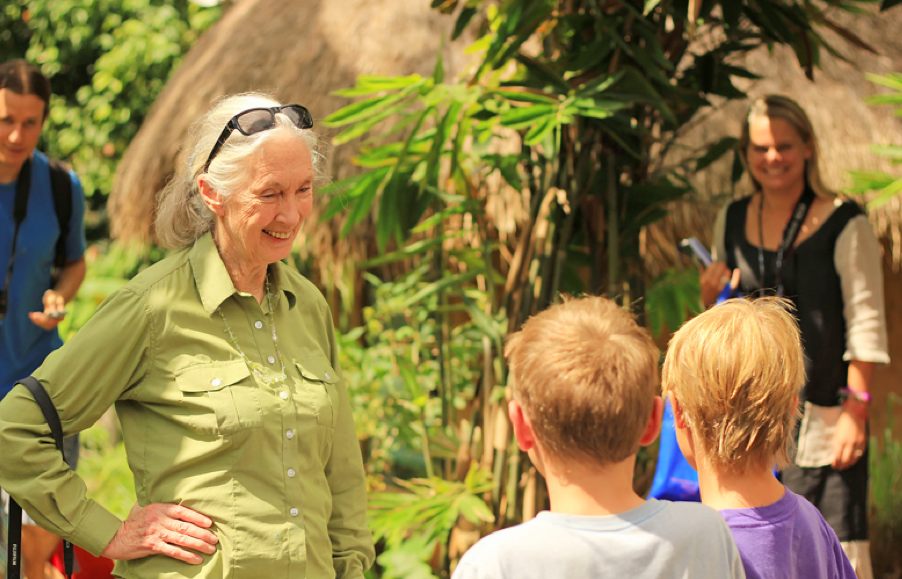
Jane Goodall conversing with children participating in the conference.
(Photo courtesy of Green School)

Rights of animals

As the sun slowly set over Bali, dozens of attendees sat cross-legged in the main tent, listening attentively to Goodall’s soft voice, enchanted by her heartfelt talk “Where the Hope Lies.”

Here, Goodall shared her personal stories of how she became a world-renowned primatologist, on the tremendous supports from her mother — who accompanied her daughter to Tanzania’s Gombe Stream National Park in 1960 out of concern for her safety — and on her belief and conviction on non-human rights. She stands firm that animals possess emotions and personalities just like humans do, and that they therefore deserve ethical treatment as well.

“In what terms should we think of these beings, non-human yet possessing so very many human-like characteristics, how should we treat them?” she asked. “Surely we should treat them with the same consideration and kindness as we show to other humans; and as we recognize human rights, so too should we recognize the rights of the great apes and other animals.”

Goodall also emphasized the importance of planting environmental awareness in young minds through specific programs such as Roots & Shoots, which she first founded back in Tanzania.

Roots & Shoots aims to bring together youths of all ages, from preschool to university, to work on environmental, conservation and humanitarian issues. The program now has chapters in more than 132 countries, involving 100,000 youth.

A day prior to the conference, the first Plastik Tidak Fantastik Festival (Plastic Isn’t  Fantastic Festival) was held by the student-led initiative Bye Bye Plastic Bag.

Hosting Goodall herself during the festival were Isabel and Melati Wijsen, the founders of the BBPB campaign. The sisters, aged just 11 and 12, who are also students at the Green School, accompanied Goodall throughout the day that was filled with various entertaining and socially responsible workshops; a fund-raising fun-run; a trash fashion show; and live musical performances, all prepared and presented by the students.

“Change happens by listening and then starting a dialogue with the people who are doing something you don’t believe is right,” Goodall told the attentive Bali kids from BBPB.

She appealed for the students to be the messengers for a brighter and more environmentally conscious future by being aware and taking the initiative to create more harmonious relationships between the environment and mankind.

The event was closed with a book signing by Goodall.

“Each one of us matters, has a role to play, and makes a difference. Each one of us must take responsibility for our own lives, and above all, show respect and love for the living things around us, especially each other,” she said.

Such inspiring words echoed in the tranquil grounds of the Green School as the sun slowly cast its last shadow.

As they found a way into the hearts of the audience, many participants, both young and adult, seemed to feel motivated to create a greener and more sustainable future for Bali and beyond.

Related Article:


Sunday, June 22, 2014

Dogged resistance: Animal activists at the Yulin dog meat festival

Want China Times, CNS and Staff Reporter 2014-06-21

One dealer threatens to strangle the dog if no one offers a better
price. A woman instantly pays his price. (Photo/CFP)

A dealer holds a dog up by the neck.
He knows he is selling to animal lovers
who will pay for its release. (Photo/CFP)
June 21 sees the now infamous Yulin Summer Solstice Dog Meat Festival in southern China's Guangzi Zhuang autonomous region, an event that includes lots of liquor and hot pots filled with dog meat. Locals consider the event a celebration of a longstanding tradition but it is increasingly controversial as China becomes a wealthier country and many come to see dogs as pets rather than anotehr animal to be eaten.

On June 20, the sun is scorching at noon. A couple stand in front of a dog meat restaurant, plates in hand, protesting that eating dog is an atrocity. Most people just walk by but some stop to argue with them about the legality of the practice. Zhou, the husband, said he and his wife have come from another province and hope to raise local awareness of the cruelty of eating dogs on such a massive scale as the annual event.

This woman has paid US$56 to save
the dog from being eaten. (photo/CFP)
At 8pm in the evening, several animal lovers are distributing their literature in the city's downtown area. The more flyers they give away, the more angry locals come and remonstrate with them.

These are two scenes and they are far from isolated. For weeks, animal lovers having been carrying out actions such as intruding into slaughterhouses, protesting to the government, buying dogs that were set aside for slaughter and playing prayers for dogs with a loudspeaker in public. Perhaps the most melodramatic scene was the man dressed as a monk accompanied by eight volunteers praying for the souls of the dogs publicly in the local market on June 19.

Faced with the rising controversy, the Yulin government has been trying to equivocate between two groups equally convinced that right is on their side. It denies that it organizes the festival, suggests its staff avoid eating dog meat publicly, suggests restaurants remove the word dog from their signs, bans the slaughter of dogs in public, bans restaurants without licenses and bans trucks without licenses bringing in dogs from other provinces.

So many suggestions and bans. Not intended to defeat the animal lovers but to trudge a precarious middle path between the animal lovers and the local tradition.

As for the restaurants, they do not mind removing the word dog, nor do they want to make a fuss amid the countless threatening phone calls. Ning, the owner of a famous local restaurant, said she even planned to change the staff's uniform in exchange for peace. Her restaurant is legal and licensed; she pays more than US$16,000 in tax every year but she prefers to keep low profile in the current febrile atmosphere.

A staff member at another restaurant expressed similar feelings. All he wants is to get through this time of year safely. Asked what he thinks of the animal rights activists, he says, "I'm fine with them as long as they don't come making a scene in the restaurant."

At the market at 11am a fierce battle rages between activists and the vendors selling dogs to go in the restuarants' hot pots. Crowds had been gathering in the market since the early morning. There were dog dealers, dog eaters, dog lovers, reporters and rubberneckers, all with their own reason for being there.

Dog dealers know how to distinguish dog lovers from dog eaters as they try to make a sale. A dealer suddenly holds a dog in the air with an iron fork, then drops the animal to the ground, repeating this act three times. A crowd gathers and people began shouting angrily while offering prices.

As the price swells, another dealer follow suit but this time threatens to strangle his dog if no one offers a good price.

At the end of the day, 60 dogs were ransomed in this way at a cost of US$16,000. The dog lovers are pleased that these animals at least are not for the pot. The rubberneckers are satisfied with the kerfuffle; the reporters' memory cards are filled with photos; a dealer waves banknotes to a small group of cheering people.

All are happy — except for the many dogs still crammed in cages in the corner.

Related Article:


Saturday, June 21, 2014

Obama orders review of pesticides' effect on bees

Yahoo – AFP, Kerry Sheridan, 20 June 2014

Honey bees work in their hive at a outdoor market August 15, 2013,
in Washington (AFP Photo/Paul J. Richards)

Washington (AFP) - The White House on Friday ordered environmental regulators to review the effect that pesticides may be having on bees and other pollinators that have suffered significant losses in recent years.

Environmental advocates welcomed the plan but said it did not go far enough, noting that the European Union has already banned three common pesticides, known as neonicotinoids, on the basis that they were making bees sick.

Honey bees contribute $15 billion in value to US crops annually, and have suffered severe losses in recent years due to a phenomenon known as colony collapse disorder.

Scientists still do not fully understand why various types of bees and butterflies are dying, but research points to a combination of stresses, including parasites, pathogens and exposure to pesticides widely used in farming.

The government's new plan calls for the Environmental Protection Agency to "assess the effect of pesticides, including neonicotinoids, on bee and other pollinator health and take action, as appropriate," within 180 days.

The memo signed by President Barack Obama also called for a sweeping strategy to be produced across government agencies in the next six months that would protect pollinators by improving their habitat.

Measures include planting flowers along highways, landscaping federal facilities with plants that are beneficial to pollinators, and expanding pollinator habitat in conservation areas.

"Over the past few decades, there has been a significant loss of pollinators, including honey bees, native bees, birds, bats, and butterflies, from the environment," Obama said.

"The problem is serious and requires immediate attention."

The US Department of Agriculture also directed an extra $8 million toward a program in some midwestern states to cultivate new habitats for honey bees.

However, environmental groups said the measures fall short.

"President Obama's announcement on protecting pollinators does not go far enough," said Friends of the Earth president Erich Pica.

"The administration should prevent the release and use of these toxic pesticides until determined safe," Pica added, noting that the US should follow Europe's lead.

The European Commission has restricted the use of three pesticides belonging to the neonicotinoid family, known as clothianidin, imidacloprid and thiametoxam, for a period of two years.

The EPA website says the United States "is not currently banning or severely restricting the use of the neonicotinoid pesticides."

Instead, they are "being re-evaluated... to ensure they meet current health and safety standards."

Larissa Walker, who heads the Center for Food Safety's pollinator campaign, said the announcement was "on the right track," but expressed concern.

"Assessment and habitat building alone won't save our pollinators. We need decisive action on pesticides," she said.

"We look to the Obama administration for leadership that will have the lasting impact we need to keep our pollinator populations sustainable and healthy."

Friday, June 20, 2014

Angry Japan farmers bring Fukushima cow to Tokyo

Yahoo – AFP, 20 June 2014

Japanese farmers bring a cow to the front of the agriculture ministry in
Tokyo, on June 20, 2014

Angry farmers from Fukushima brought a large cow to the centre of Tokyo Friday to demand Japan's government investigate a disease they say cattle have developed since the nuclear disaster three years ago.

"Kibo no Bokujo" leader Masami
 Yoshizawa (right) argues with a Japanese
 policeman as he tries to bring a cow to
 the agriculture ministry in Tokyo, on
June 20, 2014
Operators of non-profit "Kibo no Bokujo", or "Farm of Hope", delivered a full-size black cow to the front of the agriculture ministry to demand an investigation into why it and many other animals have developed white dots on their skin since reactors went into meltdown after the earthquake and tsunami of March 2011.

The farm is located only 14 kilometres (nine miles) from the nuclear plant and is keeping some 350 cows that were abandoned in the area when their owners had to evacuate because of radiation contamination.

"Our cows cannot be shipped as meat. They are evidence of lives affected by radiation," said Masami Yoshizawa, leader of the farm, in front of the ministry, as his supporters and media looked on.

Fellow Fukushima farmer Naoto Matsumura said: "What if this started happening to people? We have to examine the cause of this and let people know what happened to these animals."

The vast farmland in Fukushima has been contaminated by radioactive materials from the Fukushima plant, forcing tens of thousands of local residents to give up their homes to live in temporary shelters.

The government says it could take decades to clean the region, but scientists say many residents may never be able to return because of the contamination.

Related Articles:

"Fast-Tracking" - Feb 8, 2014 (Kryon Channelling by Lee Carroll) - (Reference to Fukushima / H-bomb nuclear pollution and a warning about nuclear  (> 20 Min)


"A Summary" – Apr 2, 2011 (Kryon channeled by Lee Carroll) (Subjects: Religion, Shift of Human Consciousness, 2012, Intelligent/Benevolent Design, EU, South America, 5 Currencies, Water Cycle (Heat up, Mini Ice Ace, Oceans, Fish, Earthquakes ..), Middle East, Internet, Israel, Dictators, Palestine, US, Japan (Quake/Tsunami Disasters , People, Society ...), Nuclear Power Revealed, Hydro Power, Geothermal Power, Moon, Financial Institutes (Recession, Realign integrity values ..) , China, North Korea, Global Unity,..... etc.) - (Text version)
“... Japan

Let us talk for a moment about Japan, and then I'll close the day of messages. There are thousands of souls on my side of the veil and they're just fine, more than fine. We have spoken so often of what happens at the Wind of Birth. I told you, before they even came in, they saw the potential. I looked in their eyes. "You may not last long. You know that, don't you? You're coming into this planet and you may not be here very long. And the passing that you will have with your family will not be pleasant, if any ever are. Why would you come in anyway?" I want to tell you what they said. When a soul has the mind of God, it understands fully what generates peace and what generates energy shift. You can clearly see what generates what the planet needs the most when you are about to arrive. So they said, "We're going to be part of one of the biggest compassion events the planet has ever seen." One earthquake, one tsunami. All of those who left that day will change the earth forever. And it already has. It was the same for the last tsunami as well.

Every single one of them on my side of the veil is getting ready to come back. Many old souls were involved, and just for a moment, if they could give you any information, if they could talk to you right now, if they could speak your language and look into your eyes, they would thank you for your compassion for them and those who are left. And they would say, "Be with those family members who are still alive. Enter their hearts every day and give them peace and keep them from crying, because we're OK."

Nuclear Power Revealed

So let me tell you what else they did. They just showed you what's wrong with nuclear power. "Safe to the maximum," they said. "Our devices are strong and cannot fail." But they did. They are no match for Gaia.

It seems that for more than 20 years, every single time we sit in the chair and speak of electric power, we tell you that hundreds of thousands of tons of push/pull energy on a regular schedule is available to you. It is moon-driven, forever. It can make all of the electricity for all of the cities on your planet, no matter how much you use. There's no environmental impact at all. Use the power of the tides, the oceans, the waves in clever ways. Use them in a bigger way than any designer has ever put together yet, to power your cities. The largest cities on your planet are on the coasts, and that's where the power source is. Hydro is the answer. It's not dangerous. You've ignored it because it seems harder to engineer and it's not in a controlled environment. Yet, you've chosen to build one of the most complex and dangerous steam engines on Earth - nuclear power.

We also have indicated that all you have to do is dig down deep enough and the planet will give you heat. It's right below the surface, not too far away all the time. You'll have a Gaia steam engine that way, too. There's no danger at all and you don't have to dig that far. All you have to do is heat fluid, and there are some fluids that boil far faster than water. So we say it again and again. Maybe this will show you what's wrong with what you've been doing, and this will turn the attitudes of your science to create something so beautiful and so powerful for your grandchildren. Why do you think you were given the moon? Now you know.

This benevolent Universe gave you an astral body that allows the waters in your ocean to push and pull and push on the most regular schedule of anything you know of. Yet there you sit enjoying just looking at it instead of using it. It could be enormous, free energy forever, ready to be converted when you design the methods of capturing it. It's time.

So in closing, do you understand what you're seeing? You're seeing intelligent design, quantum energy and high consciousness. You are seeing changes in Human nature. You're seeing countries putting things together instead of separating. You are seeing those who don't want war and instead want peace, good schools for their children, safety in their streets and a say in their government. We told you it was going to happen this way. I want my partner to teach these things that I have said in his 3D lectures for awhile. Many won't be able to know these things otherwise.  …”