Robber fly - Nature photographer Thomas Shahan specializes in amazing portraits of tiny insects. It isn't easy. Shahan says that this Robber Fly (Holcocephala fusca), for instance, is "skittish" and doesn't like its picture taken.

Nature by Numbers (Video)

"The Greater Akashic System" – July 15, 2012 (Kryon Channelling by Lee Caroll) (Subjects: Lightworkers, Intent, To meet God, Past lives, Universe/Galaxy, Earth, Pleiadians, Souls Reincarnate, Invention: Measure Quantum state in 3D, Recalibrates, Multi-Dimensional/Divine, Akashic System to change to new system, Before religion changed the system, DNA, Old system react to Karma, New system react to intent now for next life, Animals (around humans) reincarnate again, This Animal want to come back to the same human, Akashic Inheritance, Reincarnate as Family, Other Planets, Global Unity … etc.)

Question: Dear Kryon: I live in Spain. I am sorry if I will ask you a question you might have already answered, but the translations of your books are very slow and I might not have gathered all information you have already given. I am quite concerned about abandoned animals. It seems that many people buy animals for their children and as soon as they grow, they set them out somewhere. Recently I had the occasion to see a small kitten in the middle of the street. I did not immediately react, since I could have stopped and taken it, without getting out of the car. So, I went on and at the first occasion I could turn, I went back to see if I could take the kitten, but it was to late, somebody had already killed it. This happened some month ago, but I still feel very sorry for that kitten. I just would like to know, what kind of entity are these animals and how does this fit in our world. Are these entities which choose this kind of life, like we do choose our kind of Human life? I see so many abandoned animals and every time I see one, my heart aches... I would like to know more about them.

Answer: Dear one, indeed the answer has been given, but let us give it again so you all understand. Animals are here on earth for three (3) reasons.

(1) The balance of biological life. . . the circle of energy that is needed for you to exist in what you call "nature."

(2) To be harvested. Yes, it's true. Many exist for your sustenance, and this is appropriate. It is a harmony between Human and animal, and always has. Remember the buffalo that willingly came into the indigenous tribes to be sacrificed when called? These are stories that you should examine again. The inappropriateness of today's culture is how these precious creatures are treated. Did you know that if there was an honoring ceremony at their death, they would nourish you better? Did you know that there is ceremony that could benefit all of humanity in this way. Perhaps it's time you saw it.

(3) To be loved and to love. For many cultures, animals serve as surrogate children, loved and taken care of. It gives Humans a chance to show compassion when they need it, and to have unconditional love when they need it. This is extremely important to many, and provides balance and centering for many.

Do animals know all this? At a basic level, they do. Not in the way you "know," but in a cellular awareness they understand that they are here in service to planet earth. If you honor them in all three instances, then balance will be the result. Your feelings about their treatment is important. Temper your reactions with the spiritual logic of their appropriateness and their service to humanity. Honor them in all three cases.

Dian Fossey's birthday celebrated with a Google doodle

Dian Fossey's birthday celebrated with a Google doodle
American zoologist played by Sigourney Weaver in the film Gorillas in the Mist would have been 82 on Thursday (16 January 2014)

Sunday, August 17, 2014

SeaWorld park to redesign controversial whale tank

BBC News, 16 August 2014

The new tanks will be twice the size as the current ones, which
animal rights groups say are too small

Related Stories

US marine theme park SeaWorld has announced it is to build a bigger tank for its killer whales, amid criticism of its treatment of the animals.

But the Florida company said that the plans were not in response to last year's documentary film "Blackfish".

The film suggested that captivity and SeaWorld's treatment provoked violent behaviour in the killer whales.

The high profile death of a trainer in front of a live audience in 2010 sparked worldwide outrage.

SeaWorld CEO Jim Atchinson said in a statement on Friday that the new tank, to be completed by 2018, would "transform how visitors experience killer whales".

The 2013 film 'Blackfish' argued that whales in captivity become
traumatised and turn violent

"Our guests will be able to walk alongside the whales as if they were at the shore, watch them interact at the depths found in the ocean, or a bird's eye view from above."

The new tank will be almost twice the size of its current orca tank, with 10 million gallons of water and a new depth of 50 feet (15m), and will include larger viewing points for visitors.

But Peta (People for the Ethical Treatment of Animals) criticised the plans, calling them a "desperate move".

"A bigger prison is still a prison," it said in a statement.

The animal rights group warned that nothing but moving the orcas to seaside sanctuaries to feel and experience the ocean again and hear their families would "save the company", which has seen its profits slump in the past year since it went public.

Dawn Brancheau was killed by the whale 'Tilikum', whilst performing
in a show at SeaWorld in 2010

Peta filed a lawsuit against SeaWorld in 2012 and named five killer whales as plaintiffs, arguing that they deserved the same constitutional protection from slavery as humans.

Dawn Brancheau, 40, who had more than 16 years of experience in killer whale shows was killed whilst performing with "Tilikum".

She died from drowning and traumatic injuries after the whale bit and dragged her underwater in front of an audience.

Related Articles:


Killer whales have been thrilling whale watchers this week in Puget Sound. But
they were especially exciting Tuesday when nearly three dozen orcas surrounded
 the ferry from Seattle as it approached the terminal on Bainbridge Island. NOAA
Fisheries Service photo by Candice Emmons

Friday, August 15, 2014

Prince Charles was right all along: Plants really can talk to each other

PRINCE Charles was right all along – plants do communicate.

Express, Geoff Maynard, Fri, August 15, 2014


Researchers have discovered that plants may use a newly discovered language to “talk” to each other.

The finding, by Professor Jim Westwood, not only enables scientists to explore how plants communicate with each other, but could also lead to new ways of fighting parasitic weeds that wreak havoc on food crops in many poor parts of the world.

Prof Westwood, who studies plant pathology and weed science at Virginia Tech in the United States, said his discovery showed that plant communication was happening a lot more than had been realised.

“Now that we have found that they are sharing all this information, the next question is, What exactly are they telling each other?” he said.

Prof Westwood examined the relationship between a parasitic plant, dodder, and two host plants, Arabidopsis and tomatoes.

He discovered that to suck moisture and nutrients out of the host plants, dodder and the host were able to exchange messages within cells.

Prof Westwood found that during this parasitic relationship, thousands upon thousands of messenger molecules were being exchanged between both plants, allowing them to freely communicate.

He said that through this exchange, the parasitic plant may dictate what the host plant should do – such as lowering its defences to make it easier for the parasite to attack. Prof Westwood said his next project was to find out what the plants were saying.

It is thought that using this new information, scientists could now discover if other organisms such a bacteria and fungi also communicate.

It could also help solve issues of food scarcity.

Related Articles:


"... Universal communication: When you walk into the forest and the trees talk to you, what is that about? Gaia speaks to you! What does that voice sound like? Am I getting through to you? Do you understand what I'm saying?

You are able to hear these things in your own way, but none of them are synaptic. Are the trees in trouble? Are they crying? Perhaps they are celebrating? All of this information is available to those who can hear it.

"Kryon, is it true that in the forest there are what you would call devas?" Here's my answer: Are you kidding? Of course! Yes! You are asking what they are. They are multidimensional aspects of Gaia. I love how Humans deal with multidimensional energies. They "3D-ize" them. When Human Beings cannot understand a multidimensional energy, they make them entities, dress them [put outfits on them in their minds], give them names, and put them in Human movies. They're beautiful! You know they are, and they're everywhere. Go into the forest and they'll talk to you. Sit down in the grass and let them communicate with you. They're part of the energy soup that is Gaia, which is Mother Nature, the personality that is the love of God in nature.

Dear one, you're not going to receive bad things from a deva. You're not going to get bad information from hugging a tree. You know that, don't you? What does this tell you about how Gaia feels about you? These are just a few things when it comes to the subject of communication from others to you. ..."


"... Some of you will walk into the forest and you'll feel it. It surrounds you with its love and beauty. Gaia speaks to you. The trees are pushing out oxygen with a benevolent system of photosynthesis. The plants give you oxygen and you give them carbon dioxide. What a system! Look around. Science will say that system happened by accident - a random occurrence. Do you believe that? What a beautiful system! The trees themselves know who you are. You walk into the forest and you feel it hug you, but perhaps another is next to you who came with a chainsaw. They don't care and they don't feel it. To them, the forest is only a resource. What's the difference between the two of you? There's no judgment here, I'm just asking you. What do you think the difference is? The answer: You're letting multidimensional awareness in and they are not. You see, you are becoming more aware of multidimensional soul communication. In this case, it's your enormous soul energy communicating with the other parts of the planet who are also multidimensional.

When you make the decision that it's OK to feel this energy, it will be there. Most of humanity so far has not made that decision. They block it. The law is this - this communication will come to you only with your allowance. The moment you open the door of allowance, you may begin to feel it. Those are our rules.

It's not just allowance for communication from the creative source, but also from an amazing number of what we would call other benevolent energies. These others are represented by groups with names that you have given them. They also cannot get through to you unless you allow it. That's their rule as well. Your names for them are Pleiadians, Arcturians, Sirians, Hathors or those from Orion. There are many more, but unless you open to the possibility of them, they can't communicate either.

Most of humanity will stand next to you as you communicate and think you're not well. That's the way it looks to them. Listen, dear ones, the benevolent groups who represent your DNA essence [your seed biology] and who know who you are are many. The amount of help you have on this planet is staggering, yet the majority of humanity will not allow awareness of it or let the possibility into their reality.. ..."

Tuesday, August 12, 2014

Chinese zoo unveils world's 'first' surviving panda triplets

Yahoo – AFP, 12 Aug 2014

Newborn panda triplets inside an incubator at a safari park in the Chinese
city of Guangzhou on August 12, 2014. (AFP Photo/Chimelong Group)

Hong Kong (AFP) - A Chinese zoo has unveiled newborn panda triplets billed as the world's first known surviving trio, in what it hailed as a "miracle" given the animal's famously low reproductive rate.

The mother panda, named Juxiao, meaning "chrysanthemum smile", delivered the triplets at Guangzhou's Chimelong Safari Park in the early hours of July 29, but was too exhausted to take care of them afterwards.

Her cubs were then put into incubators while Juxiao regained her strength, and have now been brought back to their mother for nursing and are being attended to by a round-the-clock team of feeders, the zoo said.

"They were said to be the only panda triplets that have ever survived," the safari park said in a statement released Tuesday.

An official from Sichuan Wolong National Natural Reserve, considered the foremost authority on pandas, said the trio were too young to be officially recognised as "surviving" but that they were the only known panda triplets alive.

"We can only say they are surviving once they reach six months. For now they are indeed the only surviving triplets," said an official from the centre who only gave her name as Ms. Zhao.

"The triplets can be described as a new wonder of the world," Chimelong Safari Park said, describing mortality rates among newborn pandas as "extremely high".

Pictures taken earlier this month of the triplets showed the pink-coloured cubs inside an incubator with their eyes closed and bodies sparsely covered with white fur.

"The mother and babies were in good condition, but the adorable newborns were particularly inspiring," the zoo said.

The gender of the cubs was not disclosed and they would be given their names at a later date.

Pandas, whose natural habitat lies in mountainous southwestern China, have a notoriously low reproductive rate and are under pressure from factors such as habitat loss. China has about 1,600 pandas living in the wild.

Their normal breeding season is mid-April to May.


Saturday, August 9, 2014

India stray dogs to be part of security squad

Yahoo – AFP, 9 Aug 2014

Stray dogs sleep on an empty road during a one day general strike called
 by the trade unions in Siliguri on February 28, 2012 (AFP Photo/Diptendu Dutta)

New Delhi (AFP) - Stray canines roaming the Indian capital may soon find themselves attending police training school with civic authorities planning to turn the animals into security dogs, reports said Saturday.

New Delhi residents have long informally adopted some strays as watchdogs and fed them, but this marks the first formal plan to turn them into municipal security dogs.

Delhi authorities said they would enlist police animal trainers to work with the strays and press the canines into service as guard dogs alongside a newly formed "May I Help You?" city security force which aims to assist the public and bolster safety.

Stray dogs are seen inside the gates of 
The Turf Club in Mumbai on February 1,
2012 (AFP Photo/Indranil Mukherjee)
"If these dogs are going to roam the NDMC (New Delhi Municipal Corp) area, they might as well work," the civic body's chairman Jalaj Shrivastava told The Hindu newspaper.

"Our plan is to adopt these strays and train them as guard dogs" to work with the public security force -- 40 officers have already been deployed with the city planning to engage as many as 700, he added.

While some stray dogs are friendly and docile, others are more menacing and there is a high incidence of dog bites in India.

"This initiative is meant to address two issues: take the strays off the streets, thereby tackling the dog menace, and make the city safer for residents," added Shrivastava.

There are no recent figures on the number of dogs in Delhi but a 2009 city survey put them at more than 260,000.

The reports did not say how many dogs would be used in the security scheme.

Dogs will be fed and vaccinated under the plan, welcomed by animal rights activists.

"This will engage the street dogs with society and also benefit people," Radha Unnikrishnan, an animal rights activist, told the Hindustan Times.

A 2001 law forbids killing the roaming dogs and the stray population has soared, feeding on India's infamous mountains of street garbage as well as on scraps given to them by residents. Hindus object to the killing of many types of animals.

Cities across India already run sterilisation and vaccination programmes but an estimated 20,000 people die each year from rabies infections in India, over a third of the global total.

The stray dog programme is the latest animal initiative in New Delhi.

A federal minister earlier this month announced authorities were deploying 40 professional monkey impersonators in government buildings to frighten away rhesus macaque monkeys which terrorise bureaucrats, invading offices, grabbing files and snatching food.

The men mimic sounds of langurs, which were used to chase away macaques around Delhi for decades until authorities started enforcing two years ago a four-decade-old wildlife law that bans keeping langurs in captivity.

Russian bear grumbles as food sanctions hit Moscow zoo

Yahoo – AFP, 8 Aug 2014

A polar bear eats bread in the Moscow Zoo on August 8, 2014

Moscow (AFP) - Russia's drastic ban on food imports from Europe has claimed it first victims -- the rather choosy animals at Moscow zoo.

Keepers at the zoo, one of Europe's oldest, are scrambling to adjust the menus for its animals, which rely heavily on Dutch vegetables and Polish apples.

"Almost all the animals eat fruits and vegetables except for those who eat fish," said Moscow Zoo spokeswoman Anna Kachurovskaya.

A northern fur seal eats a fish in
 Moscow Zoo on August 8, 2014 (AFP
Photo/Kirill Kudryavtsev)
"Those who eat fish are also in trouble because fish is also embargoed."

With fears of rising food prices hitting poor Russians, the animals have also been caught in the crossfire of the tit-for-tat sanctions war with the West over Russian involvement in Ukraine.

Russian Prime Minister Dmitry Medvedev on Thursday announced the embargo on most food imports from the EU, the United States and several other countries in a measure that includes beef, pork, fruit and vegetable produce, poultry, fish, cheese, milk and dairy products.

The zoo will now have to find new suppliers, in particular for celery and apples, and said it is very concerned about feeding the animals in the winter when Russian produce is not as readily available.

Russian officials have voiced confidence that new suppliers for most imported products can be found, although certain items may be difficult to replace quickly.

Apples are a particular favourite of the zoo's bears, an animal synonymous with Russia that for many symbolises the country's virility and independence.

"So the bear eats apples. It used to eat Polish apples, now it will have to eat Russian ones," Kachurovskaya said. "That is not the problem, the problem is we are uncertain about what we will have to confront in the winter."

"In general we use imported products for the animals for a variety of reasons, including their preferences as well as cost," Kachurovskaya said.

"We are looking at what we can do, but it is not going to be easy."

The zoo, a sprawling grounds in the Moscow city centre which has more than 150 wild animals, celebrates its 150th anniversary this year.

Related Article:


Thursday, August 7, 2014

Telegraph the 'zonkey' born at Crimean zoo


A hybrid of zebra and a donkey stands at the Taigan zoo park outside
 Simferopol. (AFP/Yuriy Lashov)A hybrid (R) of zebra and a donkey plays with
his mother at the Taigan zoo park outside Simferopol. (AFP/Yuriy Lashov)

BELOGORSK: A zoo in the Black Sea peninsula of Crimea has welcomed its latest arrival - a "zebroid", or "zonkey", which was born after a lonesome zebra got intimate with a donkey.

Named Telegraph by keepers at the Taigan zoo park in southern Crimea, the foal's head and body are the solid brown of a donkey but his legs have the characteristic black stripes of a zebra. Born last week, "Telegraph is very popular with visitors" who can watch him romping around with his mother, according to zoo director Oleg Zubkov.

Cross-breeding between zebras and other members of the equine family is not unheard of, although it is rare that the zebra is the mother. But the breeding of zonkeys or other hybrids is normally frowned upon by the zoo community.

"Such things don't happen in civilised zoos, but can occur at private zoos or on farms," said Anna Kachurovskaya, a spokeswoman for Moscow Zoo. "This sort of marketing is not justified or scientific ... zoos are for preserving wild species, that is one of their most important goals."

Zubkov said Telegraph's mother, who had not had a mate for a long time, was lonely and uncomfortable in her enclosure at the private zoo founded two years ago about 30 kilometres (20 miles) from Crimea's main city Simferopol. "So on the advice of a zoologist we moved her in with several other hooved animals and she really liked the donkey. As a result of their affection for one another we've gotten Telegraph," Zubkov said in an email to AFP.

Telegraph was named after a local newspaper which recently celebrated its fifth anniversary.

Russia seized the Ukrainian peninsula of Crimea in March in a move hotly contested by Kiev and the international community.

- AFP/ec
Telegraph the zonkey with his mother. Photograph: Yuri
Lashov/AFP/Getty Images

Related Article:


Reward offered for 'sadistic' Grand Canyon squirrel kicker

Yahoo – AFP, 6 Aug 2014

Fog drifts over parts of the Grand Canyon, Arizona on May 11, 2014 (AFP Photo/
Mladen Antonov)

Washington (AFP) - Animal rights group PETA posted a $15,000 reward Wednesday for information leading to the arrest of a shirtless man seen kicking a squirrel off the edge of the Grand Canyon.

Video of the unidentified male luring the squirrel to its widely-assumed death went viral earlier this week on YouTube, which has since taken it down.

"It is imperative to find anyone who commits sadistic and violent acts against a vulnerable being," said PETA director Martin Mersereau in announcing the reward.

"Animal abusers are bullies and cowards who look to victimize the most vulnerable, defenseless individuals available to them -- human or nonhuman -- and this man must be caught as soon as possible," he added.

It's not known when the low-quality video was made, but National Parks Service (NPS) spokeswoman Kirby-Lynn Shedlowski said it appears to have been shot along the Grand Canyon's heavily-touristed South Rim section.

"It's an ongoing investigation," she told AFP by telephone, adding that the man and a second, similarly bare-chested male seen in the 15-second video "could be long gone."

One of America's greatest natural wonders, the Grand Canyon National Park gets nearly five million visitors a year. Rules strictly forbid the feeding of its varied wildlife.

In the video, the man -- wearing dark shorts, a straw hat and no shoes -- is seen offering food to the squirrel, with the second man in boxer shorts in the background with a camera.

The man lures the unsuspecting rodent to the edge, then slips a running shoe onto his left foot and gives it a swift kick into the air and into the canyon, which is one mile (1.6 kilometers) deep and up to 18 miles (29 kilometers) wide.

In the United States, harassing wildlife is a federal offense that can result in six months in prison or a fine of up to $5,000.

Britain's Daily Mail newspaper quoted one Jonathan Hildebrand, who supposedly shot the video, as saying he had no part in the incident and did not know the two individuals.

"All I know is that they were French," he was quoted as saying, while PETA said "the perpetrator is rumored to be French or French Canadian."

Shedlowski, who could not recall any similar incident in the past, said: "As far as our investigation is concerned, they are two individuals."

Wednesday, August 6, 2014

Protecting wildlife goes hi-tech, and gets harder

Yahoo – AFP, Kerry Sheridan, 6 Aug 2014

Elephants graze in a marsh on October 8, 2013 at Amboseli National Park
in Kenya (AFP Photo/Tony Karumba)

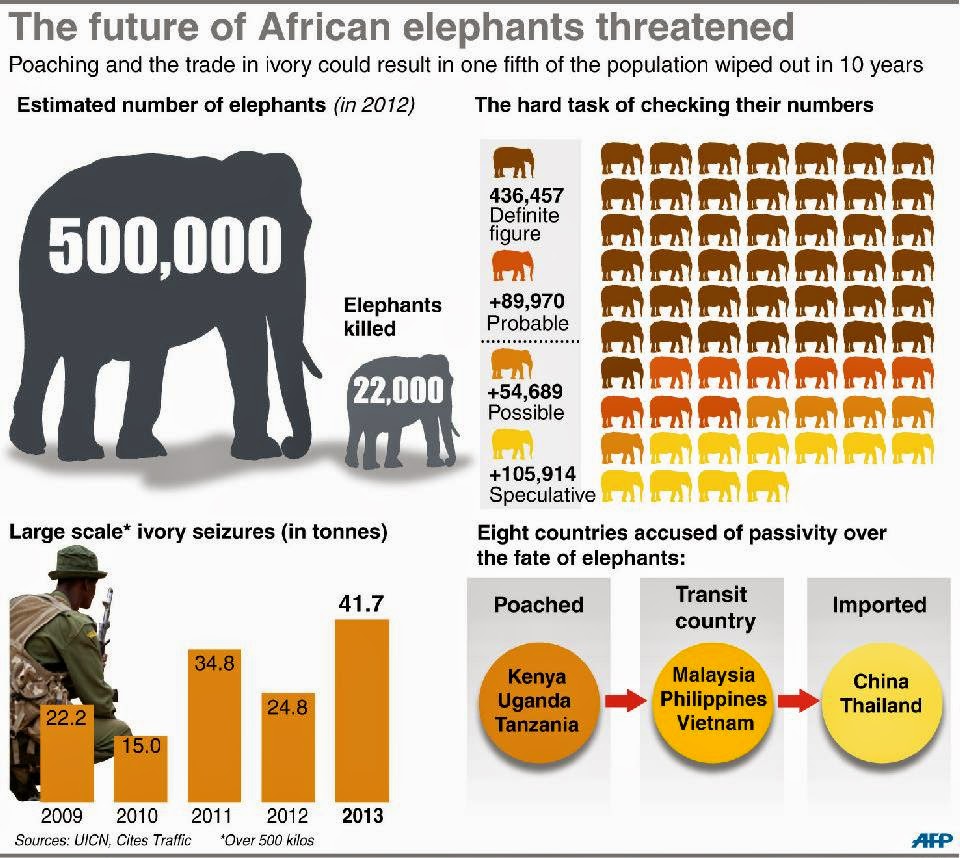
Washington (AFP) - Those who want to protect elephants and rhinoceroses in Africa often face dangerous criminal traffickers who are bold, enterprising and well-equipped, leaders said at the US-Africa summit this week.

For that reason, some African heads of state appealed for more helicopters to protect wildlife ranges, and sophisticated scanners for inspecting cargo for hidden tusks and horns that can sell for more than gold.

But during a discussion on wildlife trafficking, leaders also acknowledged that ending the demand -- primarily from Asia -- for rhino horn and elephant ivory is key.

Park ranger Stephen Midzi patrols a
section of Kruger National Park, in
northern South Africa, scouting for
possible poachers on July 31,
2014 (AFP Photo)
"In the last decade we have seen an alarming trend of increasingly organized, well-equipped and violent criminals turning to wildlife crime," said President Ali Bongo Ondimba of Gabon.

"Today rhinos are often poached from helicopters by teams with sophisticated communications," he said at a panel discussion with the leaders of Tanzania, Namibia and Togo, along with US Interior Secretary Sally Jewell.

The four African leaders, while not necessarily at the epicenter of the poaching crisis, swapped stories about how they had become engaged in a problem that is only getting worse.

Last year, some 20,000 elephants were slaughtered in Africa, outpacing their birthrate, while in South Africa alone, 1,004 rhinos were killed, for a rate of about three per day, said Jewell.

"This hugely profitable illicit activity generates billions of dollars in revenue every year, fueling growth in international criminal syndicates and reversing decades of hard-won conservation gains across the continent," she said.

The trade has taken some leaders by surprise, including President Faure Gnassingbe of Togo who recounted how he learned last year that a shipment of 1,000 elephant tusks from Togo had been stopped in Malaysia.

"I was really surprised because we don't have that many elephants," he said.

When more tusks originating from Togo were stopped in Hong Kong, he realized the problem. They were being trafficked through his tiny West African nation, home to about seven million people and just over 800 elephants.

A search for the criminal led to an arrest of a man who was found with 700 kilograms (1,500 pounds) of elephant tusks, he said.

Park rangers patrol a section of Kruger
National Park, in South Africa, scouting
for possible poachers on July 31, 2014
(AFP Photo)
President Jakaya Kikwete of Tanzania described efforts to bolster the capacities of park rangers, who often find themselves in the line of fire and are killed trying to protect animals.

Adding helicopters, drones, and security forces to the nation's wildlife reserves could help, but only if matched by efforts to quelch demand in Asia, he said.

"If you are able to stop the market for ivory and rhino horns, definitely you will be able to save these species," he said.

But doing that remains a challenge. Ivory markets in China and Thailand are thriving, and in nations like Vietnam and China, ground rhino horn is highly prized for its supposed medicinal effects, including the belief it can cure cancer.

Richard Haas, a retired US diplomat and a board member of Conservation International, said both sides are gaining in tools and technology.

"While capacity is growing on the side of the good guys, capacity is also growing on the side of the poachers. And for every bit of progress one also gets the sense that there are some setbacks," Haas said.

Haas asked the African leaders what kinds of incentives they could offer Asian governments to reduce the ivory and rhino horn demand, but none offered any specifics.

"To talk to the Chinese is something we have done," said the president of Gabon, describing how he broached the topic once with a Chinese official, whom he did not name.

Last year, some 20,000 elephants were slaughtered in Africa, outpacing their
 birthrate, while in South Africa alone, 1,004 rhinos were killed, for a rate of about
three per day (AFP Photo)

After listening to the official describe the importance of pandas in China, he asked what would happen if Africans began propagating the myth that panda hair was good for fertility, and a trafficking onslaught against pandas ensued?

He said the Chinese official looked at him with astonishment.

"And I said, 'You know we feel exactly the same way about our elephants and rhinos.' He understood."

Asked why certain nations were present but not others, an official said the four leaders chosen for the panel represented different regions of Africa with distinct views on the problem and the actions being taken.

"Having governments at high-level meeting saying, 'This is a problem,' is not going to solve anything. But it is a step in the right direction," Sue Lieberman, executive director for conservation policy at The Wildlife Conservation Society, told AFP.

Lieberman said three things need to stop: the killing on the ground, the trafficking and the demand.

"We need everything. We need to be strategic about it. It is not always about high-tech toys."

Tuesday, August 5, 2014

Rescue Efforts Take Place After Nearly 400 Die in China Quake

Jakarta Globe – AFP, Aug 04, 2014

Chinese rescuers carry an injured resident after an earthquake hit an area of
 Ludian county in Zhaotong in southwest China's Yunnan province on Aug. 3,
2014. (AFP Photo)

Kunming. An intense rescue operation was under way in China Monday after an earthquake killed at least 381 people and injured thousands more, leaving scenes of devastation across a mountainous area.

More than 12,000 houses collapsed and 30,000 were damaged in the quake zone in the southwestern province of Yunnan, China’s official news agency Xinhua said.

Soldiers stretchered the injured away from the scene in the immediate aftermath, one carrying an elderly man on his back another a child in his arms, with residents fleeing in terror as aftershocks hit.

Rescuers rushed victims to local hospitals and as dawn broke Monday continued to pick through the rubble of destroyed homes in a desperate search for survivors.

Images on social media showed painstaking attempts to extricate residents from the rubble of their homes, while reports said heavy rains were hampering rescue efforts.

In Ludian county, the worst-affected area, Xinhua said its reporters “saw drenched survivors sit along the muddy roads waiting for food and medication. Some half-naked survivors were quivering in the rain.”

A total of 7,000 emergency personnel, including 5,000 soldiers, police and firefighters had been mobilised, Xinhua said Monday, and Premier Li Keqiang was heading to the scene.

Equipment brought to the area included life detection instruments and excavating tools.

“They are also battling the continual downpour that has brought down the temperature in the remote area and made shortages of food and medicine even more pernicious,” Xinhua added.

Volunteers from across China were heading to Yunnan to assist. At the airport in the provincial capital Kunming, one group were discussing how to reach the worst hit areas.

“It is our duty to help,” one told AFP.

A total of 381 people had been killed by the tremor, with 1,801 injured, according to China’s Ministry of Civil Affairs.

Users of China’s Twitter-like Sina Weibo expressed sympathy for the victims, posting images of candles and crying faces.

“May the dead rest in peace and the living be strong,” read one typical comment.

Scene ‘like a battlefield’

The US Geological Survey (USGS) reported the quake at a magnitude of 6.1 and said it struck at a relatively shallow depth of 10 kilometers.

“Too many buildings were damaged and we are collecting data on deaths and injuries,” Xinhua quoted local official Chen Guoyong as saying in Longtoushan, the township at the epicentre.

State television broadcast footage of people running from their homes and gathering in the streets, as witnesses described the devastation on social networks.

A Ludian resident described the scene as resembling a “battlefield after bombardment”, telling Xinhua: “I have never felt [such] strong tremors before. What I can see are all ruins.”

Volunteer Ma Hao, a college student who was helping to carry the injured out of the collapsed buildings in Longtoushan, described a race to pull the living from the rubble that left little time for the dead.

“We had no time to take care of the bodies. We need to help those alive first,” he told Xinhua.

Electricity and telecommunications have been cut across the area and 57,200 residents need to be transferred to safe areas, Xinhua reported.

Ludian has a population of nearly 266,000 and sits more than 300 kilometres north of the provincial capital Kunming.

A spokesman for UN chief Ban Ki-moon said the secretary general was “saddened by the loss of life”, while the White House National Security Council also offered condolences, and said the United States “stands ready to assist.”

Chinese state media put the magnitude of the first earthquake at 6.5, citing the China Earthquake Networks Center.

Southwest China lies where the Eurasian and Indian plates meet and is prone to earthquakes. In 1974, a 6.8-magnitude quake in the same area killed more than 1,500 people.

In Sept. 2012, 80 people were killed when twin earthquakes struck the mountainous border area of Yunnan and Guizhou.

An 8.0-magnitude quake in May 2008 rocked Sichuan, which neighbors Yunnan, killing tens of thousands of people and flattening swathes of the province.

Sunday, August 3, 2014

India evacuates Bihar villages after landslide in Nepal

Authorities in India have begun evacuating villagers after efforts to clear a landslide in Nepal sparked fears of flash floods. The landslide early Saturday killed at least eight people and buried dozens of homes.

Deutsche Welle, 2 Aug 2014


The landslide created a mud dam blocking the Sunkoshi river, which flows into India's Bihar state as the Kosi. Indian officials say water levels have risen above the danger mark and authorities fear that water could inundate hundreds of Bihar's villages as Nepal attempts to clears the debris.

"We are repeatedly appealing to villagers settled along the Kosi embankments to flee to safer places as soon as possible," Vysaji, the principal secretary in Bihar's disaster management department, told reporters late Saturday. "The blasting of blockage in river could result in a 10-meter (33-foot) high wall of water sweeping down Kosi into Bihar which could bring trouble," added Vysaji, who goes only by one name.

Nepal's army announced that it had started opening the dam by setting off two controlled blasts and that water had started to drain out slowly. Indian authorities, taking no chances, have put eight districts under flood alert, and begun evacuations in the districts of Supaul, Madhubani and Saharsa. Authorities have also opened sluice gates at a barrage along the Kosi at the border, deployed rescue teams and sent more than 200 boats to evacuate villagers.

The disaster preparations come just days after a landslide killed dozens of people in India.

'We are looking'

The landslide hit early Saturday in Nepal, burying two dozen homes before dumping mud and stones into the river, northeast of the capital, Kathmandu. Officials have recovered eight bodies from the debris of dozens of collapsed houses so far, and police have warned that the death toll will likely rise.

At least 40 people were injured, four of them critically. More than 100 people remain missing, and at least 5,000 have been displaced.

"The landslide has caused huge damage," Bharat Bahadur Bohara, a police officer, told the news agency Reuters. "We cannot make any estimates of the number of deaths now. We are looking for other people who might be trapped."

Nepalese authorities have also asked residents in downstream villages to evacuate as the mud dam could collapse at any time.

mkg/hc (Reuters, AFP, dpa, AP)

Saturday, August 2, 2014

India Landslide Rescuers Press On Despite ‘Very Slim Chances’ As Toll Hits 73

Jakarta Globe – AFP, Aug 02, 2014

Rescuers search for landslide victims in torrential rain. (AFP Photo)

Rescuers continued digging Saturday despite ‘very slim chances’ of finding any more people alive in the mud and debris from a major landslide in western India, where 73 have been killed.

Seventy–three bodies and eight survivors have now been pulled from the site where a village once stood in a remote part of western Maharashtra state, but incessant rains, marshy terrain and strong winds have hampered rescue efforts.

“Whole night the operation was on. We were able to recover 73 dead, eight alive,” Alok Awasthi, commandant of the National Disaster Response Force [NDRF], told NDTV news channel adding half the work had been completed.

“Around 80 people are still feared trapped… chances of survival are very very slim.”

The NDRF has said about 160 people were thought to have been living in the dozens of houses damaged when a hill gave way and cascaded onto their village of Malin.

The force, which mobilised 378 rescue workers to help with the search, worked into the night and entered its fourth day in a desperate hunt for any more survivors after lights powered by portable generators were set up.

The rescue operation could continue another two days due to difficult conditions, state relief and rehabilitation minister Patangrao Kadam said, according to the Press Trust of India news agency.

Grieving relatives have been rushing to identify bodies and attending mass cremations at their village after losing whole families as tonnes of earth and trees came crashing down onto the homes below on July 30.

“I’m shell-shocked… our roots [at Malin] have been wiped out in an instant,” Vilas Jhanjre, a factory worker, told The Hindu newspaper after he failed to find his parents’ bodies at the wiped–out village and nearby hospital.

“Life ceases to have meaning without one’s parents.”

Dramatic footage of the landslide showed a chunk of hillside giving way with a cascade of mud, rocks and trees, sending up clouds of dust below.

Disaster experts and Maharashtra Chief Minister Prithviraj Chavan have blamed the landslide on deforestation and construction work on the hills.

While India’s annual rains are a lifeline for the economy, flooding and building collapses are frequent during the monsoon season.

A landslide in the eastern state of Odisha on Thursday cut off about a dozen villages, while another in the northern Himalayan state of Uttarakhand killed at least five people.

Uttarakhand was hit by a landslide and flooding disaster last year that is thought to have killed nearly 6,000 pilgrims, tourists and others.

A separate landslide struck a village in northeastern Nepal Saturday killing at least seven people with dozens missing.

Agence France-Presse

Friday, August 1, 2014

Giraffe dies being transported along a S.African highway

Yahoo – AFP, 31 July 2014

A giraffe at Kruger National Park in South Africa on June 21,
2010 (AFP Photo/Pierre-Philippe Marcou)

Johannesburg (AFP) - A young giraffe died Thursday from head injuries sustained while being transported, blindfolded, in an open truck along a South African highway, an animal welfare agency said.

Society for the Prevention of Cruelty to Animals (SPCA)'s Rick Allan told AFP he suspected the giraffe died after hitting its head against an overhead bridge.

The SPCA has launched investigations and may lay criminal charges against those involved in transporting the animals.

"Two giraffes were being transported by road... one of the giraffes had an incident. We are not quite sure what happened, but we got unconfirmed reports that it hit its head on a bridge," he said.

A veterinarian had determined that the giraffe, which he described as young, "had died due to head injuries," he said. The second animal is alive and well, he added.

It was unclear where the animals were being moved from or where they were being taken to, or if they were wild or belonged to a zoo, he said.

The incident took place between the capital Pretoria and the commercial hub of Johannesburg.

"Our investigations so far showed that the transport used was inadequate and incorrect," said Allan.

"There are lots of projectiles flying around on the highway (and) especially leaving an animal with its heard sticking out blindfolded, is looking for problems."