Robber fly - Nature photographer Thomas Shahan specializes in amazing portraits of tiny insects. It isn't easy. Shahan says that this Robber Fly (Holcocephala fusca), for instance, is "skittish" and doesn't like its picture taken.

Nature by Numbers (Video)

"The Greater Akashic System" – July 15, 2012 (Kryon Channelling by Lee Caroll) (Subjects: Lightworkers, Intent, To meet God, Past lives, Universe/Galaxy, Earth, Pleiadians, Souls Reincarnate, Invention: Measure Quantum state in 3D, Recalibrates, Multi-Dimensional/Divine, Akashic System to change to new system, Before religion changed the system, DNA, Old system react to Karma, New system react to intent now for next life, Animals (around humans) reincarnate again, This Animal want to come back to the same human, Akashic Inheritance, Reincarnate as Family, Other Planets, Global Unity … etc.)

Question: Dear Kryon: I live in Spain. I am sorry if I will ask you a question you might have already answered, but the translations of your books are very slow and I might not have gathered all information you have already given. I am quite concerned about abandoned animals. It seems that many people buy animals for their children and as soon as they grow, they set them out somewhere. Recently I had the occasion to see a small kitten in the middle of the street. I did not immediately react, since I could have stopped and taken it, without getting out of the car. So, I went on and at the first occasion I could turn, I went back to see if I could take the kitten, but it was to late, somebody had already killed it. This happened some month ago, but I still feel very sorry for that kitten. I just would like to know, what kind of entity are these animals and how does this fit in our world. Are these entities which choose this kind of life, like we do choose our kind of Human life? I see so many abandoned animals and every time I see one, my heart aches... I would like to know more about them.

Answer: Dear one, indeed the answer has been given, but let us give it again so you all understand. Animals are here on earth for three (3) reasons.

(1) The balance of biological life. . . the circle of energy that is needed for you to exist in what you call "nature."

(2) To be harvested. Yes, it's true. Many exist for your sustenance, and this is appropriate. It is a harmony between Human and animal, and always has. Remember the buffalo that willingly came into the indigenous tribes to be sacrificed when called? These are stories that you should examine again. The inappropriateness of today's culture is how these precious creatures are treated. Did you know that if there was an honoring ceremony at their death, they would nourish you better? Did you know that there is ceremony that could benefit all of humanity in this way. Perhaps it's time you saw it.

(3) To be loved and to love. For many cultures, animals serve as surrogate children, loved and taken care of. It gives Humans a chance to show compassion when they need it, and to have unconditional love when they need it. This is extremely important to many, and provides balance and centering for many.

Do animals know all this? At a basic level, they do. Not in the way you "know," but in a cellular awareness they understand that they are here in service to planet earth. If you honor them in all three instances, then balance will be the result. Your feelings about their treatment is important. Temper your reactions with the spiritual logic of their appropriateness and their service to humanity. Honor them in all three cases.

Dian Fossey's birthday celebrated with a Google doodle

Dian Fossey's birthday celebrated with a Google doodle
American zoologist played by Sigourney Weaver in the film Gorillas in the Mist would have been 82 on Thursday (16 January 2014)
Showing posts with label Food - Beverages. Show all posts

Wednesday, August 30, 2017

Dutch dairy cows to be sent to Siberia, in a bid to up milk production

DutchNews, August 29, 2017


French dairy company Danone, owner of Dutch company Numico, is going to export five thousand Dutch and German dairy cows to Russia, the Volkskrant reported on Tuesday. 

The animals will be transported over a distance of 4,500 kilometres to a farm in Tyumen in Western Siberia. 

The reason for the move by Danone, which does not normally trade in cattle, are the rising milk prices in Russia. The country closed its borders to Western European cheese in a reaction to the European boycott over Ukraine. That, in turn, means local milk is now used to make Russian cheese causing milk prices to spike.

This year alone milk prices have gone up by 14% in Russia. ‘ This is endangering the production of dairy products, such as yoghurt,’ head of Danone’s Russian unit told Bloomberg. By having the cattle graze in Russia the company is hoping to bring down the price of milk. 

Tuesday, August 15, 2017

Bugs on the menu at Swiss supermarket

Yahoo – AFP, August 14, 2017

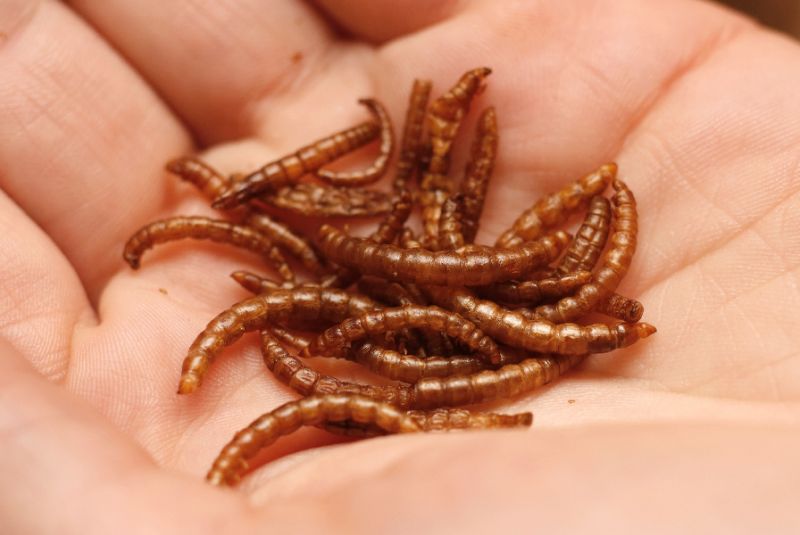
Protein-rich mealworms make up the bulk of the "insect balls" due to go on
sale at Switzerland's Coop supermarket (AFP Photo/Dieter Nagl)

Geneva (AFP) - Switzerland's first insect-based food aimed at humans will go on sale next week following a revision of the country's food safety laws, a supermarket chain said Monday.

Switzerland's second-largest supermarket chain, Coop, announced it would begin selling an insect burger, and insect balls, based on protein-rich mealworm.

The products, made by a Swiss start-up called Essento, will be available in a handful of Coop branches, including in Geneva, Bern and Zurich, as of August 21, according to a statement.

Switzerland is the first European country to authorise the sale of insect-based food items for human consumption, a spokeswoman for the country's food safety authority told AFP.

Swiss food safety laws were changed last May to allow for the sale of food items containing three types of insects: crickets, grasshoppers and mealworms, which are the larval form of the mealworm beetle.

These insects, long used in animal feed, must be bred under strict supervision for four generations before they are considered appropriate for human consumption, according to Swiss law.

Local production will thus take a few months to get started.

In the meantime, imports are possible under strict conditions -- the insects must be raised in accordance with the Swiss requirements at a company submitted to inspections by national food safety authorities.

Related Article:


Sunday, November 13, 2016

Vanilla and spice next to bloom in Dutch greenhouses

Yahoo – AFP, Maude Brulard, November 12, 2016

University of Wageningen researcher Filip van Noort and vanilla grower Joris
Elstgeest inspect vanilla orchids, part of four years of ground-breaking research
(AFP Photo/Maude Brulard)

Bleiswijk (Netherlands) (AFP) - Flowers more exotic than the humble tulip will soon flourish for the first time in Dutch greenhouses after intensive research into growing the capricious vanilla orchid to harvest one of the world's most expensive spices.

In the middle of potato fields in a central Dutch rural town, scientists from Wageningen University have for the past four years been nurturing vanilla orchids. And their research has been deemed a success.

"Based on our information, businesses believe vanilla is a plant with a lot of potential for Dutch greenhouses and have decided to start growing it," said researcher Filip van Noort.

How many orchids will be planted will be decided at the start of the next growing season in the spring, and it will take at least three years before the first Dutch-grown vanilla hits the market.

In Bleiswijk, home to the ground-breaking research, vines from about 100 plants stretch metres high in hot, tropical greenhouses. Hidden under fleshy, oval-shaped leaves are the buds, that will eventually become the vanilla pods so prised by chefs the world over.

"The challenge is to ensure the plants blossom and then to be able to pollinate them in a cost-effective way," said van Noort.

Cultivation of the vanilla orchid is hugely labour intensive as the orchid's flowers 
only last one day and must be pollinated by hand if they are to produce fruit
 (AFP Photo/Maude Brulard)

Black gold

Cultivation is hugely labour intensive. The orchid's flowers only last one day and must be pollinated by hand if they are to produce fruit. So it was an apt challenge for the Dutch -- renowned for their green fingers and their expertise in greenhouse cultivation.

"A few years ago we were looking for new plants which could be grown in Dutch greenhouses," explained van Noort.

The aim was to increase the variety of crops grown by Dutch farmers as they search for improved profits.

Vanilla made sense. Currently the Indian Ocean island of Madagascar holds a quasi-monopoly over world supply producing some 80 percent of global vanilla bean stocks.

It is also the world's second most expensive spice, with prices climbing to 350 euros ($380) a kilo this month -- compared with 60 euros in 2014.

"In the past the price was too low to be interesting. But today, with demand increasing, the prices are rising," said orchid expert Joris Elstgeest.

The long, black vanilla pods, with their distinctive caramel and at times woody scent, have to be collected by hand from the vines and then dried before being sold.

It is the sticky tiny black seeds scraped from inside the pods which are a baker's delight, lending an almost intoxicating flavour to everything from cakes and ice-cream.

The long, black vanilla pods, with their distinctive caramel and at times woody scent, 
have to be collected by hand from the vines and then dried before being sold 
(AFP Photo/Maude Brulard)

All organic

Originating from Mexico, the vanilla orchid was brought to Europe by Spanish explorer Christopher Columbus. But all attempts to grow it in milder climates failed for lack of the type of bee which pollinated the flowers.

It was not until 1841 that someone on the island of Reunion figured out how to pollinate the flowers one-by-one.

That method finally paved the way towards large-scale production, with Madagascar proving the most effective of growers.

But even if prices fall and as other countries explore possible vanilla crops, Dutch growers believe it will prove a good investment.

In past decades, synthetic vanilla flavourings were increasingly adopted by the food industry. But with a return to all things authentic and organic, the real stuff is making a welcome return.

Bleiswijk vanilla is wholly organic, say its Dutch growers, unlike in Madagascar, they claim.

Vanilla is also the world's second most expensive spice, with prices climbing
 to 350 euros ($380) a kilo this month -- compared with 60 euros in 2014 
(AFP Photo/Maude Brulard)

Half of Madagascar's vanilla is exported to Europe, and a third to the United States. But clients say the quality has been slipping, with producers harvesting the pods before they reach maturity to cash in on the price boom.

Some Madagascans even speculate the vanilla industry is being used as a front for the illegal trade in rosewood –- a sought-after product in China.

The Dutch consortium behind the project says it has already received lots of interest from local high-end restaurants as well as food companies.

The Netherlands is a global leader in the art of greenhouse growing with almost 10,000 hectares of this lowlands country set with rows of glasshouses growing all kinds of flowers, fruits and vegetables -- compared to just 1,900 hectares in France.

And researchers are already setting their sights on other spices.

"We've also got black pepper, which seems to be adapting well," said van Noort, adding indigo used to dye blue jeans was another project.

And perhaps saffron -- the world's most expensive spice derived from the saffron crocus -- could be next to flourish here.

Wednesday, October 5, 2016

Cow manure power plan steams ahead

DutchNews, October 4, 2016

Grass: a new potential power source.
Photo: DutchNews.nl
Two hundred farmers will soon be generating electricity from cow manure and there are plans to recruit 1,000 in four years, reports NOS on Tuesday.

FrieslandCampina, the largest dairy collective in the Netherlands, set up a business in September called Jumpstart to channel subsidies to farmers who want to install mono-digesters that break down waste into biogas.

Henk Kamp, minister for economic affairs, has committed €150m to the project and turned on the first mono-digester in Friesland on Tuesday morning.

FrieslandCampina plans to pay farmers a surcharge of €10 per thousand litres of milk they sell if they buy a mono-digester, and currently works with 13,500 of the Netherland’s 17,000 farmers. The organisation has committed to carbon-neutral growth, and currently most of the 13% of carbon emissions from the agriculture sector come from methane released by cow manure. 

There has been some debate about whether it is sustainable to generate electricity from cow dung, since mono-digesters only become profitable for a farm of at least 150 cattle. 

On Monday, FrieslandCampina announced that it wants to change its profit-sharing scheme with members, abolishing a quantum allowance and effectively stopping seasonal payments to farmers. It intends to increase its premium for outdoor grazing to €1.50 per 100kg of milk (from €1), and final proposals will be agreed in December.

Related Articles:


(39) Question: Dear Kryon: I've noticed how many children are developing severe allergies to foods (my daughter included). When I've researched this, it seems that most of the allergies are essentially to seeds, grains, legumes, eggs, and dairy. I've noticed that these foods all hold the potential for life, or in the case of dairy, are essentially used to sustain the first stages of life in an animal's baby. My feeling is that because we're not releasing the life force within these foods (that is, sprouting, etc.), they're becoming harmful to us. I would like your impressions of this.

Answer: For thousands of years, these foods have worked for humanity. In these cases you speak about, the main culprit continues to be the way in which these foods are collected and processed. You won't find these allergies in third-world countries, and you won't find them within the children who work on farms, where they eat the foods directly. There will eventually have to come a day when you relax some of your efficiency attributes and go back to the way food was meant to be collected and eaten. And yes... there are effects from how the dairy animals are treated, too. Going back to some basics will help, and so will eliminating some of the procedures that supposedly create a "safer food." These procedures have instead made them begin to look like foreign food to the Human body.

Tuesday, August 11, 2015

Scotland to ban genetically modified crops

Scotland's government says it plans to ban the cultivation of genetically modified crops. While widely grown in the Americas and Asia, there is more skepticism over the practice in Europe.

Deutsche Welle, 9 Aug 2015


Scotland's Environment Ministry announced Sunday it intended to ban the growth of genetically modified crops on its territory in order to cultivate its "clean and green brand" of products.

No GM crops are currently grown commercially in Britain, though the central government in London says it supports the use of GM crops if they are safe.

Richard Lochhead, the Scottish government's minister for the environment, food and rural affairs, said Sunday he planned to take advantage of new European Union rules allowing countries to opt out of growing EU-authorized GM crops.

GM crops, including maize, have been the
subject of numerous protests in the EU
"The Scottish government will shortly submit a request that Scotland is excluded from any European consents for the cultivation of GM crops, including the variety of genetically modified maize already approved and six other GM crops that are awaiting authorization," Lochhead said in a statement.

The minister said there is no domestic market for GM crops and it wanted to strengthen its brand of exports, especially its food and drink sector worth an annual 19.78 billion euros ($21.7 billion).

"Scotland is known around the world for our beautiful natural environment - and banning growing genetically modified crops will protect and further enhance our clean, green status," Lochhead said.

Health debate

GM crops are the subject of global debate, with some environmental and health groups questioning their environmental impact. Producers, however, insist they are safe.

The Scottish government in Edinburgh has been responsible for mainly domestic policies, including agriculture, since 1999 when power was devolved from the central government in London.

jar/cmk (Reuters, AFP)
Related Article:

“..  Health

Normal good health is turning to simple physics for some of the simplest things. New kinds of foods are being grown with new physics, not chemistry. These will be physic-foods [Kryon name] that are not genetically altered or chemically altered, but benevolently enhanced by physics! This causes a new kind of super growth that can feed the planet in a way it's never been fed before. It will create food that is resistant to absolutely everything - insects, bacteria and disease - all through physics. Who thought of that? What you're expecting in the future regarding health is based upon the past. The big filter of past knowledge keeps you from thinking out of the box. You don't know what you don't know.  ….”

Sunday, June 28, 2015

Pets doing their bit for the economy

Every third German household is home to a pet. Dogs and cats, as expected, are the most popular. But what you might not know is how much money Germans spend every year for their beloved animals. DW takes a look.

Deutsche Welle, 27 June 2015


For German pet owners, their loved ones don't come without a price.

Nine billion euros, to be exact.

When it comes to producing food for pets, we're talking about 3.5 billion euro ($3.9 billion) revenues for producers. At least a third of all households have a pet - that amounts to a good 26 million animals living across Germany.

The untouched leader of all pets is the cat - there are 8.2 million house felines Germany. Around 5.4 million dogs are in position two. That's followed by rabbits, hamsters and guinea pigs who clock in at just above 5 million.

The economic impact of all this is significant: around 7 percent of all supermarket revenues in larger cities go to pet food.

Dogs can wolf down an awful lot of food...

Dog tax

Millions of hearts are moved by house pets - and billions of euros.

The costs aren't just for food. What about the equipment?

"We're talking about 30 euros for a leash, and then there's the kennel and stuff like that," says Martina Glitz, who owns a pet shop.

According to Glitz, dog owners are set back around 100 euros per month in the end.

And buying a dog isn't cheap either. Depending on the race, ranging from shepherds to labradors, a puppy can cost up to 1,500 euros here in Germany.

And what if your puppy misbehaves? Dog school rates are pretty hefty here, and they are seen as obligatory among neighbors. An hour will set you back 50 euros.

Last but not least - let's not forget the dog tax. Depending on where you live in this country, that could mean between 50 and 300 euros per year.

Dog sunglasses for convertible ride

These are just the basics.

Dog sunglasses for a ride in your convertible? That'll cost you around 80 euros. Pedicure for your collie? No comment on that particular cost…

And what about insurance?

Cats aren't cheap either...
As soon as your public liability insurer finds out that you've bought a dog, don't yelp if your rates go up between 70 and 180 euros. And that's without the premium packages offered by some pet insurance companies - depending on your coverage, we're talking about 150 to 400 euros for those.

Cats are pretty cheap - at first glance.

But after food and other expenses, says Martina Glitz, they're expensive too.

"You've got your food expenses at around 30 euros. And then your treats will cost you 10, and your veterinarian costs you around 30 on top. So don't think you'll get away with a cat for under 80 euros."

German families are more than willing to fork it out for their beloved domestic animals. And their willingness - once again, 9 billion euros - puts them almost at the top of the rankings when it comes to pet lovers in Europe.

The Brits have that position for now. But industry experts say the Germans will soon overtake them.

Whoof. Meow. (What does a guinea pig say?)

Related Article:

Question: Dear Kryon: I live in Spain. I am sorry if I will ask you a question you might have already answered, but the translations of your books are very slow and I might not have gathered all information you have already given. I am quite concerned about abandoned animals. It seems that many people buy animals for their children and as soon as they grow, they set them out somewhere. Recently I had the occasion to see a small kitten in the middle of the street. I did not immediately react, since I could have stopped and taken it, without getting out of the car. So, I went on and at the first occasion I could turn, I went back to see if I could take the kitten, but it was to late, somebody had already killed it. This happened some month ago, but I still feel very sorry for that kitten. I just would like to know, what kind of entity are these animals and how does this fit in our world. Are these entities which choose this kind of life, like we do choose our kind of Human life? I see so many abandoned animals and every time I see one, my heart aches... I would like to know more about them.

Answer: Dear one, indeed the answer has been given, but let us give it again so you all understand. Animals are here on earth for three (3) reasons.

(1) The balance of biological life. . . the circle of energy that is needed for you to exist in what you call "nature."

(2) To be harvested. Yes, it's true. Many exist for your sustenance, and this is appropriate. It is a harmony between Human and animal, and always has. Remember the buffalo that willingly came into the indigenous tribes to be sacrificed when called? These are stories that you should examine again. The inappropriateness of today's culture is how these precious creatures are treated. Did you know that if there was an honoring ceremony at their death, they would nourish you better? Did you know that there is ceremony that could benefit all of humanity in this way. Perhaps it's time you saw it.

(3) To be loved and to love. For many cultures, animals serve as surrogate children, loved and taken care of. It gives Humans a chance to show compassion when they need it, and to have unconditional love when they need it. This is extremely important to many, and provides balance and centering for many.

Do animals know all this? At a basic level, they do. Not in the way you "know," but in a cellular awareness they understand that they are here in service to planet earth. If you honor them in all three instances, then balance will be the result. Your feelings about their treatment is important. Temper your reactions with the spiritual logic of their appropriateness and their service to humanity. Honor them in all three cases.

Tuesday, June 23, 2015

Chinese woman pays to rescue 100 dogs from meat festival: report

Yahoo – AFP, 22 June 2015

Animal-loving Yang Xiaoyun (C) pays about 7,000 yuan (US$1,100) to save
 around 100 dogs in Yulin in southern China's Guangxi province on June 20, 2015 
(AFP Photo)

Yulin (China) (AFP) - A Chinese woman has paid over $1,000 to save 100 canines from being eaten during a dog meat festival, media said, as activists have lashed out at the event labelling it cruel.

Animal-loving Yang Xiaoyun paid about 7,000 yuan (US$1,100) to save around 100 dogs in the southern city of Yulin on Saturday, web portal Netease reported.

Vendors wait for customers to buy 
dogs in cages at a market in Yulin
 in southern China's Guangxi province 
on June 21, 2015 (AFP Photo)
The city holds an annual festival devoted to the animal's meat on the summer solstice, which has provoked an increasing backlash from animal protection activists.

Reports said that Yang, 65, plans to rehouse the dogs at her home nearly 2,000 kilometres (124 miles) away in Tianjin.

Pictures posted online showed her browsing a market in Yulin where the dogs were kept in cages.

Activists, who say the festival is cruel, have in the past travelled to the city to hold demonstrations, sometimes buying dogs to save them from the cooking pots.

Locals have been quoted as saying that animals are killed in a humane way for the festival, where their meat is then served with lychees.

The majority of "meat dogs" in the country are stolen pets and strays, according to an investigation published this month by Hong Kong-based charity Animals Asia, though eating dog is unusual in most parts of China.

Around 30 million households in the country are estimated to keep dogs as pets, helping to fuel the growing animal rights movement.

This year the festival has been targeted by British Comedian Ricky Gervais, who posted a series of messages on Twitter with the hashtag "StopYuLin2015".

Cooked dogs hang at a stall in Yulin in southern China's Guangxi province
on June 21, 2015 (AFP Photo)

The city's government has tried to distance itself from the event.

"Some residents of Yulin have the habit of coming together to eat lychees and dog meat during the summer solstice," the city's news office wrote on Sina Weibo, a Chinese Twitter equivalent.

"The 'summer solstice lychee and dog meat festival' is a commercial term, the city has never (officially) organised a 'dog meat festival'," it added.

Eating dog is not illegal in China, but the government called on meat vendors to respect food safety laws.

"Yulin is an open, tolerant and civilised city," it said. "We welcome people across the world to pay attention to Yulin."


Dogs hung out at a butcher's stall in Yulin, Guangxi, 2014. (Photo/CFP)

Related Article:


Saturday, June 20, 2015

Dog meat festival in China draws international criticism

Want China Times, Chen Po-ting Staff Reporter, 2015-06-20

Dogs hung out at a butcher's stall in Yulin, Guangxi, 2014. (Photo/CFP)

Amid abounding criticism at home and abroad, the The Yulin Dog Meat Festival will kick off on June 21. Dog meat sellers in Guangxi said they felt the festival has been stigmatized but are remaining resilient and preparing their dogs all the same, writes our sister paper China Times.

The controversial "Dog Meat Festival" is viewed as a traditional summer event for those living in Yulin, Guangxi Zhuang autonomous region. In recent years, many animal welfare groups have come out against the festival, calling it crueal and inhumane to man's best friend.

Major animal group Humane Society International (HSI) filmed a short documentary on dogs being slaughtered in Yulin's dog meat butcheries. The film got many concerned about the practice, with British comedian Ricky Gervais even asking his fans to sign a petition to ban the festival and the dog meat trade. He said that the film broke his heart and that he would never forget the faces of those slaughtered dogs. He went on to say that no animal should be treated like that.

Netizens also took to Twitter, with over 250,000 people tweeting "Stop Yulin."

Peter Li, a staff from HIS stated that he saw hundreds of dogs killed and hung out on the street. There were also cats jammed into crowded cages, some not even having the ability to stand and just waiting for death. There was also blood, organs, and bones scattered everywhere, Li said.

Facing wave after wave of condemnation, Yulin's dog sellers said that the event is a traditional festival which began with their ancestors and that the dogs are mainly from puppy mills.

One dealer threatens to strangle the dog if no one offers a better
price. A woman instantly pays his price. (Photo/CFP)

Related Articles:

Sunday, May 17, 2015

Mozart-Loving Chickens May Answer Quest for Healthier Nugget

Jakarta Globe, Naveen Thukral & Gavin Maguire, May 17, 2015

Chickens bred with drug-free feed rest in their coop as lights are dimmed and
 classical music by Mozart is being played in the background at Kee Song Brothers'
 drug-free poultry farm in Yong Peng, in Malaysia's southern state of Johor
April 16, 2015. (Reuters Photo/Edgar Su)

Yong Peng, Malaysia. In barns filled with classical music and lighting that changes to match the hues outside, rows of chickens are fed a diet rich in probiotics, a regimen designed to remove the need for the drugs and chemicals that have tainted the global food chain.

As food giants face growing pressure to offer healthier produce, Southeast Asian poultry firm Kee Song Group says its use of “good” bacteria in feed and water means it can meet one the industry’s biggest challenges: how to mass produce drug and hormone-free poultry at a reasonable price.

A series of scandals in the last few years —from melamine-tainted milk powder in China, horse meat supplied as beef in Europe and growth drugs causing lameness in US cattle — has triggered a consumer backlash over food standards and safety.

Recently, Tyson Foods pledged to eliminate the use of human antibiotics in chicken by 2017, one of the most aggressive timetables yet by a US poultry firm.

The top American poultry producer, which supplies fast-food chains such as McDonald’s, is among a number of groups globally incorporating probiotics into feed.

“For meat producers, reputation risks are becoming stronger driving companies to focus on safe ingredients specially in Europe and the United States,” said Pawan Kumar, director for food and agricultural research at Rabobank in Singapore.

Kee Song says the cost to produce drug-free chickens using probiotics is now only 10-12 percent more than using antibiotic-fed poultry. It sells these birds at a 30 percent premium in stores, far less than expensive free-range organic chicken.

The firm annually produces around 4 million drug-free birds at its Malaysian farms in Yong Peng, 125 km north-west of Singapore, and aims to expand sales to China and the West.

“Probiotics, either alone or in combination with essential oils and organic acids, are at the forefront of international approaches to replace antibiotics,” said Wayne Bryden, Professor of Animal Science at the University of Queensland.

Probiotics populate the gut with healthy bacteria in a bid to curb bad bacteria, while oils and organic acids are also often included in feed to aid digestion.

A team at the Australian university, partly funded by feed maker Ridley AgriProducts, have found in preliminary trials that using a probiotic can double the efficiency of use of protein from feed to boost weigh gain in livestock.

Superbugs

An estimated 80 percent of antibiotics used in the United States are administered to livestock with the use expected to surge by two thirds globally between 2010 and 2030.

Scientists are worried the practice could spur antibiotic-resistant superbugs.

McDonald’s has also pledged to eliminate chickens fed on human antibiotics at its US restaurants and is looking at similar steps in Asia.

“In Asia Pacific, we will be working with our supply partners and relevant experts to implement this enhanced measure,” a company spokesperson said via email.

While demand for healthier products is increasing fast in the West, some experts say that in parts of Asia customers will not be prepared to pay more for drug-free poultry, though China could be a promising market after high-profile food scares.

Mozart and blue lighting

In Kee Song’s Malaysian poultry farm, 20,000 chickens rest on saw dust in the dimly lit barns, with feed and water laced with probiotics being automatically pumped into feeding pans.

As well as playing Mozart, lighting is used in a bid to keep the birds tranquil with neon blue lighting turned on when the birds are taken for slaughter.

“Look at the environment, chickens stay healthy and happy here,” the firm’s Chairman Ong Kee Song told Reuters.

“Even the droppings don’t smell,” added Ong, who has been a vegetarian for 17 years after a stay at a Buddhist temple.

Traditional chicken farms are notorious for producing noxious fumes as well as loud noise from squawking birds.

Growth hormones mixed with feed can also produce oversized breasts and wings that underdeveloped legs struggle to support for more than a few steps.

Chia Tet Fatt, a molecular geneticist who previously was a professor at Singapore’s Nanyang Technological University teamed up with Kee Song to produce the probiotic used, lactobacillus, and confirmed chickens were not fed any drugs or antibiotics.

Tan Chee Kiang, vice president of Charoen Pokphand, the world’s biggest animal feed miller, also said the feed it supplied to Kee Song was free of antibiotics.

By not using drugs, the poultry farms need to maintain stringent cleanliness measures to avoid the risk of infection and it takes three days more than conventionally produced chickens to attain a commercially viable weight of 1.8 to 2.0 kg.

As well as supplying supermarkets, Kee Song also sells to some restaurants in Singapore, including French restaurant Cocotte, where the chicken is used for a signature dish.

Reuters

Tuesday, March 10, 2015

More than two million migratory birds killed in Cyprus

Yahoo – AFP, 9 Mar 2015

More than two million migratory birds were killed in Cyprus last autumn to feed 
an illicit taste for the delicacy on the Mediterranean island, a conservationist 
group said Monday (AFP Photo/Francois Nascimbeni)

Nicosia (AFP) - More than two million migratory birds were killed in Cyprus last autumn to feed an illicit taste for the delicacy on the Mediterranean island, a conservationist group said Monday.

The survey by Birdlife Cyprus was carried out in the key season between September and October and estimates the number of birds indiscriminately trapped in nets or with limesticks.

The group said its surveillance showed "a dramatic situation of this illegal activity sadly taking place," with the number of mist nets used almost doubling in 2014 from the year before.

It found some 16 kilometres (10 miles) of net supports active during autumn and more than 6,000 limesticks were reported from enforcement agencies and other non-governmental organisations.

Limesticks are twigs covered in a sticky substance that instantly trap birds that alight onto them, leaving them to dangle helplessly.

"With these trapping levels for autumn 2014, BirdLife Cyprus estimated that over two million birds could have been killed across the whole of Cyprus," said Birdlife, the most since it began monitoring the activity 13 years ago.

Such methods are used to catch blackcaps and song thrushes, much sought after delicacies that fetch up to 80 euros ($86) for a dozen at Cypriot restaurants.

The Game and Fauna Service, in charge of the fight against poaching in Cyprus, says the illegal trade is worth about 15 million euros a year.

Birdlife said the figures showed illegal trappings were now "out of control" and that more needed to be done by the authorities in Cyprus, including the British military at bases on the island.

'Out of control'

A clampdown on restaurants was needed to prevent Cyprus revisiting the 1990s when up to 10 million birds were estimated to have been killed.

An estimated 60 species are listed as threatened or in need of protection 
are snared in illegal Cypriot traps (AFP Photo/Menahem Kahana)

Autumn is the peak season for bird trapping with an estimated 3,000-4,000 poachers involved. The numbers for spring are lower because the birds are less plump.

Birdlife Cyprus chief Clairie Papazoglou said poaching was a "serious, persistent and growing problem" in "what has been the worst year with the highest trapping levels since the start of the monitoring programme in 2002".

Tim Stowe of the Royal Society for the Protection of Birds called for zero-tolerance by the British military.

"The report highlights the illegal trapping of songbirds on the British military base has escalated and we are urging the Ministry of Defence... to resolve it before this autumn's migration," said Stowe.

A huge crackdown on trappers and restaurants was enforced before Cyprus joined the European Union in 2004, but now conservationists say the government lacks the political will to eradicate the trade.

Birdlife has also called for tougher sentencing available to the courts to be enforced while pinpointing a need to change attitudes towards killing and eating migratory birds.

The law provides for penalties of up to three years in jail and fines as high as 17,000 euros but these are rarely imposed.

During winter, millions of birds take refuge in Cyprus from colder northern climates.

An estimated 60 species are listed as threatened or in need of protection are snared in illegal Cypriot traps.