Robber fly - Nature photographer Thomas Shahan specializes in amazing portraits of tiny insects. It isn't easy. Shahan says that this Robber Fly (Holcocephala fusca), for instance, is "skittish" and doesn't like its picture taken.

Nature by Numbers (Video)

"The Greater Akashic System" – July 15, 2012 (Kryon Channelling by Lee Caroll) (Subjects: Lightworkers, Intent, To meet God, Past lives, Universe/Galaxy, Earth, Pleiadians, Souls Reincarnate, Invention: Measure Quantum state in 3D, Recalibrates, Multi-Dimensional/Divine, Akashic System to change to new system, Before religion changed the system, DNA, Old system react to Karma, New system react to intent now for next life, Animals (around humans) reincarnate again, This Animal want to come back to the same human, Akashic Inheritance, Reincarnate as Family, Other Planets, Global Unity … etc.)

Question: Dear Kryon: I live in Spain. I am sorry if I will ask you a question you might have already answered, but the translations of your books are very slow and I might not have gathered all information you have already given. I am quite concerned about abandoned animals. It seems that many people buy animals for their children and as soon as they grow, they set them out somewhere. Recently I had the occasion to see a small kitten in the middle of the street. I did not immediately react, since I could have stopped and taken it, without getting out of the car. So, I went on and at the first occasion I could turn, I went back to see if I could take the kitten, but it was to late, somebody had already killed it. This happened some month ago, but I still feel very sorry for that kitten. I just would like to know, what kind of entity are these animals and how does this fit in our world. Are these entities which choose this kind of life, like we do choose our kind of Human life? I see so many abandoned animals and every time I see one, my heart aches... I would like to know more about them.

Answer: Dear one, indeed the answer has been given, but let us give it again so you all understand. Animals are here on earth for three (3) reasons.

(1) The balance of biological life. . . the circle of energy that is needed for you to exist in what you call "nature."

(2) To be harvested. Yes, it's true. Many exist for your sustenance, and this is appropriate. It is a harmony between Human and animal, and always has. Remember the buffalo that willingly came into the indigenous tribes to be sacrificed when called? These are stories that you should examine again. The inappropriateness of today's culture is how these precious creatures are treated. Did you know that if there was an honoring ceremony at their death, they would nourish you better? Did you know that there is ceremony that could benefit all of humanity in this way. Perhaps it's time you saw it.

(3) To be loved and to love. For many cultures, animals serve as surrogate children, loved and taken care of. It gives Humans a chance to show compassion when they need it, and to have unconditional love when they need it. This is extremely important to many, and provides balance and centering for many.

Do animals know all this? At a basic level, they do. Not in the way you "know," but in a cellular awareness they understand that they are here in service to planet earth. If you honor them in all three instances, then balance will be the result. Your feelings about their treatment is important. Temper your reactions with the spiritual logic of their appropriateness and their service to humanity. Honor them in all three cases.

Dian Fossey's birthday celebrated with a Google doodle

Dian Fossey's birthday celebrated with a Google doodle
American zoologist played by Sigourney Weaver in the film Gorillas in the Mist would have been 82 on Thursday (16 January 2014)
Showing posts with label UK. Show all posts

Monday, January 14, 2019

Animated film to spotlight bear that served in WWII

Yahoo – AFP, Anna Maria Jakubek, January 13, 2019

Wojtek getting attention from female soldiers. His remarkable life has now
been turned into a movie (AFP Photo/Handout)

Warsaw (AFP) - During World War II, Wojciech Narebski and his fellow Polish servicemen had to lift crate after heavy metal crate of artillery. Fortunately for them, one of the soldiers had superhuman strength: Corporal Wojtek, a Syrian brown bear.

"When he saw that we were struggling, he'd want to help... He'd come over, grab a crate and carry it to the truck," Narebski, now 93, told AFP of his days with Wojtek in the 22nd Artillery Supply Company.

This can be heavy work, even for a bear. When Wojtek got tired, he would simply stack one crate on top of the other, "which also helped us, because we didn't have to lift the crate off the ground," recounted the veteran who spent two and a half years with the friendly giant he considered a brother.

"Of course he got a reward. Honey, marmalade. That was his favourite."

Wojtek the Bear also liked to drink beer and smoke (or rather eat) cigarettes, take showers, snuggle with his handler at night, and wrestle with his comrades.

When an opponent lost, Wojtek would lick their face in apology.

'Corporal' Wojtek the bear helps carry a tree trunk in Castrocaro, Italy on March 22, 
1945. His comrades rewarded Wojtek for his efforts with honey, marmalade, beer, 
and snuggles (AFP Photo/Handout)

Old photos show the bulky beast -- who grew to be over 1.8 metres (six feet) tall and weighed about 220 kilogrammes (490 pounds) -- giving bear hugs, opening his toothy jaw wide for food, and enjoying a day at the beach with smiling soldiers.

The unbelievable true story of the orphaned cub, which was found by Polish troops in Persia and then travelled through Iraq, Syria, Palestine, Egypt, Italy and Scotland as a morale-booster, is now being turned into an animated movie.

The British-Polish filmmakers hope to release the family-friendly "A Bear Named Wojtek" in 2020 on the 75th anniversary of Victory in Europe Day.

But the film's British producer, Iain Harvey, was skeptical when Scottish animator Iain Gardner first approached him.

"To be honest I thought, 'This man has had too many whiskys'," Harvey said, before he realised that: "For once the magic is real."

In this undated handout provided by the Polish Institute and the Sikorski museum, 
Wojtek is surrounded by soldiers in then Persia as a cub. He later got his own 
army paybook and rations (AFP Photo/Handout)

Real-life fairytale

"When you actually find a story that is almost like a fairytale but is real, and documented and true, it just opens up so many more emotions I think," he told AFP.

"You know, that humanity can have magic and that things can happen that you wouldn't normally think are rational," he went on.

Not that all the lore is true.

Wojtek probably did not visit the Sphinx in Egypt, as recounted by some storytellers. Nor did the Nazis necessarily know they had a special animal enemy and bombard his positions.

Sometimes truth is stranger than fiction, however.

Docile Wojtek was an enlisted soldier, with his own paybook, rations, and rank -- a status he needed to sail from Egypt to Italy with his comrades in arms.

Wojtek was orphaned as a cub and brought up by soldiers, coming to believe 
he was human (AFP Photo/Handout)

"The port authority is being difficult about the bear and monkey," reads a 1944 entry in the company's journal.

"Only after consulting the British High Command in Cairo does the port authority allow them to board the ship."

Yes, there was a monkey too.

In fact there were hundreds of non-humans milling about during the war, according to wartime Polish refugee Krystyna Ivell, who herself had a chameleon in Palestine.

"You have no mother, you have no sisters, you have no father, you're all alone, you might die, so of course you find something to love," said the 83-year-old, who put together a London exhibition and compiled a book: "Wojtek Album", with photos and anecdotes about the bear.

"Stray dogs. Foxes. Horses. You name it. Everybody wanted a pet... I remember a bloke who had a ferret, and used to have it under his khaki shirt and the head would appear," she told AFP.

'Polish soul'

What was special about Wojtek, according to Narebski, was that he seemed to believe he was human.

Wojtek getting attention from female soldiers. His remarkable life 
has now been turned into a movie (AFP Photo/Handout)

"Because he was brought up from a cub among people, he acquired human traits... In a bear's body there was a Polish soul," said Narebski, who was known as "Little Wojtek" and the bear as "Big Wojtek".

He recalled an occasion in Italy, along the Adriatic Sea, when the hairy Corporal Wojtek managed to break away from the men and make a beeline for the water, giving beachgoers a fright.

"Well he didn't pay them any attention... it was hot and he swam around a bit, shook himself off, and then came right back."

This docility is what Gardner, the animator, finds interesting about the imagery of a bear in a human conflict.

"The most common kind of cultural shared image that we have of a bear is that it's a savage animal. You know, it's a beast," Gardner said.

"And yet you put it in the context of the Second World War and you have to ask, 'Who are the animals?'"

After the war, Wojtek ended up at Edinburgh Zoo in Scotland, where he died at the age of 21 in 1963.

At the time, the BBC announced "with regret the death of a famous Polish soldier."


Sunday, May 6, 2018

50 live crocodiles from Malaysia seized at London airport

Yahoo – AFP, May 4, 2018

Saltwater crocodiles from Malaysia found at London Heathrow Airport had not been
packed in accordance with international regulations, making the importation illegal
(AFP Photo/ARNO BURGI)

British officials have seized an illegal shipment of 50 live crocodiles at London Heathrow Airport, the UK Border Force said Friday.

The year-old juvenile saltwater crocodiles were found crammed into five boxes coming from Malaysia.

The were bound for a farm in Cambridgeshire, eastern England, where they were to be bred for their meat.

The animals had not been packed in accordance with international regulations, making the importation illegal.

Each box only had room for four crocodiles but 10 had been packed into each one.

"It is just not acceptable for reptiles to be transported in this way," said Grant Miller, head of the national Border Force Convention on International Trade in Endangered Species (CITES) at Heathrow.

"The crocodiles had started to fight each other during the flight as space was limited, so little attention had been paid to their welfare.

"We will seize anything that contravenes CITES regulations, so this should serve as a warning to those thinking about transporting wildlife in such conditions."

The crocodiles were found on April 27. One has since died and the others are being cared for before being rehomed.

Monday, January 8, 2018

.Britain's May, in U-turn, won't push for end to fox hunting ban

Yahoo – AFP, January 7, 2018

British Prime Minister Teresa May, reneging on a campaign promise, said she
would not seek a vote to overturn a 2004 ban on fox hunting. (AFP Photo/Leon NEAL)

London (AFP) - British Prime Minister Theresa May said Sunday she will ditch an election pledge for a vote on reversing the fox-hunting ban following a public backlash.

"On this issue of fox hunting, what I can say is that there won't be a vote during this parliament," she told BBC's Andrew Marr Show.

"I've never fox hunted, but I've not changed my view on that," added May, who is a supporter of the sport.

"But as prime minister my job isn't just about what I think about something, it's actually about looking at what the view of the country is, I think there was a clear message about that."

The manifesto of May's Conservative Party for last year's general election contained a pledge to hold a free vote on overturning the 2004 law banning the use of dogs to hunt foxes and other wild mammals in England and Wales.

The opposition Labour Party focused heavily on the issue during campaigning, helping it to score a shock upset in depriving May of her majority.

The subject received extra attention on December 26, Boxing Day, when hundreds of British hunting groups met across the country on the busiest day in the hunting calendar.

Britain still allows trail hunts, which let packs follow a route rather than an animal, and drag hunting, in which hounds track artificial scents.

Critics argue that dogs still chase and kill live animals on these hunts, with organisers claiming the kills are accidental.

Hunters claim they comply with the law.

The U-turn is likely to anger parts of May's rural base, who see the ban as an imposition of urban values on their way of life.

Ann Mallalieu, president of the Countryside Alliance -- a rural life lobby group which claims to have around 100,000 supporters -- wrote in the Daily Telegraph last month that some lawmakers had admitted their opposition to fox hunting was an element of "class warfare".

But Labour leader Jeremy Corbyn has called the sport "cruel and barbaric".


Tuesday, August 11, 2015

Scotland to ban genetically modified crops

Scotland's government says it plans to ban the cultivation of genetically modified crops. While widely grown in the Americas and Asia, there is more skepticism over the practice in Europe.

Deutsche Welle, 9 Aug 2015


Scotland's Environment Ministry announced Sunday it intended to ban the growth of genetically modified crops on its territory in order to cultivate its "clean and green brand" of products.

No GM crops are currently grown commercially in Britain, though the central government in London says it supports the use of GM crops if they are safe.

Richard Lochhead, the Scottish government's minister for the environment, food and rural affairs, said Sunday he planned to take advantage of new European Union rules allowing countries to opt out of growing EU-authorized GM crops.

GM crops, including maize, have been the
subject of numerous protests in the EU
"The Scottish government will shortly submit a request that Scotland is excluded from any European consents for the cultivation of GM crops, including the variety of genetically modified maize already approved and six other GM crops that are awaiting authorization," Lochhead said in a statement.

The minister said there is no domestic market for GM crops and it wanted to strengthen its brand of exports, especially its food and drink sector worth an annual 19.78 billion euros ($21.7 billion).

"Scotland is known around the world for our beautiful natural environment - and banning growing genetically modified crops will protect and further enhance our clean, green status," Lochhead said.

Health debate

GM crops are the subject of global debate, with some environmental and health groups questioning their environmental impact. Producers, however, insist they are safe.

The Scottish government in Edinburgh has been responsible for mainly domestic policies, including agriculture, since 1999 when power was devolved from the central government in London.

jar/cmk (Reuters, AFP)
Related Article:

“..  Health

Normal good health is turning to simple physics for some of the simplest things. New kinds of foods are being grown with new physics, not chemistry. These will be physic-foods [Kryon name] that are not genetically altered or chemically altered, but benevolently enhanced by physics! This causes a new kind of super growth that can feed the planet in a way it's never been fed before. It will create food that is resistant to absolutely everything - insects, bacteria and disease - all through physics. Who thought of that? What you're expecting in the future regarding health is based upon the past. The big filter of past knowledge keeps you from thinking out of the box. You don't know what you don't know.  ….”

Thursday, March 12, 2015

British husband and wife jailed over 'appalling' animal cruelty

RSPCA found more than 40 pets in small, squalid rooms with no natural light

The Guardian, Steven Morris and agency, Wednesday 11 March 2015

The RSPCA stopped their first search of Paul and June Harding’s property
in Somerset on health and safety grounds. Photograph: Sean Dempsey/PA

A couple who kept more than 40 pets in squalid conditions at their home have been jailed, with the presiding magistrate describing it as the worst case of animal cruelty he had seen in 30 years.

June Harding, 46, and husband Paul, 45, left their 31 dogs, seven cats and four guinea pigs to sleep in their own faeces in tiny rooms with no natural light. Their water supplies were so dirty they had turned black and many of the animals suffered infected eyes, rotting teeth and ulcers.

Two of the animals had to be put down when they were found by police and animal welfare inspectors.

Police who visited their home had to abandon their initial search because of the overbearing stench of ammonia and RSPCA inspectors described the conditions as “appalling”.

On Wednesday at Taunton magistrates court in Somerset, the pair were each sentenced to 12 weeks in prison after pleading guilty to a total of 28 charges of animal neglect.

The chair of the bench, Clive Powell, said it was the worst case he had seen in 30 years. “My stomach churned when I saw the pictures provided by the RSPCA,” he said.

Police officers first visited the couple’s home in Montacute, Somerset, on 6 May last year. Matthew Knight, prosecuting for the RSPCA, said: “Mr Harding was reluctant to let police into the property. The officers noted the poor quality of the house and abandoned their search on health and safety grounds.”

Police returned with the RSPCA on 30 June. “In general, the interior was filthy,” said Knight. “There was an overpowering smell of ammonia. A number of officers had to leave the property due to the smell. The hallway of this property was covered in dirt, hair and faeces.

“The living room – little natural light with puddles of urine on the floor. There was a very small window ajar. This seemed to be the only form of ventilation. There was a room at the back called the cat room. Six cats were found. They seemed frightened and lived inside old chairs.”

Clive Rees, mitigating, said that June Harding genuinely thought she was looking after the animals while Paul Harding tried to distance himself from the situation.

He said: “The pair did not inflict anything on the animals that they did not inflict on themselves. Clearly they were having to live in the premises and were blind to the fact it was in such a mess. Their intention was to look after the animals but the care of the animals was not adequate.”

Paul Harding was found guilty of all 16 offences: 13 of causing unnecessary suffering to animals and three of failing to meet the needs of the animals. June Harding pleaded guilty to 12 charges – nine of causing unnecessary suffering and three of failing to meet the needs of the animals.

The couple were also banned from keeping animals for life. Many of the animals have since been rehomed by the RSPCA. An appeal against the sentence has already been lodged but bail was denied while it is processed.

Tuesday, March 10, 2015

More than two million migratory birds killed in Cyprus

Yahoo – AFP, 9 Mar 2015

More than two million migratory birds were killed in Cyprus last autumn to feed 
an illicit taste for the delicacy on the Mediterranean island, a conservationist 
group said Monday (AFP Photo/Francois Nascimbeni)

Nicosia (AFP) - More than two million migratory birds were killed in Cyprus last autumn to feed an illicit taste for the delicacy on the Mediterranean island, a conservationist group said Monday.

The survey by Birdlife Cyprus was carried out in the key season between September and October and estimates the number of birds indiscriminately trapped in nets or with limesticks.

The group said its surveillance showed "a dramatic situation of this illegal activity sadly taking place," with the number of mist nets used almost doubling in 2014 from the year before.

It found some 16 kilometres (10 miles) of net supports active during autumn and more than 6,000 limesticks were reported from enforcement agencies and other non-governmental organisations.

Limesticks are twigs covered in a sticky substance that instantly trap birds that alight onto them, leaving them to dangle helplessly.

"With these trapping levels for autumn 2014, BirdLife Cyprus estimated that over two million birds could have been killed across the whole of Cyprus," said Birdlife, the most since it began monitoring the activity 13 years ago.

Such methods are used to catch blackcaps and song thrushes, much sought after delicacies that fetch up to 80 euros ($86) for a dozen at Cypriot restaurants.

The Game and Fauna Service, in charge of the fight against poaching in Cyprus, says the illegal trade is worth about 15 million euros a year.

Birdlife said the figures showed illegal trappings were now "out of control" and that more needed to be done by the authorities in Cyprus, including the British military at bases on the island.

'Out of control'

A clampdown on restaurants was needed to prevent Cyprus revisiting the 1990s when up to 10 million birds were estimated to have been killed.

An estimated 60 species are listed as threatened or in need of protection 
are snared in illegal Cypriot traps (AFP Photo/Menahem Kahana)

Autumn is the peak season for bird trapping with an estimated 3,000-4,000 poachers involved. The numbers for spring are lower because the birds are less plump.

Birdlife Cyprus chief Clairie Papazoglou said poaching was a "serious, persistent and growing problem" in "what has been the worst year with the highest trapping levels since the start of the monitoring programme in 2002".

Tim Stowe of the Royal Society for the Protection of Birds called for zero-tolerance by the British military.

"The report highlights the illegal trapping of songbirds on the British military base has escalated and we are urging the Ministry of Defence... to resolve it before this autumn's migration," said Stowe.

A huge crackdown on trappers and restaurants was enforced before Cyprus joined the European Union in 2004, but now conservationists say the government lacks the political will to eradicate the trade.

Birdlife has also called for tougher sentencing available to the courts to be enforced while pinpointing a need to change attitudes towards killing and eating migratory birds.

The law provides for penalties of up to three years in jail and fines as high as 17,000 euros but these are rarely imposed.

During winter, millions of birds take refuge in Cyprus from colder northern climates.

An estimated 60 species are listed as threatened or in need of protection are snared in illegal Cypriot traps.


Tuesday, September 23, 2014

Britain's panda pregnancy fails

Yahoo – AFP, 22 Sep 2014

Tian Tian, the female panda at Edinburgh Zoo, relaxes in her compound
on August 9, 2013

Britain's only female giant panda has suffered a failed pregnancy, her second in two years, Edinburgh Zoo said on Monday.

Edinburgh said its 10-year-old panda Tian Tian, who is spending a decade in the Scottish capital on loan from China with her male companion Yang Guang, was on course to carry to full term, but "sadly this did not happen".

"She is no longer pregnant," said Iain Valentine, director of giant pandas for the Royal Zoological Society of Scotland.

"Panda reproduction and biology is complex. All data gathered since conception took place pointed to a pregnant panda likely to carry to full term. Sadly this did not happen."

"There is no evidence she has had a miscarriage, so late reabsorption of the foetus could have occurred," he said.

Tian Tian ("Sweetie") was artificially inseminated on April 13 after repeated attempts to make her mate with Yang Guang ("Sunshine"), and her pregnancy was announced in August.

Edinburgh is paying around $1 million (750,000 euros) a year to Chinese authorities for Tian Tian and Yang Guang -- the only pair of giant pandas in Britain -- who arrived in 2011.

Related Article:


Sunday, September 21, 2014

Zoos in dilemma amid rising costs of panda

Want China Times, Hung Chao-Chun and Staff Reporter 2014-09-21

Tian Tian, a female panda loaned to Edinburg Zoo with her male partner Yang
Guang, enjoys bamboo shoots in their residence. (Photo/ Xinhua)

The possible pregnancy of the female panda Tian Tian in the Edinburg Zoo has brought to light discussions of "pandanomics," as the cost to maintain giant pandas have surged over the years, reports our Chinese-language sister newspaper Want Daily.

Britain's The Guardian compared giant pandas with Premier League footballers — they both cost a fortune to purchase and maintain but can guarantee crowds. If Tian Tian gives birth soon, the zoo's finances will be secured because the cub will draw millions of visitors. But if the animal is not pregnant, then the zoo will face declining public interest, coupled with rising costs and financial difficulties.

The couple in the zoo, Tian Tian and Yang Guang, arrived in 2011. Since then, the number of visitors has increased by over four million. Nevertheless, from the experience in other zoos in the world that earnings will decline if no cubs pop out on a Chinese panda loan.

The Edinburg Zoo pays 600,000 (US$978,000) a year for the 10-year rent of the pair and spent 300,000 (US$489,000) building a home for the pandas. The costs for fresh bamboo shoots, which are imported from France, have gone up 40% since 2011.

Cubs born must be returned to China after two years. Should any one die due to human factors, the zoo must pay 300,000.

Washington, Atlanta, Memphis and San Diego Zoos are said to have spent more on keeping the pandas than what they received from exhibiting them.

It may be time that zoos worldwide rethink their giant panda rentals with China.

The latest research by Oxford University has concluded China's recent panda loans were all linked to trade. According to The Guardian, the Edinburg deal coincided with a 2.6 billion (US$4.3 billion) contract on petrochemical and renewable technology, Jaguar cars and salmon businesses between the two countries.

Panda pairs were loaned to Canada and Australia following uranium, oil, and minerals deals. Singapore, Malaysia, Thailand and Macao received their pandas after signing free-trade agreements with China, said the report.

Related Article:


Thursday, August 28, 2014

Giant wasps' nest found growing on single bed in spare bedroom

Nest in Winchester home measured 3ft x 1.5ft and housed 5,000 wasps, which had chewed through mattress and pillows to build it

theguardian.com, Agency, Wednesday 27 August 2014

Giant wasps' nest found in Winchester home. Pest controller John Birkett said: 'In 45
 years I have never seen anything like it.' Photograph: John Birkett/Longwood
Services Pest Control

A man who went into a rarely-used spare room in his mother's home was shocked to discover that 5,000 wasps had made a giant nest in the bed.

The nest, 3ft wide x 1.5ft deep, was still expanding and the insects had chewed through the mattress and pillows to build it.

When pest controller John Birkett was called to the scene he realised it had been growing for several months. His client, who lives alone in the five-bedroom house in Winchester, Hampshire, had not been in the spare bedroom for months. When her son opened the door and discovered the nest in the single bed he realised a window had been left open the whole time.

Birkett, of Longwood Services, said: "We got a call as we normally do … but a bedroom – I thought that was unusual. I opened the door and I just couldn't believe it. The pillow was covered in this 3ft wasps' nest and the workers were still busy building the nest.

"In 45 years I have never seen anything like it. There must have been 5,000 wasps. It's amazing that the woman didn't realise she was living with them.

"I got dressed up like a spaceman and tried to destroy as many as I could with the workers flying around the room. In that nest there must have been up to 700 queen wasps."

He said the only nest he had previously found in a room was about the size of a tennis ball.

Birkett finally managed to clear the area using a spray to kill the wasps. He was even able to rescue the beloved blanket on the bed.

Though he got the job done, Birkett was saddened at the death of so many wasps. "It was a work of art and they had worked so hard, but she looked at it and said, 'No, no, no - you've got to get rid of it.' If they did that in three-and-a-half months, that's amazing, isn't it? They're just little things."

Herd mentality: 'Sheepdog mystery' solved at last

Yahoo – AFP, Richard Ingham, 27 Aug 2014

A sheepdog herds a flock in Lowther, northwest England, on September 13, 
2009 (AFP Photo/Paul Ellis)

Paris (AFP) - There is the riddle of the Bermuda Triangle. The unresolved identity of Jack the Ripper. The enigma of how the Universe developed beyond a quark-gluon soup following the Big Bang.

And then there is the Sheepdog Mystery.

A puzzle that has niggled mathematical minds for years, the Mystery is this: how does a single dog get so many selfish sheep to move so efficiently in the same direction?

The answer, revealed on Tuesday in a journal published by Britain's prestigious Royal Society, is that sheepdogs cleverly follow a simple rulebook.

Researchers fitted highly accurate GPS tracking devices into backpacks that were then placed on a trained Australian Kelpie sheepdog and on a flock of 46 female merino sheep in a five-hectare (12-acre) field.

They then used the GPS data to build a computer model of what prompted the dog to move, and how it responded.

Sheep cohesiveness is the big clue.

The dog's first rule is to bind the sheep together by weaving around side-to-side at their backs, and once this has been achieved, it drives the group forward.

"It basically sees white, fluffy things in front of it," said Andrew King of Swansea University in Wales.

"If the dog sees gaps between the sheep, or the gaps are getting bigger, the dog needs to bring them together."

Daniel Stroembom of Uppsala University in Sweden explained: "At every step in the model, the dog decides if the herd is cohesive enough or not.

"If not cohesive, it will make it cohesive, but if it's already cohesive, the dog will push the herd towards the target."

Single sheep dogs can successfully herd flocks of 80 or more sheep in their everyday work and in competitive herding trials.

But the model suggests that, in theory, a dog could herd more than 100 by following the two simple rules.

In contrast, other attempts at resolving the Sheepdog Mystery are more pessimistic. They say that 50 sheep would be the limit -- beyond this, another dog (or a human) would be needed to close up the gaps.

The study, published in the Journal of the Royal Society Interface, comes with an intimidatingly geeky headline: "Solving the Shepherding Problem: Heuristics for Herding Autonomous, Interacting Agents."

But the work goes beyond scientific curiosity, said the authors.

"There are numerous applications for this knowledge, such as crowd control, cleaning up the environment, herding of livestock, keeping animals away from sensitive areas and collective or guiding groups of exploring robots," said King.

Wednesday, July 23, 2014

The Queen's Gold Cup winner Estimate tests positive for morphine

• Buckingham Palace release statement on monarch's filly
• Contaminated feed believed to be reason behind shock news

The Guardian, Tony Paley, Tuesday 22 July 2014

The Queen greets Estimate after her horse's victory in the Gold Cup
at Royal Ascot last year. Photograph: Julian Herbert/Action Images

The racehorse owned by the Queen that won the Ascot Gold Cup last year has tested positive for morphine, Buckingham Palace announced on Tuesday night.

Estimate, a five-year-old filly trained by Sir Michael Stoute, came second in the same race this year, and is one of five horses understood to have recorded a positive test for the banned substance. The palace said they believed the morphine had come via consumption of a contaminated feed product.

John Warren, the Queen's bloodstock and racing adviser, said: "On Thursday 17 July the British Horseracing Authority [BHA] announced that a number of post-race samples, obtained from recent race meetings, had been found to indicate the presence of morphine, which is a prohibited substance on race days. Five horses, under the care of various trainers, were affected. I can confirm that one of those horses was Estimate, the five-year-old filly trained by Sir Michael Stoute and owned by the Queen. Initial indications are that the positive test resulted from the consumption of a contaminated feed product. Sir Michael is working closely with the feed company involved to discover how the product may have become contaminated prior to delivery to his stables."

Warren added: "As the BHA investigates this matter, including potential links between the different cases, Sir Michael continues to offer his full co-operation. There will be no further comment until the BHA announces its considered findings. … Her Majesty has been informed of the situation."

Feed supplier Dodson & Horrell issued a statement the day after the BHA announcement saying it had been informed by its suppliers of possible contamination in one of its products.

The Queen's victory in the 2013 Gold Cup was hugely popular and marked the first victory in the feature race at the meeting for a reigning British monarch.

It is not the first time the Queen has been connected with a drugs scandal in horse racing. In 2009 Nicky Henderson was fined £40,000 and banned from making entries for three months after Moonlit Path, a horse in his care owned by the Queen, was injected with a banned blood-clotting agent on the day of a race. Charlie Hills, who is based in Lambourn, is the only other trainer to have so far to have confirmed that one of his horses has tested positive in the current morphine case. 

Tuesday, August 27, 2013

London, a playground for 10,000 urban foxes

Google – AFP,  Jacques Klopp (AFP), 27 august 2013

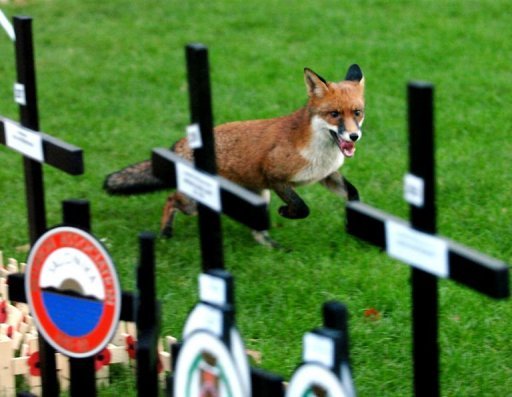
A fox runs in the Field of Remembrance in London's Westminster 
Abbey on November 11, 2004 (POOL/AFP/File, Arthur Edwards)

LONDON, England — To some they are a nuisance, even a danger. To others, London's 10,000 foxes are a delightful reminder that this concrete wilderness is teeming with wildlife.

The ruddy brown creatures seem out of place on the streets of the British capital -- but they are now so common that 70 percent of Londoners will have seen one slinking around in the last week, according to a recent survey.

For some city-dwellers, the red fox is the ultimate nightmare neighbour.

Many a Londoner will have had a night's sleep ruined by a fox's eerie screeching, only to wake and find their rubbish bins have been upturned. To add insult to injury, the scavenging fox will have left a stench of musk behind.

With their flashing eyes and razor-sharp teeth, the foxes have even been characterised as a menace.

A fox looks through a gate at the Royal
 Courts of Justice in central London on
 September 23, 2003 (AFP/File, Odd 
Andersen)
There have been a spate of reports of babies attacked in their cots by foxes in recent years, though animal rights campaigners say the dangers are wildly exaggerated.

In June, London's mayor Boris Johnson reignited a long-running debate over whether the animals should be culled -- by jokingly suggesting that the traditional sport of fox hunting, outlawed in Britain since 2005, should be legalised in the capital.

"This will cause massive unpopularity and I don't care," said the colourful mayor, who said he was driven to speak out after his cat was apparently attacked by one of London's foxes.

"If people want to get together to form the fox hounds of Islington (a leafy north London borough), I'm all for it."

There are some 33,000 urban foxes in Britain and a third reside in the capital, according to research by Bristol University. A further 250,000 live in rural areas.

"They are adaptable animals which can eat many kinds of food and are by nature opportunists," said Calie Rydings of the animal charity RSPCA.

"So it is not surprising that they can be found in some towns and cities."

With its large parks as well as thousands of houses with private gardens, London is a paradise for foxes.

They have been a part of the city landscape since the 1930s, when the urban sprawl began to encroach on their rural territory.

Despite the complaints, the foxes have mostly cohabited happily with their human neighbours.

Some 86 percent of people like the animals, according to a poll for Channel 4 TV. Another survey by Bristol University found that 10 percent of Londoners regularly feed them.

Britain has some of the highest-density fox populations in the world, according to Stephen Harris, professor of environmental sciences at Bristol.

"Despite this, they cause remarkably few problems and the vast majority of householders like to see the foxes in their garden," he told AFP.

Yet every few years, a case hits the headlines that sparks an outcry against the foxes and a slew of calls for the animals to be culled or moved to the countryside.

In 2010, an east London mother spoke of her "living nightmare" after her nine-month-old twin girls were mauled by a fox as they slept in their cots.

In February, a one-month-old baby boy had his finger ripped off.

But animal charities say such attacks are extremely rare -- and in some case, foxes are not even the culprits.

Trevor Williams, director of the Fox Project charity, said he knew of three reported 'attacks' by foxes on babies in eleven years -- but claims one was actually carried out by the family's own dog.

A fox runs through the Field of 
Remembrance in London's Westminster 
Abbey on November 11, 2004 (POOL/
AFP/File, Kirsty Wigglesworth)
"According to neighbours, the second also involved a dog. The third story was so full of contradictions, few people believe it," he told AFP.

Even if the stories are true, Williams claimed, the rate of attacks is nothing compared to the 250,000 people bitten by pet dogs each year in Britain.

The biggest threat, according to the RSPCA, is to the foxes themselves.

The average life expectancy of an urban fox is only two years, compared to four years in captivity.

Cars are responsible for 60 percent of their deaths. The rest die from illness or are killed by around 100 marksmen authorised to shoot foxes in London.

Three years ago, there was an uproar after a video emerged showing four masked men bludgeoning a fox to death with a cricket bat in a London park.


But it turned out to be a hoax. The perpetrators, film directors Chris Atkins and Johnny Howorth, had faked the killing in a bid to highlight the "ludicrous media coverage" of fox attacks.

Fox in the city (AFP/Graphics)

Related Article:

The Animals are Not Waiting for Us


A fox runs past the door of 10 Downing Street in London (Photo: JustinTallis/AFP)