Robber fly - Nature photographer Thomas Shahan specializes in amazing portraits of tiny insects. It isn't easy. Shahan says that this Robber Fly (Holcocephala fusca), for instance, is "skittish" and doesn't like its picture taken.

Nature by Numbers (Video)

"The Greater Akashic System" – July 15, 2012 (Kryon Channelling by Lee Caroll) (Subjects: Lightworkers, Intent, To meet God, Past lives, Universe/Galaxy, Earth, Pleiadians, Souls Reincarnate, Invention: Measure Quantum state in 3D, Recalibrates, Multi-Dimensional/Divine, Akashic System to change to new system, Before religion changed the system, DNA, Old system react to Karma, New system react to intent now for next life, Animals (around humans) reincarnate again, This Animal want to come back to the same human, Akashic Inheritance, Reincarnate as Family, Other Planets, Global Unity … etc.)

Question: Dear Kryon: I live in Spain. I am sorry if I will ask you a question you might have already answered, but the translations of your books are very slow and I might not have gathered all information you have already given. I am quite concerned about abandoned animals. It seems that many people buy animals for their children and as soon as they grow, they set them out somewhere. Recently I had the occasion to see a small kitten in the middle of the street. I did not immediately react, since I could have stopped and taken it, without getting out of the car. So, I went on and at the first occasion I could turn, I went back to see if I could take the kitten, but it was to late, somebody had already killed it. This happened some month ago, but I still feel very sorry for that kitten. I just would like to know, what kind of entity are these animals and how does this fit in our world. Are these entities which choose this kind of life, like we do choose our kind of Human life? I see so many abandoned animals and every time I see one, my heart aches... I would like to know more about them.

Answer: Dear one, indeed the answer has been given, but let us give it again so you all understand. Animals are here on earth for three (3) reasons.

(1) The balance of biological life. . . the circle of energy that is needed for you to exist in what you call "nature."

(2) To be harvested. Yes, it's true. Many exist for your sustenance, and this is appropriate. It is a harmony between Human and animal, and always has. Remember the buffalo that willingly came into the indigenous tribes to be sacrificed when called? These are stories that you should examine again. The inappropriateness of today's culture is how these precious creatures are treated. Did you know that if there was an honoring ceremony at their death, they would nourish you better? Did you know that there is ceremony that could benefit all of humanity in this way. Perhaps it's time you saw it.

(3) To be loved and to love. For many cultures, animals serve as surrogate children, loved and taken care of. It gives Humans a chance to show compassion when they need it, and to have unconditional love when they need it. This is extremely important to many, and provides balance and centering for many.

Do animals know all this? At a basic level, they do. Not in the way you "know," but in a cellular awareness they understand that they are here in service to planet earth. If you honor them in all three instances, then balance will be the result. Your feelings about their treatment is important. Temper your reactions with the spiritual logic of their appropriateness and their service to humanity. Honor them in all three cases.

Dian Fossey's birthday celebrated with a Google doodle

Dian Fossey's birthday celebrated with a Google doodle
American zoologist played by Sigourney Weaver in the film Gorillas in the Mist would have been 82 on Thursday (16 January 2014)
Showing posts with label South Korea. Show all posts

Thursday, October 17, 2019

Kim's horseback ride spurs policy shift speculation

Yahoo – AFP, 16 October 2019

Analysts say Kimg Jong Un's horseback hike may signal a new policy direction
for the nuclear-armed North

New pictures of Kim Jong Un riding a white horse through a winter landscape to the summit of Mount Paektu, a sacred peak for North Koreans, have fuelled speculation that the young leader may be set for a major policy announcement.

The images released by the official KCNA news agency were accompanied by a gushing text, that noted the "noble glitters" in Kim's eyes, and labelled his snowy, horseback ride "a great event of weighty importance" for the nation.

Accompanying officials were left convinced that "there will be a great operation to strike the world with wonder again and make a step forward in the Korean revolution," the agency said.

Pictures of Kim Jong Un riding a white horse through a winter landscape have 
fuelled speculation that the young leader may be set for a major policy announcement

Analysts said the hike may signal a new policy direction for the nuclear-armed North.

"In the past, Kim has climbed Mount Paektu ahead of major political decisions," said Shin Beom-chul, an analyst at the Asan Institute of Policy Studies.

Kim hiked to the peak in December 2017 before launching diplomatic overtures that led to his first ever summit with US President Donald Trump.

But negotiations have been gridlocked since a second summit between Kim and Trump collapsed in February and the North has been raising tensions through a series of missile tests.

The official KCNA news agency described Kim Jong Un's horseback mountain 
ride as 'a great event of weighty importance' for the nation

The sight of North Korean leaders riding white horses across snow-capped peaks – and in particular Mount Paektu - have been a dominant theme of past photos, posters and portraits of Kim's father Kim Jong Il and grandfather Kim Il Sung.

According to B.R. Myers, a professor at Dongseo University in South Korea who specialises in North Korean propaganda, the images present an imperial motif of a leader protecting the cultural and ideological purity of the nation from corrupt, outside forces.

Kim also visited the site of a giant construction project in nearby Samjiyon county, KCNA reported, and blamed US-led international sanctions for his country's hardships.

Kim Jong Un also visited the site of a giant construction project in Samjiyon 
county, KCNA reported

"The situation of the country is difficult owing to the ceaseless sanctions and pressure by the hostile forces and there are many hardships and trials facing us," Kim was quoted as saying.

North Korea is under multiple sets of UN sanctions for its nuclear and missile programmes.

Pyongyang and Washington restarted working-level talks this month in Sweden only for it to quickly break down, with the North blaming the US for not giving up its "old attitude".

North Korea tested this month what it said was a submarine-launched ballistic missile that marked a "new phase" in its capabilities -- the most provocative in a series of weapons tests it carried out since 2018.

Moon's posted two pictures of the pooches, one of them showing five furry white 
pups cuddled on Moon's lap with the sixth in the first lady's arms

Related Articles:


Two dogs, aged around one year old, were given as a gift to the South
Korean President Moon Jae-in (AFP Photo/Handout)

Thursday, February 14, 2019

Rescue of 200 dogs destined for slaughterhouse begins in South Korea

Yahoo – News, 13 February 2019

The animal protection group Humane Society International saved about 200 dogs
at a dog farm in Hongseong, 150 kilometres south of Seoul

A rescue operation to save hundreds of dogs in South Korea from the slaughterhouse began Wednesday, as pressure mounts on the country to end its custom of killing canines for meat.

About one million dogs are eaten a year in South Korea, often as a summertime delicacy, with the greasy red meat -- invariably boiled for tenderness -- believed to increase energy.

But the tradition has earned criticism abroad and has declined as the nation increasingly embraces the idea of dogs as pets instead of livestock, with eating them now something of a taboo among young South Koreans.

The two-week rescue operation by animal protection group Humane Society International (HSI) will save about 200 canines at a dog farm in Hongseong county, 150 kilometres south of Seoul.

The dogs will be sent to Canada and the United States for rehoming

The dogs will then be sent to Canada and the United States for rehoming.

"These dogs are no different from any other dogs. Once they receive some tender loving care that they deserve and that they need," Kelly O'Meara, an HSI official, told AFP.

The farm was the 14th complex shut down by the group since 2015.

The organisation said it has rescued around 1,600 dogs during that time, with farmers given support to move into other lines of work. One transformed his dog meat business into a blueberry farm.

Lee Sang-gu, the owner of the Hongseong farm, said he decided to change his business because it was "not profitable anymore", noting even his family members were against eating dog.

According to a survey in 2017, 70 percent of South Koreans do not eat dog, 
but far fewer -- about 40 percent -- believe the practice should be banned

According to a survey in 2017, 70 percent of South Koreans do not eat dog, but far fewer -- about 40 percent -- believe the practice should be banned.

It also found 65 percent support raising and slaughtering dogs under more humane conditions.

The country's largest canine slaughterhouse complex in Seongnam city, south of Seoul, was dismantled in November. Activists who visited found electrocution equipment and a pile of dead dogs abandoned on the floor.

There are currently no laws on how to treat or slaughter canines for meat in South Korea. While farmers have urged Seoul to include dogs under livestock welfare regulations, animal rights groups oppose doing so, seeking complete abolition instead.

Tuesday, November 27, 2018

Doggy diplomacy: S. Korea unveils newborn Northern pups

Yahoo – AFP, 26 November 2018

Gomi, which was given to Moon Jae-in by Kim Jong Un, gave birth to six puppies

South Korean President Moon Jae-in and his wife have been pictured cuddling a litter of puppies whelped by one of the dogs given to them by North Korean leader Kim Jong Un as a symbol of the strengthening ties between the two countries.

Images released on Sunday show the couple smiling as they sit on the ground outside their residence in Seoul surrounded by the six pups and their mother Gomi.

Kim sent Moon a pair of indigenous North Korean hunting dogs following their meeting in Pyongyang in September as a token of their rapidly blossoming friendship.

"Meet the newborn puppies of Gomi, one of the Pungsan dogs from North Korea," Moon's office tweeted on Sunday.

It posted two pictures of the dogs, one of them showing five furry white pups cuddled on Moon's lap with the sixth in the first lady's arms, with Gomi by their side in the courtyard of the presidential residence.

Moon's posted two pictures of the pooches, one of them showing five furry white 
pups cuddled on Moon's lap with the sixth in the first lady's arms

Both the mother and the puppies -- three males and three females born on November 9 -- were "very healthy", the presidential office said.

Known for loyalty and intelligence, the Pungsan breed -- a hunting dog with a thick, creamy white coat, pointy ears and hazel eyes -- is originally from an area of the same name in the North.

"As the pregnancy period of dogs is about two months, Gomi must have been pregnant when she came to us," Moon tweeted when the puppies were born, adding: "I hope inter-Korean ties will also be like this."

Moon is a known animal lover who has four dogs -- the two canines gifted by Kim, another Pungsan dog Maru, and a black mutt named Tory he adopted after taking office -- plus a former shelter cat called Jjing-Jjing.

Friday, November 23, 2018

South Korea closes biggest dog slaughterhouse complex

Yahoo – AFP, 22 November 2018

The Taepyeong-dong complex housed at least six dog slaughterhouses that could
hold several hundred animals at a time

South Korean officials on Thursday began to dismantle the country's largest canine slaughterhouse complex, as animal rights activists push to end the custom of eating dog meat.

About one million dogs are eaten a year in South Korea, often as a summertime delicacy with the greasy red meat -- invariably boiled for tenderness -- believed to increase energy.

But the tradition has earned criticism abroad and has declined as the nation increasingly embraces the idea of dogs as pets instead of livestock, with eating them now something of a taboo among young South Koreans.

The Taepyeong-dong complex in Seongnam city, south of Seoul, housed at least six dog slaughterhouses that could hold several hundred animals at a time, and was a major source for dog meat restaurants across the country.

It will be cleared over two days and transformed into a public park, Seongnam city officials said.

Slaughterhouse operators reportedly used the site for decades without proper authorisations, and after a years-long legal battle a Seoul court ruled the city council could force out the businesses.

The site will be cleared over two days and transformed into a public park

Animal rights campaigners slammed the operators for mistreating dogs and killing them cruelly -- including electrocuting them before butchering them in the sight of other caged dogs.

Activists found electrocution equipment in the complex and a pile of dead dogs abandoned on the floor when they visited the site on Thursday, according to US animal rights group Humane Society International.

"This is a historic moment," Korean Animal Rights Advocates (KARA) said in a blog post. "It will open the door for more closures of dog meat slaughterhouses across the country, expediting the decline of the overall dog meat industry."

According to a survey last year, 70 percent of South Koreans do not eat dogs, but far fewer -- about 40 percent -- believe the practice should be banned. It also found 65 percent support raising and slaughtering dogs in more humane conditions.

There are currently no laws on how to treat or slaughter canines for meat in South Korea. While farmers have urged Seoul to include dogs under livestock welfare regulations, animal rights groups oppose doing so, seeking complete abolition instead.

Monday, October 1, 2018

Pyongyang gifts dogs to S.Korea's Moon

Yahoo – AFP, September 30, 2018

Two dogs, aged around one year old, were given as a gift to the South
Korean President Moon Jae-in (AFP Photo/Handout)

South Korean President Moon Jae-in received a pair of North Korean indigenous hunting dogs from Pyongyang, his office said Sunday, the latest token of the rapidly blossoming friendship on the peninsula.

"Cheong Wa Dae (the presidential office) was offered a pair of Pungsan dogs from the North as a gift at the North-South summit and received them Thursday," the South's presidential office said in a statement.

The canines, both aged around one, were handed over via the truce village of Panmunjom with three kilograms of dog food to "help with their adaptation", it added.

Known for its loyalty and cleverness, the Pungsan breed -- a hunting dog with thick, creamy white coat, pointy ears and hazel eyes -- is one of the National Treasures of North Korea.

Relations between North and South Korea have been improving after
 three summits this year (AFP Photo)

The canine gifts come after a September meeting between Moon and North Korea leader Kim Jong Un in Pyongyang, at which Kim agreed plans to shutter a missile-testing site and visit Seoul.

North and South Korea also announced that they would jointly bid for the 2032 Olympics.

Former South Korean President Kim Dae-jung had also received a pair of Pungsan pups after his landmark summit in Pyongyang with then North Korean leader Kim Jong Il in 2000.

The dogs were kept at the Seoul Grand Park and both died of natural causes in 2013 after giving birth to 21 puppies.

The newly arrived pooches will reside at the presidential office with Moon -- an animal lover who already owns a Pungsan dog named Maru, a former shelter cat called Jjing-Jjing, and Tory, a black mutt he adopted after taking office.

Thursday, December 28, 2017

Korea dog meat campaigners accused of barking up wrong tree

Yahoo – AFP, Jung Ha-Won, December 27, 2017

South Koreans are believed to consume about one million dogs a year as a
summertime delicacy (AFP Photo/JUNG Yeon-Je)

Namyangju (South Korea) (AFP) - Barking at their rescuers, labradors, beagles and mongrels desperately scrambled out of rusty cages in South Korea: saved from the dinner plate by a deal with dog-meat farmer Kim Young-Hwan.

In the face of falling demand, Kim agreed to close his establishment in exchange for compensation from US-based Humane Society International (HSI). The dogs are bound for a new life in adoptive homes in the West.

He is the 10th canine-meat farmer to accept such an offer in three years. The exact sums are confidential, but each deal requires hundreds of thousands of dollars once adoption costs are included.

"This business is doomed... I wanted to quit before it's too late," Kim said.

The 56-year-old had 170 dogs at his farm in Namyangju, north of Seoul.

"The price has plummeted in recent years," he told AFP. "I'm barely making ends meet these days. Plus I've been harassed by animal rights groups all the time. It's such a hassle."

The push by animal rights activists, including many overseas groups, to outlaw dog meat consumption in the South has sparked mixed reactions and accusations of Western hypocrisy.

Dogs are seen in cages at a dog farm during a rescue organised by the Humane
 Society International (HSI) in Namyangju on the outskirts of Seoul (AFP Photo/
JUNG Yeon-Je)

'Lambs or rabbits'

South Koreans are believed to consume about one million dogs a year as a summertime delicacy, with the greasy red meat -- which is invariably boiled for tenderness -- believed to increase energy.

The tradition has declined as the nation increasingly embraces the idea of dogs as pets instead of livestock, with eating them now something of a taboo among young South Koreans.

Nevertheless, activists have stepped up campaigns to ban dog consumption, with online petitions urging boycotts of the 2018 Pyeongchang Winter Olympics over the issue and protests in Seoul.

Such lobbying has provoked angry debates over what many describe as cultural double standards.

"I don't eat dogs, but I am disgusted by those who preach that only animals deemed cuddly enough or friendly enough by Westerners deserve to live," read one online comment.

One fifth of the South's 50 million people own pets, mostly dogs and cats, said another netizen, but for many of the rest, dogs were "no more special than lambs or rabbits".

The push by animal rights activists, including many overseas groups, to outlaw dog 
meat consumption in the South has sparked accusations of Western hypocrisy
(AFP Photo/JUNG Yeon-Je)

Similar debates have emerged in other Asian nations where dogs are eaten.

China's most notorious dog meat festival in the southwestern town of Yulin has drawn crowds despite international outrage, with sellers saying the criticism has actually encouraged more people to eat canines.

Taiwan banned dog meat consumption in April to mixed reaction, with some deeming it unfair to single out certain species under what was mocked as the "cute animal protection law".

Polls show South Korean public opinion is divided.

According to a survey this year 70 percent of South Koreans do not eat dogs, but far fewer -- about 40 percent -- believe the practice should be banned.

It also found 65 percent support raising and slaughtering dogs in more humane conditions.

There is currently no law on how to treat or slaughter canines in the meat trade in South Korea. But while farmers have urged Seoul to include dogs under livestock welfare regulations, animal rights groups oppose doing so, seeking complete abolition instead.

Suffer and love

At Kim's rundown farm, dogs sat behind tarnished brown rusty bars, their bowls filled with soupy scraps.

Housed in pairs, they spent up to a year in cages about two square metres and reeking of excrement before being sent to slaughterhouses.

Kim had 170 dogs at his farm in Namyangju, north of Seoul (AFP Photo/JUNG Yeon-Je)

Senior HSI director Kelly O'Meara said no animals should endure such awful conditions, and dogs in particular had "a special place" for people as they are often pets.

"That has certainly been the case in the West, but in Asia we see more and more people having dogs as companion animals too," she told AFP.

Each such farm closure -- one of HSI's most expensive initiatives -- is broadcast live online.

But Ahn Yong-Geun, a food and nutrition professor at ChungCheong University in Cheongju, questioned whether such organisations would condemn larger-scale beef or pork industries -- which have lobbying power and broad public support -- "in the same angry, aggressive fashion".

"The activists won't get as much excitement from donors about a pig rescue project or a cow rescue project, although these animals have just as much capacity to suffer and love as dogs," said Ahn, a vocal critic of the push to ban dog meat.

Wendy Higgins, director of international media at HSI, said the group encouraged people to "reduce and replace meat in their diet" but admitted rescue campaigns for animals such as cattle or pigs were not common.

Even so campaigns against cruelty in dog farming could "make people widen their circle of compassion for other animals in animal agriculture too", she added.

For his part farmer Kim will not be raising any other animals for meat -- he is banned from doing so under the deal with HSI.

"The social atmosphere has changed," he said, adding: "Eating dog is seen as if it's a crime these days."

Related Article:


An animal rights collective, known as Dog Meat Free Indonesia Coalition,
together with world-renowned celebrities launched a global campaign to stop
the trade in dog meat on Thursday (02/11) at Hotel Gran Mahakam in South
Jakarta, in light of recent disturbing findings of animal cruelty in the Southeast
Asian country. (Photo courtesy of Dog Meat Free Indonesia Coalition)

Thursday, April 13, 2017

Taiwan bans eating dogs and cats

Yahoo – AFP, April 12, 2017

The tradition of eating dog meat dates back hundreds of years in many
Asian countriesView photos (AFP Photo/Hoang Dinh Nam)

Taiwan has banned the eating of dogs and cats, lawmakers said Wednesday, as pressure grows to improve animal welfare after a spate of cruelty cases that stirred public outrage.

Parliament passed legislation to outlaw the consumption, purchase or possession of dog and cat meat, with offenders facing a fine of up to Tw$250,000 ($8,170).

Authorities can also name and shame those who break the law.

"This shows that Taiwan is a society with advanced animal welfare," said lawmaker Wang Yu-min who proposed the new rules.

The bill also hiked the penalty for killing or abusing animals to a maximum two-year jail term and a stiff fine of Tw$2 million.

Dog consumption -- believed by some in Taiwan to help boost male potency -- was common on the island decades ago but has become less popular amid growing calls to protect animal rights.

In 2001, Taiwan amended its animal protection law to ban the slaughter of pets -- which included dogs and cats -- for food, although there was no penalty on eating or buying the meat.

More than 10,000 canines are killed every year at China's notorious dog meat
festival in Yulin (AFP Photo/JOHANNES EISELE)

Sales of pet meat were banned at the end of 2003.

But a string of much-publicised animal abuse cases have continued to triggered deep public concern and demands for tougher protection laws.

Last year, the military was forced to apologise after a video surfaced of three soldiers torturing and strangling a stray dog to death with an iron chain, prompting several street protests.

And in 2014, a male hippo famous for regularly performing at a private zoo in central Taiwan died after breaking a leg and sustaining other injuries during transportation, sparking a public outcry.

Reactions to the new law were mixed, with some deeming it unfair to only single out cats and dogs for better protection.

"This is the cute animal protection law? only cute animals are protected while the rest deserve to die?" read one message posted on Apple Daily's website.

Dog meat consumption is also common in countries such as China, Indonesia,
Vietnam and South Korea (AFP Photo/SONNY TUMBELAKA)

"Why doesn't the parliament amend laws to toughen punishment on drunk driving, fraud and homicide? what a lousy job it is doing," said another post.

Dog meat consumption is also common in countries such as China, Vietnam and South Korea.

Last year, China's most notorious dog meat festival drew crowds despite international outrage, as more than 10,000 dogs were killed at the event in conditions activists described as brutal.

South Koreans are believed to consume somewhere between 1.5 million - 2.5 million dogs every year, but the meat farming industry is in decline, with little demand among the younger generation.

In Vietnam, cat meat -- known locally as "little tiger" -- is also a delicacy and although officially banned it is widely available in specialist restaurants.

Tuesday, October 25, 2016

Dutch public broadcaster pays to clone pet dog for new show

DutchNews, October 24, 2016

Photo: BNN still

A Dutch public broadcaster is claiming it had a pet dog cloned in South Korea for a new show. It is illegal to clone animals in the Netherlands, but not to import a cloned pet from abroad. 

The dog which was cloned was a 12-year-old bulldog called Joep, which lived in Rotterdam. Joep has since died, but the owner is extremely happy with the clone, named Pipo, according to the Telegraaf.

‘It is not just his appearance, which is almost identical,’ the owners told the paper. ‘We are surprised on a daily basis how much his behaviour and character matches with our old dog. It is unbelievable.’ 

Joep’s owners had responded to an appeal by BNN which was looking for people who wanted to have their pet cloned and were willing to send a tissue sample to the company, named by the Telegraaf as Sooam Biotech. 

Sooam is said to be the leading laboratory in the world for dog cloning and has produced more than 700 dogs for commercial customers. 

The Telegraaf says it cost the broadcaster €50,000 to have the dog cloned. 

Opposition MPs have criticized the idea of cloning animals to order and animal welfare groups point out that hundreds of dogs in animal shelters could do with a new owner. 

The programme, Klonen: Wens of Waanzin?, is part of a series about cloning around the world and will be broadcast on Friday.

Related Articles:

Mouse cloned from drop of blood

“The Akashic System” – Sep 11, 2010 (Kryon Channelling by Lee Carroll) - (Text version)
“… Animals

I speak of the precious animals all the time and how they're here to service humanity and how they do it so completely. I've spoken about how some of them are here to be eaten. Many don't like to hear this, but understand that collectively the animals understand this. They have to be part of the Human food chain, since humanity doesn't have the ability to grow things fast enough and distribute that food. So that's a service, you see? For those of you who are vegan, you might say, "I never eat them!" That is a choice for your health. It's appropriate and accurate, but doesn't hold true for the survival of the Human race, for animals are needed for Human nourishment and survival at the moment.

So let's divert for a moment and give you some valuable information about Human consumption of animal life. Many Humans need to eat them, but never understanding that the animal knew this when it came in. Is this too spooky for you? This is known by those who know of animal spirits and can see the sacrifice and appropriateness of this. It was also very well known by the ancients. But here is the question, dear Human: How do you treat them? With that kind of purpose on the planet, how do you treat them before they become your food? How did the ancients treat them? Now that's a hard question, isn't it? Let me give you an attribute of truth. Did you know the better they're treated, the more nutritious they'll be within your body? "Kryon, please don't talk about that. We don't want to think about it." Dear one, if not me, then who? Listen, if these animals are willing to come and be so grand a part of the life-force of this planet and help it to vibrate higher by keeping you alive so you can make choices, don't they deserve respect and comfort while they are growing up? The end result will be a far better contribution to your health. Let the scientists lead the way and do some comparison studies to show that the nutritional values increase dramatically when an animal is honored during its short lifetime. The ancients knew this and honored each animal before it became part of their life-force.

There is no Cave of Creation for the animals. They are here in support of humanity. Some of them are here to love you and you know that. We speak of the ones in your home. They're here to love you - another great service to Humans. You look in their eyes and they look back. They see the old soul within you, did you know that? They know the system. But they don't live very long, do they? Sometimes there is heartbreak when they leave. But the good news? Yes, they can reincarnate! They have choice with you to continue the love affair! I don't know how many dear ones in the room are aware of that system and I want my partner to develop this more clearly so those animal lovers will know this. When their dear loved animals die, they can continue the love affair if they want to by looking in the right place and finding the returning soul, picking it up and continuing what they had. There's somebody in the room and reading that needed to hear that. There is a system for their core souls to return!

So in a way, many animals have souls, too, but they're not in the Cave of Creation. They don't have the profound system of planetary change that you do, which is a consciousness that can increase itself by free choice. The Human is the only being on Earth who can do this, because the Human has divinity in the DNA. It was implanted there, appropriately and with love, approximately 100,000 years ago by that which is from another star system.

We have given you all this before. In all appropriateness, the Humans on this planet received their spiritual seeds from the Pleiadians in a beautiful way, in an appropriate way, in a divine way, in a perfect way. There were no wars, no conspiracies, and these beautiful star souls are still here. They're your brothers and your sisters and a piece of them is in you. You're in a quantum state with them. I can't explain that anymore either. But some of you can feel it. Some of you can see it. It's beautiful, and it's not inappropriate, odd or scary. Instead, it is the real creation story on the planet and can be found in the indigenous writings all over the planet. Look for references to the seven sisters and the stories about creation.

In your DNA surges all that you ever were, old soul, and we have told you in many channellings how you can access this. This access is not just as spiritual information, but as the ability to access some of the Human attributes that you had in the past. The essence of the energy of who you used to be is in your DNA. Therefore, this Akashic information has the ability to communicate to the blueprint of your stem cells. Remember, it's all within the same double-helix structure that contains the protein-encoded section, your genes! Are you understanding this? Your DNA is, therefore, a far larger system than any medical authority has ever believed it to be. It is an interdimensional system that has the ability to modify itself at any time. It explains spontaneous remission. Spontaneous remission is the Human Being who decides they're done with the disease, and who then picks up the energy from a past life that never had the disease. Many Humans have rid themselves of the most virulent diseases known to man. They suddenly come up clean with no trace of it - spontaneous remission. The dreaded disease simply goes away. I'll tell you, dear one, that is not a miracle from above. That's a miracle from within.  …”


Thursday, April 28, 2016

Korean dog meat farmers seek fresh start

Yahoo – AFP, Hwang Sung-Hee, 27 April 2016

Dogs sit in a cage as they are rescued from a dog meat farm by the US-based 
Humane Society International in Wonju (AFP Photo/Ed Jones)

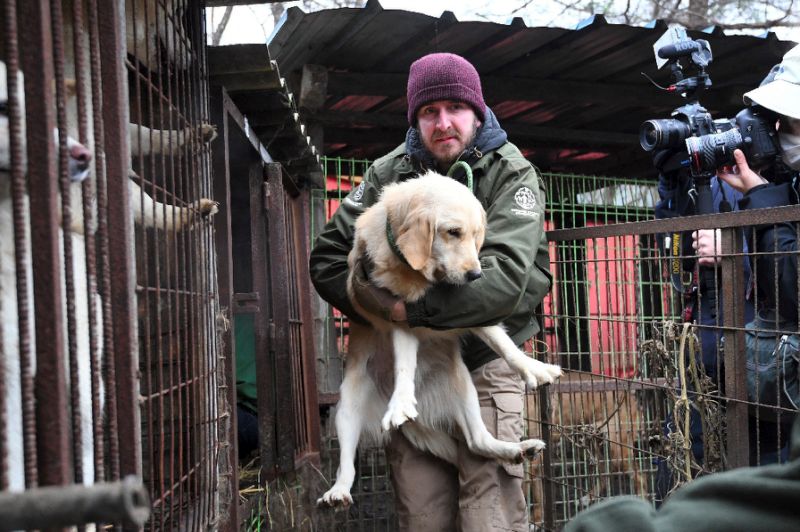
"It's a dying business," Gong In-Young said Wednesday as he watched US activists clear out the cages of the South Korean dog meat farm he has been running for the past decade.

Close to 200 dogs, including Golden Retrievers, Siberian Huskies, Rottweilers, Japanese Tosas and Korean Jindo dogs, paced in circles inside the small wire cages, barking furiously at their rescuers.

The dogs in Gong's farm, one of thousands across the country, were bred specifically for consumption and confined in their cages from birth until slaughtered for their meat.

South Koreans are believed to consume somewhere between 1.5 million-2.5 million dogs every year, but the meat farming industry is in decline, with little demand among the younger generation.

Gong's business is the fifth and the largest dog meat farm to be closed down by the US-based Humane Society International (HSI), and Gong said he was happy to get out.

"In the past, people ate dogs because there was nothing else to eat but nowadays, young people don't have to eat it," Gong said. "It's becoming weird for people," he added.

Lola Webber of Humane Society International transport dogs in crates during the 
closure of a dog meat farm in Wonju (AFP Photo/Ed Jones)

Changing tastes

A poll conducted by Gallup Korea last year showed that only 20 percent of men in their 20s consumed dog meat in the past year, compared to half of those in their 50s and 60s.

Gong also noted that the increasing popularity of dogs as domestic pets had played a large part in reducing demand for their meat.

The HSI rescued a total of 225 dogs last year, closing down four farms in what they call a "constructive and collaborative" approach to phase out an industry that has long been criticised by international animal welfare groups.

Most of the dogs are flown to the United States and Canada for adoption.

In return for shuttering his business for good, a farmer receives up to $60,000 -- depending on the number of dogs being bred -- that can be used as seed money for a more "humane" farm, growing anything from blueberries to green peppers.

Through its well-publicised rescues, HSI seeks to raise awareness about the cruelty of dog meat farms and "initiate a conversation with South Korean policymakers," the group's campaign manager Andrew Plumbly said.

Dogs sit in a cage as they are rescued from a dog meat farm by the US-based 
Humane Society International in Wonju (AFP Photo/Ed Jones)

South Korea is preparing to host the 2018 Winter Olympics, and Plumbly said the global publicity surrounding the event provided an opportunity to push for change.

Olympics spotlight

"Part of the spotlight will touch on the dog meat trade so they may feel pressure in that regard and hopefully they will respond constructively," he said.

The South Korean authorities are sensitive to the negative publicity attached to the dog meat industry, and dog restaurants in Seoul were shut down ahead of the 1988 summer Olympics.

Gong, who stumbled into the dog meat industry after many failed business attempts, admits he was "never proud" of his farm, which only ever earned him a modest living.

In a normal year, he would sell around 200 animals, with an average price -- depending on size -- of about $200.

Adam Parascondola of Humane Society International comforts a dog during an 
operation to shut down a dog meat farm in Wonju (AFP Photo/Ed Jones)

"I realised the dogs will become a lot happier if I changed my mind," Gong said, while Snow, his pet Spitz, sauntered between rows of crates with dogs awaiting their departure.

Running a dog farm in South Korea requires no special licence, although Gong said there were regular government checks to ensure neighbours weren't being disturbed and dog waste was being properly disposed of.

Asked to compare the living conditions of Snow and the dogs in the cages, Gong admitted: "It's the difference between heaven and hell."

Related Article: