Robber fly - Nature photographer Thomas Shahan specializes in amazing portraits of tiny insects. It isn't easy. Shahan says that this Robber Fly (Holcocephala fusca), for instance, is "skittish" and doesn't like its picture taken.

Nature by Numbers (Video)

"The Greater Akashic System" – July 15, 2012 (Kryon Channelling by Lee Caroll) (Subjects: Lightworkers, Intent, To meet God, Past lives, Universe/Galaxy, Earth, Pleiadians, Souls Reincarnate, Invention: Measure Quantum state in 3D, Recalibrates, Multi-Dimensional/Divine, Akashic System to change to new system, Before religion changed the system, DNA, Old system react to Karma, New system react to intent now for next life, Animals (around humans) reincarnate again, This Animal want to come back to the same human, Akashic Inheritance, Reincarnate as Family, Other Planets, Global Unity … etc.)

Question: Dear Kryon: I live in Spain. I am sorry if I will ask you a question you might have already answered, but the translations of your books are very slow and I might not have gathered all information you have already given. I am quite concerned about abandoned animals. It seems that many people buy animals for their children and as soon as they grow, they set them out somewhere. Recently I had the occasion to see a small kitten in the middle of the street. I did not immediately react, since I could have stopped and taken it, without getting out of the car. So, I went on and at the first occasion I could turn, I went back to see if I could take the kitten, but it was to late, somebody had already killed it. This happened some month ago, but I still feel very sorry for that kitten. I just would like to know, what kind of entity are these animals and how does this fit in our world. Are these entities which choose this kind of life, like we do choose our kind of Human life? I see so many abandoned animals and every time I see one, my heart aches... I would like to know more about them.

Answer: Dear one, indeed the answer has been given, but let us give it again so you all understand. Animals are here on earth for three (3) reasons.

(1) The balance of biological life. . . the circle of energy that is needed for you to exist in what you call "nature."

(2) To be harvested. Yes, it's true. Many exist for your sustenance, and this is appropriate. It is a harmony between Human and animal, and always has. Remember the buffalo that willingly came into the indigenous tribes to be sacrificed when called? These are stories that you should examine again. The inappropriateness of today's culture is how these precious creatures are treated. Did you know that if there was an honoring ceremony at their death, they would nourish you better? Did you know that there is ceremony that could benefit all of humanity in this way. Perhaps it's time you saw it.

(3) To be loved and to love. For many cultures, animals serve as surrogate children, loved and taken care of. It gives Humans a chance to show compassion when they need it, and to have unconditional love when they need it. This is extremely important to many, and provides balance and centering for many.

Do animals know all this? At a basic level, they do. Not in the way you "know," but in a cellular awareness they understand that they are here in service to planet earth. If you honor them in all three instances, then balance will be the result. Your feelings about their treatment is important. Temper your reactions with the spiritual logic of their appropriateness and their service to humanity. Honor them in all three cases.

Dian Fossey's birthday celebrated with a Google doodle

Dian Fossey's birthday celebrated with a Google doodle
American zoologist played by Sigourney Weaver in the film Gorillas in the Mist would have been 82 on Thursday (16 January 2014)
Showing posts with label Fox. Show all posts

Monday, January 8, 2018

.Britain's May, in U-turn, won't push for end to fox hunting ban

Yahoo – AFP, January 7, 2018

British Prime Minister Teresa May, reneging on a campaign promise, said she
would not seek a vote to overturn a 2004 ban on fox hunting. (AFP Photo/Leon NEAL)

London (AFP) - British Prime Minister Theresa May said Sunday she will ditch an election pledge for a vote on reversing the fox-hunting ban following a public backlash.

"On this issue of fox hunting, what I can say is that there won't be a vote during this parliament," she told BBC's Andrew Marr Show.

"I've never fox hunted, but I've not changed my view on that," added May, who is a supporter of the sport.

"But as prime minister my job isn't just about what I think about something, it's actually about looking at what the view of the country is, I think there was a clear message about that."

The manifesto of May's Conservative Party for last year's general election contained a pledge to hold a free vote on overturning the 2004 law banning the use of dogs to hunt foxes and other wild mammals in England and Wales.

The opposition Labour Party focused heavily on the issue during campaigning, helping it to score a shock upset in depriving May of her majority.

The subject received extra attention on December 26, Boxing Day, when hundreds of British hunting groups met across the country on the busiest day in the hunting calendar.

Britain still allows trail hunts, which let packs follow a route rather than an animal, and drag hunting, in which hounds track artificial scents.

Critics argue that dogs still chase and kill live animals on these hunts, with organisers claiming the kills are accidental.

Hunters claim they comply with the law.

The U-turn is likely to anger parts of May's rural base, who see the ban as an imposition of urban values on their way of life.

Ann Mallalieu, president of the Countryside Alliance -- a rural life lobby group which claims to have around 100,000 supporters -- wrote in the Daily Telegraph last month that some lawmakers had admitted their opposition to fox hunting was an element of "class warfare".

But Labour leader Jeremy Corbyn has called the sport "cruel and barbaric".


Tuesday, March 1, 2016

Golden jackal spotted in the Netherlands: is it an escapee?

DutchNews, February 29, 2016

Photo: Alterra 
A golden jackal has been spotted in the Veluwe heathland region of the Netherlands, thousands of kilometres from its natural habitat, researchers at Wageningen University said on Monday. 

The jackal was spotted by chance on a night camera earlier in February and its identity confirmed by experts in Eastern Europe, the university said.

It is unclear if the jackal crossed the border into the Netherlands or, more probably, escaped or was released from a private zoo. The jackals are larger than a fox, with a shoulder height of around 50 centimetres. 

The golden jackal is common in north Africa, the Middle East, southern Asia and the Balkan states but has more recently been spotted in Denmark and near Frankfurt in Germany. The jackal hunts small animals like rabbits as well as reptiles, birds, fruit and waste food. 

The university is keeping the beast’s exact location a secret but researchers are now looking for hair or faeces which can be used to carry out dna research and help establish where it came from. 

Friday, August 7, 2015

Video: Fox attacks man in Dutch suburban garden Society

DutchNews, August 6, 2015

Photo: video still Eduard Plate
A hungry fox pacing next to a chicken coup in the garden of a family home in Zeewolde has attacked the person filming its actions on a mobile phone. 

Eduard Plate, who is a Flevoland provincial councillor for the VVD, spotted the fox hanging around his neighbours’ chickens on Wednesday afternoon and started filming it. After a few seconds the fox turned and saw Plate. It leapt at him, forcing him to run off and stop filming. 

Plate called in pest control experts who caught the fox and took it to Lelystad where it was killed, RTL news reports. 

The fox had been spotted in the garden on a previous occasion and was hanging around the built-up area since Monday. According to RTL news, the animal was ‘sick’ but did not give further details.

A spokesman for Faunabeheer Flevoland said it is extremely unusual for a fox to attack someone and that the animal will have felt threatened. 


Tuesday, August 27, 2013

London, a playground for 10,000 urban foxes

Google – AFP,  Jacques Klopp (AFP), 27 august 2013

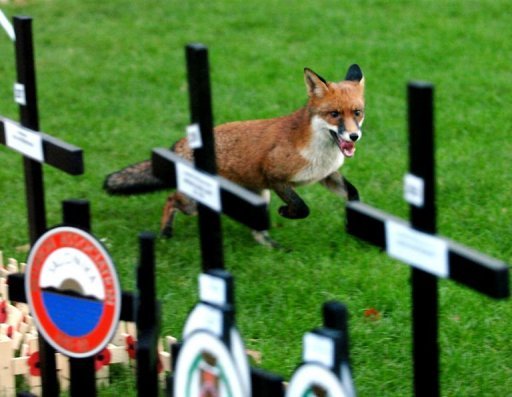
A fox runs in the Field of Remembrance in London's Westminster 
Abbey on November 11, 2004 (POOL/AFP/File, Arthur Edwards)

LONDON, England — To some they are a nuisance, even a danger. To others, London's 10,000 foxes are a delightful reminder that this concrete wilderness is teeming with wildlife.

The ruddy brown creatures seem out of place on the streets of the British capital -- but they are now so common that 70 percent of Londoners will have seen one slinking around in the last week, according to a recent survey.

For some city-dwellers, the red fox is the ultimate nightmare neighbour.

Many a Londoner will have had a night's sleep ruined by a fox's eerie screeching, only to wake and find their rubbish bins have been upturned. To add insult to injury, the scavenging fox will have left a stench of musk behind.

With their flashing eyes and razor-sharp teeth, the foxes have even been characterised as a menace.

A fox looks through a gate at the Royal
 Courts of Justice in central London on
 September 23, 2003 (AFP/File, Odd 
Andersen)
There have been a spate of reports of babies attacked in their cots by foxes in recent years, though animal rights campaigners say the dangers are wildly exaggerated.

In June, London's mayor Boris Johnson reignited a long-running debate over whether the animals should be culled -- by jokingly suggesting that the traditional sport of fox hunting, outlawed in Britain since 2005, should be legalised in the capital.

"This will cause massive unpopularity and I don't care," said the colourful mayor, who said he was driven to speak out after his cat was apparently attacked by one of London's foxes.

"If people want to get together to form the fox hounds of Islington (a leafy north London borough), I'm all for it."

There are some 33,000 urban foxes in Britain and a third reside in the capital, according to research by Bristol University. A further 250,000 live in rural areas.

"They are adaptable animals which can eat many kinds of food and are by nature opportunists," said Calie Rydings of the animal charity RSPCA.

"So it is not surprising that they can be found in some towns and cities."

With its large parks as well as thousands of houses with private gardens, London is a paradise for foxes.

They have been a part of the city landscape since the 1930s, when the urban sprawl began to encroach on their rural territory.

Despite the complaints, the foxes have mostly cohabited happily with their human neighbours.

Some 86 percent of people like the animals, according to a poll for Channel 4 TV. Another survey by Bristol University found that 10 percent of Londoners regularly feed them.

Britain has some of the highest-density fox populations in the world, according to Stephen Harris, professor of environmental sciences at Bristol.

"Despite this, they cause remarkably few problems and the vast majority of householders like to see the foxes in their garden," he told AFP.

Yet every few years, a case hits the headlines that sparks an outcry against the foxes and a slew of calls for the animals to be culled or moved to the countryside.

In 2010, an east London mother spoke of her "living nightmare" after her nine-month-old twin girls were mauled by a fox as they slept in their cots.

In February, a one-month-old baby boy had his finger ripped off.

But animal charities say such attacks are extremely rare -- and in some case, foxes are not even the culprits.

Trevor Williams, director of the Fox Project charity, said he knew of three reported 'attacks' by foxes on babies in eleven years -- but claims one was actually carried out by the family's own dog.

A fox runs through the Field of 
Remembrance in London's Westminster 
Abbey on November 11, 2004 (POOL/
AFP/File, Kirsty Wigglesworth)
"According to neighbours, the second also involved a dog. The third story was so full of contradictions, few people believe it," he told AFP.

Even if the stories are true, Williams claimed, the rate of attacks is nothing compared to the 250,000 people bitten by pet dogs each year in Britain.

The biggest threat, according to the RSPCA, is to the foxes themselves.

The average life expectancy of an urban fox is only two years, compared to four years in captivity.

Cars are responsible for 60 percent of their deaths. The rest die from illness or are killed by around 100 marksmen authorised to shoot foxes in London.

Three years ago, there was an uproar after a video emerged showing four masked men bludgeoning a fox to death with a cricket bat in a London park.


But it turned out to be a hoax. The perpetrators, film directors Chris Atkins and Johnny Howorth, had faked the killing in a bid to highlight the "ludicrous media coverage" of fox attacks.

Fox in the city (AFP/Graphics)

Related Article:

The Animals are Not Waiting for Us


A fox runs past the door of 10 Downing Street in London (Photo: JustinTallis/AFP)

Thursday, August 15, 2013

China zoo under fire for disguising dog as lion

Google – AFP, 15 August 2013

A Tibetan mastiff at a dog show in
 Baoding, Hebei province, on March 9,
2013 (AFP/File, Ed Jones)
BEIJING — A Chinese zoo's supposed "African lion" was exposed as a fraud when the dog used as a substitute started barking.

The zoo in the People's Park of Luohe, in the central province of Henan, replaced exotic exhibits with common species, according to the state-run Beijing Youth Daily.

It quoted a customer surnamed Liu who wanted to show her son the different sounds animals made -- but he pointed out that the animal in the cage labelled "African lion" was barking.

The beast was in fact a Tibetan mastiff -- a large and long-haired breed of dog.

"The zoo is absolutely cheating us," the paper quoted Liu, who was charged 15 yuan ($2.45) for the ticket, as saying. "They are trying to disguise the dogs as lions."

Three other species housed incorrectly included two coypu rodents in a snake's cage, a white fox in a leopard's den, and another dog in a wolf pen.

The chief of the park's animal department, Liu Suya, told the paper that while it does have a lion, it had been taken to a breeding facility and the dog -- which belonged to an employee -- had been temporarily housed in the zoo over safety concerns.

Users of China's Twitter-like Sina Weibo service mocked the zoo.

"This is not funny at all. It's sad for both the zoo and the animals," said one.

"They should at least use a husky to pretend to be a wolf," said another.

Related Article:


Monday, November 5, 2012

Israeli army opens West Bank barrier for animals

Deutsche Welle, 2 November 2012


The West Bank barrier is blocking animal migration between Israel and the Palestinian territories. But now, the Israeli Defence Force is seeking ways to allow animals to get over - or even through - the wall.

Hundreds of kilometres of concrete, iron and barbed wire cut through the West Bank, across deserts, over mountains and through forests. Israelis call it a security fence while Palestinians call it a racial separation wall.

But, whatever your politics, it's plain to see that the barrier is an impassable structure which cuts a substantial visual scar across the landscape. Pass through any of the main checkpoints with their vast security system of cameras, scanners and iron gates, and it becomes clear just how difficult it is to move from one side to the other.

Spare a thought then for the wildlife in Israel and the Palestinian territories.

Israeli troops take position along part of Israel's separation barrier

Cut off from feeding grounds

Imad Atrash is the Palestine Wildlife Society Executive Director and says the barrier divides animal families. In an interview with DW, he explained that before the barrier was built, between Jerusalem and Bethlehem, the red fox population was separated by a fence. "The male was on the Israeli side and the female was inside Palestinian lands," he said. "The male dug a hole and came to the female."

A hydrax, or rock rabbit, sits near
the West Bank barrier
But then the West Bank barrier was built. "How many families of animals were separated in the West Bank?" Atrash asked.

Israeli ecologist Ron Frumkin says the barrier has had a significant impact on local species of gazelle, ibex, fox, porcupine and badger. He said splitting animal families often results in genetic mutation and inbreeding.

"Many animals that live here, need their habitats, or breeding and feeding areas," he said. "They can eat in one place but hide in another place. So animals, especially the bigger ones, need open space for their existence."

The wall blocks animals that breed in
one place and feed in another
Frumkin's reports on the ecological impact of the barrier have made it to Israel's High Court. They were instrumental in overturning a plan from the Ministry of Defence to extend the barrier in southern West Bank. There, the ibex needs to move between the vegetation of the high places in the winter to the water source of the oases in the summer. According to Frumkin, construction of the barrier could have wiped the creatures out altogether.

Frumkin explained that the barrier interrupts ecological corridors - pieces of land that connect nature reserve habitats. Unfortunately, it's too late for one section of the barrier, which divides north and south.

"The fence prevents all animals along the Judean Mountains in the south to move toward the Samaria mountains in the north, and later on to the Carmel Mountains," Frumkin told DW. He added that the barrier also harms plants that depend on animals to help disperse pollen and seeds.

The Israeli army is opening parts of the wall to allow small animals to migrate

Court supports animal protection

Court rulings against Israel's Ministry of Defence in recent years have resulted in a significant slowing down on the barrier's construction. The army now works with environmental organizations to find solutions to allow small animals to pass from Israel into the Palestinian territories and back again. It has created zigzag passes in places to facilitate the passage of small wildlife.

Nobody knows yet exactly the scope of the ecological damage on both sides of the barrier. Imad Atrash from the Palestine Wildlife Society says his group is working with the University of Kent to obtain funding for a three year study on the impact of the West Bank barrier on local wildlife. He hopes that Palestinian and Israeli environmental organizations will work together on the research in future.

Related Articles:


“… Let us talk about the swords: When you hear the word sword, the first thing that occurs to you is battle. The Bridge of Swords is a battle and we told you that as well. Swords are metaphoric and they mean many things, so let us describe the things we mean them to say to you.

Number one: They are indeed a weapon in a battle. There is a battle coming. "Kryon, does that mean there's going to be a war?" Potentially, yes. Right now we will tell you that the Middle East cooks itself. You've noticed, haven't you? What do you know about the Middle East, dear one? Let's start examining things for a moment. What energy did you grow up in? What was the energy of the Middle East? In the '40s, what was the energy? With the establishment of the state of Israel, you built a wall of hate, both sides. The wall was so thick that the children of both sides were taught to hate one another as soon as they were able to understand the language. They were told who their enemies were. Now, where were you then?

Some of you weren't here yet. By the time you arrived, in your youth, were you aware of the Middle East? Not particularly. "What's the hatred about?" you might ask. What if I told you it's about a family feud? Two sons of a Jewish master are involved. One founded the Arabs and one remained a Jew. They don't want to hear this, but they are all Jews. (Don't tell them this.)

If you look at the lineage, it's pretty obvious and yet it's a complete and total set-up for either solution or war. The set-up would have this world ending in a conflagration that would have been brought about by this hatred. That's in the prophecy of Nostradamus and your scripture, but it is no longer the prophecy of the planet. Yet the hatred still exists. The hatred is as great today as it was then, but where was all the terrorism 40 years ago? It was isolated.

Those in Israel and Palestine and surrounding areas took the brunt of it, but now it's seemingly everywhere - and you're worried. Why would this be? The answer is that the old energy was happy to have this hatred contained, for it would keep it going and never involve outsiders. Outsiders tend to bring unwanted light to the party. Suddenly, the whole earth is involved and can see the entire scenario before them. The old guard wants war, just like all the eons before them. The ones on the bridge are holding the light and showing the earth how to cross. Even many younger ones in Israel and Palestine and Iran are holding light! It's all around the old guard and they are furious, for they are losing the "battle of hatred." …”