Robber fly - Nature photographer Thomas Shahan specializes in amazing portraits of tiny insects. It isn't easy. Shahan says that this Robber Fly (Holcocephala fusca), for instance, is "skittish" and doesn't like its picture taken.

Nature by Numbers (Video)

"The Greater Akashic System" – July 15, 2012 (Kryon Channelling by Lee Caroll) (Subjects: Lightworkers, Intent, To meet God, Past lives, Universe/Galaxy, Earth, Pleiadians, Souls Reincarnate, Invention: Measure Quantum state in 3D, Recalibrates, Multi-Dimensional/Divine, Akashic System to change to new system, Before religion changed the system, DNA, Old system react to Karma, New system react to intent now for next life, Animals (around humans) reincarnate again, This Animal want to come back to the same human, Akashic Inheritance, Reincarnate as Family, Other Planets, Global Unity … etc.)

Question: Dear Kryon: I live in Spain. I am sorry if I will ask you a question you might have already answered, but the translations of your books are very slow and I might not have gathered all information you have already given. I am quite concerned about abandoned animals. It seems that many people buy animals for their children and as soon as they grow, they set them out somewhere. Recently I had the occasion to see a small kitten in the middle of the street. I did not immediately react, since I could have stopped and taken it, without getting out of the car. So, I went on and at the first occasion I could turn, I went back to see if I could take the kitten, but it was to late, somebody had already killed it. This happened some month ago, but I still feel very sorry for that kitten. I just would like to know, what kind of entity are these animals and how does this fit in our world. Are these entities which choose this kind of life, like we do choose our kind of Human life? I see so many abandoned animals and every time I see one, my heart aches... I would like to know more about them.

Answer: Dear one, indeed the answer has been given, but let us give it again so you all understand. Animals are here on earth for three (3) reasons.

(1) The balance of biological life. . . the circle of energy that is needed for you to exist in what you call "nature."

(2) To be harvested. Yes, it's true. Many exist for your sustenance, and this is appropriate. It is a harmony between Human and animal, and always has. Remember the buffalo that willingly came into the indigenous tribes to be sacrificed when called? These are stories that you should examine again. The inappropriateness of today's culture is how these precious creatures are treated. Did you know that if there was an honoring ceremony at their death, they would nourish you better? Did you know that there is ceremony that could benefit all of humanity in this way. Perhaps it's time you saw it.

(3) To be loved and to love. For many cultures, animals serve as surrogate children, loved and taken care of. It gives Humans a chance to show compassion when they need it, and to have unconditional love when they need it. This is extremely important to many, and provides balance and centering for many.

Do animals know all this? At a basic level, they do. Not in the way you "know," but in a cellular awareness they understand that they are here in service to planet earth. If you honor them in all three instances, then balance will be the result. Your feelings about their treatment is important. Temper your reactions with the spiritual logic of their appropriateness and their service to humanity. Honor them in all three cases.

Dian Fossey's birthday celebrated with a Google doodle

Dian Fossey's birthday celebrated with a Google doodle
American zoologist played by Sigourney Weaver in the film Gorillas in the Mist would have been 82 on Thursday (16 January 2014)

Tuesday, November 12, 2019

Vietnam deer rediscovered after nearly 30 years

France24 – AFP, 11 November 2019


Paris (AFP) - A very rare species of small, deer-like animal thought to be on the verge of extinction has been spotted in the northwestern jungle of Vietnam for the first time in nearly 30 years.

Known as the Silver-backed Chevrotain or Mouse deer, a specimen was last recorded in 1990, according to a study published Monday in the journal Nature Ecology and Evolution.

The species, Tragulus versicolor, was first described in 1910 based on several animals found near Nha Trang, about 450 kilometres (280 miles) northeast of Ho Chi Minh City.

With no confirmed sightings since 1990, experts assumed the species must have been pushed to the brink of extinction by hunting.

However Vietnamese biologist An Nguyen, who works with Global Wildlife Concervation and is a PhD student at the Leibnitze Institute for Zoo and Wildlife Research, had been wondering for years whether the Silver-backed Chevrotain might still be holding on somewhere.

Working with colleagues Barney Long and Andrew Tilker, the experts got together with local villagers to sift through reported sightings.

Some were consistent enough with the Silver-backed Chevrotain to justify putting up more than 30 motion-activated cameras in nearby forested habitats.

"The results were amazing. I was overjoyed when we checked the camera traps and saw photographs of a chevrotain with silver flanks," said Nguyen.

Tilker cautioned in a blog post however that "just because we found this species relatively easily doesn't mean it is not threatened".

Forests in southeast Asia are under tremendous pressure from growing populations and development "so we need to get ahead of the curve" on conservation, Tilker added.

In May, a United Nations body of biodiversity experts, known as IPBES, issued a landmark report warning that up to one million species face the risk of extinction due to humanity's impact on the planet.

Drought-hit Zimbabwe to transfer thousands of animals

Yahoo – AFP, November 11, 2019

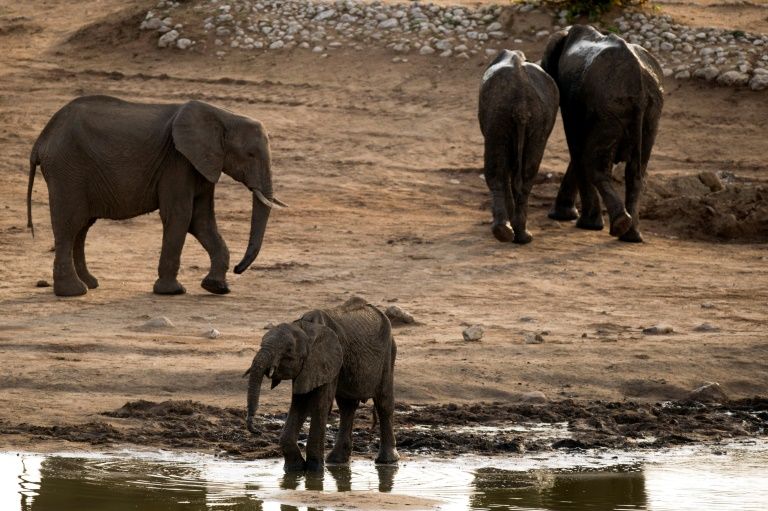
Threatened: Hundreds of elephants are to move home in the biggest wildlife
transfer in Zimbabwe's history (AFP Photo/MARTIN BUREAU)

Harare (AFP) - Zimbabwe’s wildlife agency said Monday it would move hundreds of elephants and other animals in a dramatic bid to save them from a lethal drought.

At least 120 elephants have already died over the past two months as the country grapples with one of the worst droughts in its history.

"We are moving 600 elephants, two prides of lion comprising between five and 10 members, a pack of wild dogs, 50 buffalo, 40 giraffes and 2,000 impalas," parks and wildlife authority spokesman Tinashe Farawo told AFP.

The animals will be moved from Save Conservancy, a major park in southeastern Zimbabwe, to three other game reserves.

"This will be the biggest translocation in our history," said Farawo.

Permits for the operation have already been secured, Farawo said.

The transfer will start "during the rain season, when pastures and foliage start flourishing," he added. The rain season usually kicks off from around the middle of November.

"We want to avoid a situation where we trans-locate animals, only for them to starve to death because there is no food in their new habitat," he explained.

The relocation was announced after the death of dozens of elephants in Hwange, Zimbabwe's biggest game reserve, located in the northwest of the country.

Hungry elephants have been breaking out of wildlife areas and raiding human settlements in search for food, posing a threat to communities.

Farawo said 200 people have died in "human-and-animal conflict" over the past five years.

Several southern African countries are in the grip of one of the worst droughts in decades, caused by months of above-average temperatures and erratic rainfall.

This year's drought has wilted grasslands and dried up water holes, making it increasingly difficult for animals to survive.

Botswana last month announced that more than 100 elephants had died in two months in its famed Chobe National Park.

The drought has left more than five million rural Zimbabweans -- nearly a third of the population -- at risk of food shortages before the next harvest in 2020, the UN has warned.

Food shortages for people have been amplified by the combined effects of drought and the country's enduring economic crisis.

Thursday, November 7, 2019

Malaysia hands jail term to laundrette cat killer

Yahoo – AFP, November 6, 2019
A Malaysian man was sentenced to 34 months in jail for killing a pregnant cat
by stuffing it into a laundrette dryer (AFP Photo/Jeff Haynes)

Kuala Lumpur (AFP) - A Malaysian man who killed a pregnant cat by putting it into a laundrette dryer has been sentenced to 34 months in jail, official media reported, in a case that sparked outrage.

K. Ganesh was handed the prison term Tuesday after being found guilty of breaking animal protection laws at the self-service laundry outside Kuala Lumpur in September last year, official news agency Bernama reported.

He will remain free on bail for now as he plans to appeal.

The 42-year-old was the second man to be sentenced over the killing after a taxi driver was jailed for two years for the crime in January.

Malaysians reacted with fury when CCTV footage went viral showing the cat being stuffed into the dryer late at night.

Two men then inserted tokens into the machine to set it running and left. A female customer later found the animal's carcass and the matter was reported to the police.

Sentencing Ganesh, Judge Rasyihah Ghazali said: "I hope this sentence will serve as a lesson to the accused and the public to not be cruel to animals."

He was also fined 40,000 ringgit ($9,700), Bernama reported late Tuesday. AFP could not immediately contact Ganesh's lawyers.

A third person was earlier detained over the killing but prosecutors dropped the case.

Lost pup turns out to be a rare purebred dingo

Yahoo – AFP, November 6, 2019

Dingo pup Wandi romps at the Australian Dingo Foundation headquarters
near Melbourne (AFP Photo/Shari TRIMBLE)

Sydney (AFP) - He's furry, playful, and has puppy eyes. It's little wonder Wandi was mistaken for a dog when he was found in an Australian backyard -- but DNA testing has confirmed he's a rare 100 percent dingo.

The pup was discovered whimpering and alone in a country town in Victoria in August with talon marks on his back, leading to speculation it could have been dropped by a large bird of prey.

Rescuers at first thought Wandi was either a dog or a fox, but months later DNA samples have revealed that he is in fact a purebred dingo.

Most of the creatures seen in the wild are usually, to some degree, dingo-dog hybrids.

Wandi was found whimpering in a rural back yard with talon marks on his back, 
leading to speculation he may have been dropped by a bird of prey (AFP Photo/
Shari TRIMBLE)

Australian Dingo Foundation director Lyn Watson said that when Wandi "fell out of the sky" it was an "answer to a prayer" -- he can now join 40 other dingoes in a breeding program at the charity's sanctuary.

"When we sent his DNA off we were hoping that he would be of high content, but we were pleasantly surprised to find he was as much dingo as you could get," she told AFP.

Watson hopes Wandi -- whose unusual origins story and endearing looks have attracted global attention -- will help recast the narrative surrounding dingoes and change government policies toward the much-maligned animal.

There is currently much debate in the scientific community over the classification of dingoes, believed to have come to Australia from Asia about 4,000 years ago.

An Australian Dingo Foundation handler shows of Wandi, a 
rare 100 percent purebred dingo (AFP Photo/Shari TRIMBLE)

While some consider the dingo to be a wild dog, many researchers now believe it is a separate species with a range of characteristics that differentiate it from domestic and feral canines.

Often thought of as a threat to domestic animals and livestock, some also argue the apex predator is helpful in controlling pests such feral cats and foxes, as well as numbers of native herbivores such as kangaroos.

This uncertainty has major consequences for the conservation of dingoes.

The species is protected in areas where it is considered a threatened species vulnerable to extinction, but elsewhere listed as a pest that can be controlled through measures such as shooting and baiting.

The discovery after DNA testing that Wandi is 100 percent purebred dingo has 
given experts new hope for the maligned species. Most dingoes in the wild are
dingo-dog hybrids (AFP Photo/Shari TRIMBLE)

Though rare, there have also been a number of recorded attacks on humans -- mostly at the popular tourist destination of Fraser Island.

Wandi, who was named after the town of Wandiligong where he was rescued, is now settling in to his new home at the Dingo Discovery Sanctuary near Melbourne.

"He’s very bright and he seems to be very friendly with all of our volunteers -- of course they all dote on him," Watson said.

But with legal restrictions on releasing dingoes into the wild, the pup may have to live out his days in captivity -- though Watson is optimistic that attitudes will eventually shift to allow him to roam free.

"We know the day will come when we come to our senses and fully understand the situation in the wild and that there should be dingoes there," she said.

Tuesday, October 29, 2019

Aussie racing industry pledges millions for retired horses

Yahoo – AFP, 28 October 2019

The Victoria Racing Club said 10% of ticket sales from the Melbourne Cup Carnival 
and 5% of annual membership fees would go to fund retired horse welfare
(AFP Photo/PAUL CROCK)

Australia's racing industry on Monday pledged millions of dollars for the care of retired racehorses, as it scrambles to address the fallout from animal cruelty allegations that sparked a major outcry.

National broadcaster ABC revealed this month that thousands of retired animals were being sent to abattoirs in secret, where many were allegedly beaten and abused before being killed.

Racing Victoria said it would spend at least Aus$25 million (US$17 million) over the next three years to expand an existing program of rehoming retired horses and to create a new welfare taskforce designed to prevent cruelty to racing animals.

The organisation's chairman, Brian Kruger, said it was clear the industry needed to "step up and do more".

"It's incumbent on us to ensure our horses have opportunities for a rewarding life after racing," he told reporters in Melbourne.

Separately, the Victoria Racing Club said 10 percent of ticket sales from the Melbourne Cup Carnival and five percent of annual membership fees would go toward a new equine welfare fund, which it is seeding with an initial Aus$1.5 million.

About 300,000 people attend the four-day Carnival each year, with tickets to next week's prestigious Cup race costing $90 for a general admission pass and up to hundreds of dollars for exclusive packages.

Liz Walker, the CEO of animal welfare charity RSPCA in Victoria, said the measures were a "good start" but did not go far enough.

"It tends to be focused towards the end-of-life of racehorses and we would say they really have to go right back to the beginning, and we really do need to have that birth-to-death reporting and recording as well as injury statistics," she told the ABC.

While the slaughter of racehorses is not illegal in Australia, the ABC investigation found the practice was far more widespread than acknowledged.

The racing industry insists that less than one percent of retired thoroughbreds end up in an abattoir or knackery, but the ABC claimed about 4,000 horses "disappeared" each year, with meat from slaughtered animals being shipped abroad for human consumption and pet food.

The Queensland government last week announced an inquiry into the treatment of horses at abattoirs in response to the revelations.

Related Article:


'Justice for Jerry': Runaway bull charms Croatia

Yahoo – AFP, October 28, 2019

The bull, dubbed "Jerry", escaped from a Croatian slaughterhouse last Friday
and has been on the lam ever since (AFP Photo/Thierry Zoccolan)

Zagreb (AFP) - The plight of a fugitive one-year-old bull named Jerry has won hearts in Croatia after the animal escaped from a slaughterhouse last Friday and has been on the lam ever since.

Charmed by the 650-kilogramme (1,433-pound) brown bovine's jailbreak, Croatians are calling for his life to spared.

"Justice for Jerry" and "Hang in there Jerry!" read some of the comments rooting for the bull on social media.

A cat-and-mouse game has emerged as police, veterinarians and hunters help search for the bull, who was nicknamed after the mouse in the iconic Tom and Jerry cartoon series.

The bull's owner, Ivan Bozic, has pledged to save the animal's life if he is captured.

"Since he managed to escape a certain death he will certainly stay alive," he told local media.

The owner of the slaughterhouse, based outside the coastal town of Split, said he is still baffled at how the animal managed to escape.

"I simply don't know how it happened. Apparently, pure force defeated technology," Petar Skejo told local media of how the bull appeared to have slipped out of a corral where cattle intended for slaughter are kept.

He took off into the woods and was later seen by locals near a hill, but again evaded capture.

"We wanted to catch him alive but when we approached him he jumped skilfully like a cat on a rock... and disappeared in the bushes," Skejo told state-run HRT television.

One politician, MP Ivan Pernar, has also come out in support for the beast.

"Jerry I wish you all the luck in the world," he wrote on Facebook.

Monday, October 21, 2019

Rescued circus elephant Ramba arrives at Brazil sanctuary

Yahoo – AFP, October 20, 2019

An elephant named Ramba that used to perform in circuses rests after arriving
at the Brazilian Elephant Sanctuary (AFP Photo/Rogerio Florentino)

Chapada dos Guimarães (Brazil) (AFP) - An Asian elephant that spent decades performing in South American circuses has started a new life in an open-air sanctuary in Brazil, after travelling thousands of kilometers by plane and truck from a Chilean zoo.

Ramba's much-anticipated arrival at the 1,133-hectare (2,800-acre) Elephant Sanctuary Brazil in the central west state of Mato Grosso late Friday was broadcast live on Facebook and viewed thousands of times.

The elephant, estimated to be more than 52 years old, worked in circuses in Argentina and Chile before she was rescued by activists in 2012.

She was then kept in a roadside zoo in Rancagua, in central Chile, while her rescuers searched for a new home.

Her ordeal left her with abscesses as well as kidney and liver problems.

Ramba was flown to the Viracopos international airport near Sao Paulo on Wednesday -- a day before heavily armed gunmen raided the cargo terminal in a daring heist.

She was then transported by flat-bed truck to the sanctuary in Chapada dos Guimaraes, which was opened in 2016 with the help of US-based Global Sanctuary for Elephants (GSE) -- the first of its kind in Latin America.

Ramba joins two other female Asian elephants, Rana and Maia, also former circus performers.

Videos of Ramba's road trip in Brazil were posted online. One shows her munching on watermelons in a metal crate on the back of a truck.

Ramba was accompanied by GSE chief Scott Blais as well as a veterinarian, volunteers and Brazilian federal police.

"Ramba needs a quiet place, one where she feels safe and is not on display, where she is surrounded by others of her kind who truly understand her and can help her to open her heart fully," Blais said in a statement.

"She needs sanctuary."

Thursday, October 17, 2019

Kim's horseback ride spurs policy shift speculation

Yahoo – AFP, 16 October 2019

Analysts say Kimg Jong Un's horseback hike may signal a new policy direction
for the nuclear-armed North

New pictures of Kim Jong Un riding a white horse through a winter landscape to the summit of Mount Paektu, a sacred peak for North Koreans, have fuelled speculation that the young leader may be set for a major policy announcement.

The images released by the official KCNA news agency were accompanied by a gushing text, that noted the "noble glitters" in Kim's eyes, and labelled his snowy, horseback ride "a great event of weighty importance" for the nation.

Accompanying officials were left convinced that "there will be a great operation to strike the world with wonder again and make a step forward in the Korean revolution," the agency said.

Pictures of Kim Jong Un riding a white horse through a winter landscape have 
fuelled speculation that the young leader may be set for a major policy announcement

Analysts said the hike may signal a new policy direction for the nuclear-armed North.

"In the past, Kim has climbed Mount Paektu ahead of major political decisions," said Shin Beom-chul, an analyst at the Asan Institute of Policy Studies.

Kim hiked to the peak in December 2017 before launching diplomatic overtures that led to his first ever summit with US President Donald Trump.

But negotiations have been gridlocked since a second summit between Kim and Trump collapsed in February and the North has been raising tensions through a series of missile tests.

The official KCNA news agency described Kim Jong Un's horseback mountain 
ride as 'a great event of weighty importance' for the nation

The sight of North Korean leaders riding white horses across snow-capped peaks – and in particular Mount Paektu - have been a dominant theme of past photos, posters and portraits of Kim's father Kim Jong Il and grandfather Kim Il Sung.

According to B.R. Myers, a professor at Dongseo University in South Korea who specialises in North Korean propaganda, the images present an imperial motif of a leader protecting the cultural and ideological purity of the nation from corrupt, outside forces.

Kim also visited the site of a giant construction project in nearby Samjiyon county, KCNA reported, and blamed US-led international sanctions for his country's hardships.

Kim Jong Un also visited the site of a giant construction project in Samjiyon 
county, KCNA reported

"The situation of the country is difficult owing to the ceaseless sanctions and pressure by the hostile forces and there are many hardships and trials facing us," Kim was quoted as saying.

North Korea is under multiple sets of UN sanctions for its nuclear and missile programmes.

Pyongyang and Washington restarted working-level talks this month in Sweden only for it to quickly break down, with the North blaming the US for not giving up its "old attitude".

North Korea tested this month what it said was a submarine-launched ballistic missile that marked a "new phase" in its capabilities -- the most provocative in a series of weapons tests it carried out since 2018.

Moon's posted two pictures of the pooches, one of them showing five furry white 
pups cuddled on Moon's lap with the sixth in the first lady's arms

Related Articles:


Two dogs, aged around one year old, were given as a gift to the South
Korean President Moon Jae-in (AFP Photo/Handout)

Monday, September 30, 2019

Burning issue: Indonesia fires put palm oil under scrutiny

Yahoo – AFP, Catherine Lai, September 29, 2019

Monster blazes sent a pall of acrid smoke over Southeast Asia for weeks (AFP
Photo/ADEK BERRY)

A brutal Indonesian forest fire season that left Southeast Asia choking in smog has renewed scrutiny of major palm oil and paper companies, with activists accusing them of breaking promises to halt logging.

The monster blazes sent a pall of acrid smoke over the region for weeks, closing schools and airports and causing a spike in respiratory ailments.

Mostly lit to clear land for agriculture, they were the worst seen in the country since 2015.

Leading companies have in recent years pledged not to log any more pristine rainforest, not to use burning to clear land and to cut ties with smaller suppliers who don't abide by their rules -- but critics say such vows now ring hollow.

"They do not live up to the commitments, and are not addressing the fact that we are now in a climate crisis," Annisa Rahmawati, a senior forest campaigner at Greenpeace, told AFP.

"They are still doing business as usual."

Industry players however insist they have gone to great lengths to stop burning and trees being cut down in their operations.

Singapore-listed Wilmar International, the world's biggest palm oil trader, committed in 2013 to a no-deforestation policy and says it has stopped sourcing from 17 suppliers that did not comply with their rules.

Production of Palm oil -- used in numerous everyday goods from shampoo to biscuits -- has been blamed by environmentalists for driving massive deforestation.

Palm oil production has been blamed by environmentalists for driving massive 
deforestation (AFP Photo/WAHYUDI)

Consumer goods companies are paying more attention to where they source palm oil and other materials.

Some of the world's largest brands -- including Nestle and Unilever -- pledged in 2010 to reach net zero deforestation within a decade through "responsible sourcing" of cattle, palm oil, soya and other commodities.

But after that pledge was signed, the pace of tree-felling linked to commodities increased dramatically and at least 50 million hectares (123 million acres) of forest worldwide has been destroyed Greenpeace said -- an area about the size of Spain.

Firestarters

Fires are used as a cheap way to clear agricultural land in Indonesia every year during the dry season.

Experts say it is hard to know who is responsible for the blazes in the hardest hit areas -- Indonesia's Sumatra island and the Indonesian part of Borneo -- which are home to myriad companies of varying sizes and numerous small-scale farmers.

Big firms insist they have "no-burn" policies in place and often blame smallholders for starting fires they say then spread to their plantations.

Indonesia has made some arrests over the blazes but in many cases it remains unclear who started the fires -- and who ordered them.

While larger companies have vowed not to source from smaller ones that break strict environmental rules, critics say they are not monitoring their supply chains carefully.

"The biggest challenge is the industry-wide lack of traceability of the origins of palm fruit," said Nur Maliki Arifiandi, from WWF Indonesia.

Indonesia has made some arrests over the blazes but in many cases it remains 
unclear who started the fires - and who ordered them (AFP Photo/WAHYUDI)

"This has allowed continuing deforestation, often caused by real smallholders as well as land speculators and rich, powerful people to open more natural forest areas and plant illegal oil palm plantations."

Some industry watchers say commitments by big firms have helped and official figures show the rate of forest loss in Indonesia declined in recent years.

Burning issue 

But critics say problems persist -- this week Greenpeace said in a new report that palm oil and pulpwood companies with links to land burned between 2015 and 2018 rarely faced serious government sanctions.

And last year the NGO accused palm-oil giant Wilmar, as well as other consumer brands including Colgate-Palmolive, Hershey, Nestle, and Unilever, of continuing to buy from groups that were destroying the rainforest.

At the end of 2018 Wilmar, Unilever and Mondelez committed to a mapping and monitoring platform for the palm oil sector, which Greenpeace supported at the time as a potential breakthrough in cleaning up supply chains.

But the NGO pulled out of the project last month, saying the companies were not serious about the project.

Wilmar insists it sticks to its commitments and says it continues to work towards a supply chain free from deforestation from 2020.

Activists however doubt such goals are within reach.

"We are asking companies to be more serious in implementing their targets on the ground," WWF Indonesia's Arifiandi said.

Monday, September 23, 2019

Taylor Swift pulls out of Melbourne Cup gig

France24 – AFP, 22 September 2019

Melbourne Cup, with animal rights activists taking credit after a
campaign to highlight cruelty to racehorses.

The Grammy Award-winner was announced as the headline act for the "race that stops a nation" earlier this month and was due to sing two songs from her latest hit album "Lover".

But it sparked a backlash on social media and a push by the Campaign for the Protection of Racehorses, which claimed she had "put money before compassion" and was "endorsing animal abuse".

More than 6,500 people signed an online petition urging her to cancel.

In a statement late Saturday, promotor Mushroom Events cited scheduling issues as the reason for Swift's no-show.

"Changes to her Asian promo schedule have made it logistically impossible for her to be here," it said.

The Campaign for the Protection of Racehorses applauded the decision.

"The pressure on Taylor Swift to cancel her performance was significant," it said on Facebook.

"Her fans did not want to see her supporting animal abuse. Whilst the reason being used by the racing industry is a scheduling mix-up, it appears to us that she has responded to those calls."

Six horses have died at the Melbourne Cup since 2013, including one last year when Irish five-year-old The CliffsofMoher was euthanised after suffering a fractured right shoulder during a race that has been run on the first Tuesday of November since 1876.

"Obviously, this (Swift pulling out) is disappointing for everyone," said Victoria Racing Club chief executive Neil Wilson.

"We understand how important the pre-Cup entertainment is and we look forward to providing an update (on other acts) shortly."

Wednesday, September 18, 2019

Indonesia's toxic haze affecting Borneo's orangutans – rescuers

Yahoo – AFP, 17 September 2019

Orangutans at a rehabilitation centre in Nyaru Menten, central Kalimantan are
showing signs of respiratory illness as a result of choking forest fires

Massive forest fires in Indonesia that have caused a toxic haze to spread as far as Singapore and peninsular Malaysia are also seriously affecting endangered orangutans and their habitat, a rescue foundation said Tuesday.

Jakarta has deployed thousands of troops as temporary fireman and deployed dozens of water-bombing aircraft to battle blazes that are turning pristine forest into charred landscape in Sumatra and Borneo islands.

The fires -- usually started by illegal burning to clear land for farming -- have unleashed a choking haze across parts of southeast Asia.

The Borneo Orangutan Survival Foundation said Tuesday that the haze was affecting hundreds of great apes in its care at rescue centres and wildlife re-introduction shelters.

"The thick smoke does not only endanger the health of our staff... but also it affects the 355 orangutans we currently care for", the foundation said in a statement, referring to just once cetre in Kalimantan.

The toxic haze was so bad in parts of Kalimantan that rescuers at an 
Orangutan shelter were keeping the great apes indoors for much of the day

"As many as 37 young orangutans are suspected to have contracted a mild respiratory infection," it added.

Conditions were so bad at their Samboja Lestari facility in East Kalimantan that outdoor activities for the animals had been restricted to a few hours a day.

Orangutans have been particularly vulnerable to commercial land clearances and have seen their natural habitat shrink dramatically in the last few decades.

The population of orangutan in Borneo has plummeted from about 288,500 in 1973 to about 100,000 today, according to the International Union for Conservation of Nature.

The toxic smoke caused by the forest fires is an annual problem for Indonesia and its neighbours, but has been worsened this year by particularly dry weather.

On Borneo island, which Indonesia shares with Malaysia and Brunei, pollution levels were "hazardous", according to environment ministry data.

Hundreds of schools across Indonesia and Malaysia were shut.

Friday, September 6, 2019

Minister pledges action on animal transports during heat waves

DutchNews, September 5, 2019 


Farm minister Carola Schouten is bringing in a ban on live animal transports when temperatures reach at least 35 Celsius, she told MPs on Thursday. Voluntary agreements, the minister said, are too easily ignored and the time is now right to anchor the limit in law. 

While factory farmers and slaughterhouses had taken steps to protect animals against the heat, government inspectors had noted several serious incidents during the high temperatures, the minister said. In one case, 90% of the chickens in transport crates had died during their journey. 

Esther Ouwehand told the minister during Thursday’s debate that while she welcomed the minister’s action, 35 Celsius is still far too high a temperature to be moving animals.

Sunday, September 1, 2019

Denmark to retire its last four circus elephants

Yahoo – AFP, August 31, 2019

Denmark is set to retire its last four circus elephants. Here, firefighters spray water
 to cool an elephant in high temperatures at the Arene circus in Gilleleje (AFP
Photo/Mads Claus Rasmussen)

Copenhagen (AFP) - The government of Denmark will buy the country's last four circus elephants in order to retire them, a minister said Saturday, as more countries move to shield wild animals from the practice.

Highly regulated, though still controversial, elephants, sea lions and zebras are the only animals that can be used in circuses in Denmark.

But a new anti-cruelty law will be introduced to parliament soon to impose a blanket ban for all animals, the ministry of food, agriculture and fisheries said in a statement.

The government will pay 11 million krone ($1.6 million, 1.4 million euros) to buy Ramboline, Lara, Djunga and Jenny, it said.

The animals will be sent to a zoo to live out their last days, though it is not yet clear which one.

"The elephants will be sent to the establishment that can offer them the highest level of well-being," said the ministry.

More than 40 countries around the world, about half of them in Europe, have restricted or banned the use of wild animals in zoos.

Related Article: